What If a Prophecy From Centuries Ago Was Actually a Blueprint?
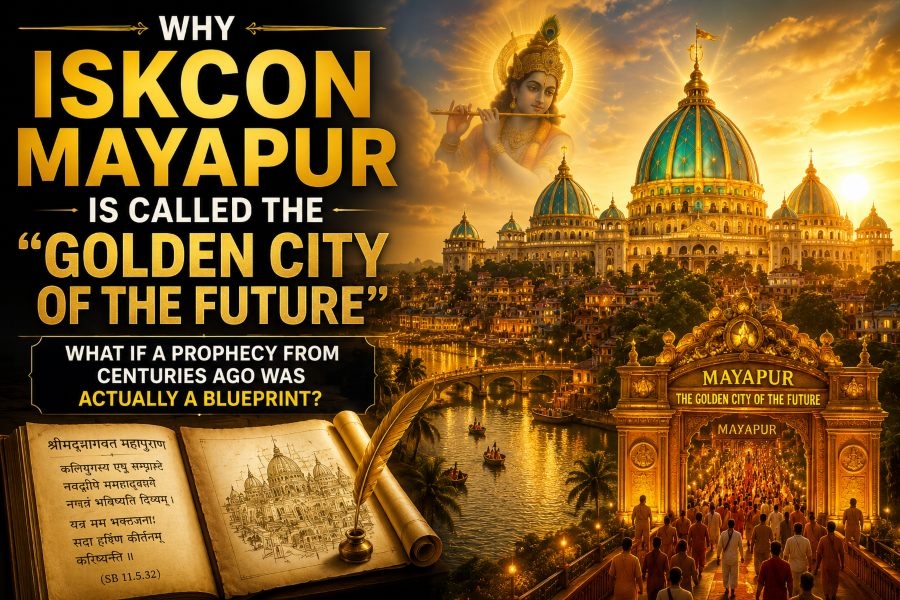
Picture a five-hundred-year-old prediction that didn't stay vague or symbolic, but instead started turning into concrete, cranes, and construction schedules. That's essentially what's happening in a quiet corner of West Bengal right now. Long before urban planners drew a single line for it, spiritual texts had already described a city that would one day pull people from every corner of the world to a small patch of land beside the Ganga. Today, that prediction has a name, a growing skyline, and a nickname that keeps showing up in conversation: the "Golden City of the Future."
The place in question is ISKCON Mayapur, and if you've come across the ISKCON Mayapur Store while shopping for devotional items online, you've already brushed up against a small piece of this much larger vision. But the "Golden City" title isn't marketing language dreamed up by a tourism board. It comes from something older, stranger, and honestly more interesting than a slogan — a genuine belief, held for centuries, that this exact location was destined to become a global spiritual capital.
Where the Nickname Actually Comes From
Most nicknames for cities are earned casually — a nod to a local industry, a historical event, a passing joke that stuck. This one is different. It traces directly back to prophetic verses found in the Chaitanya Bhagavata and other Gaudiya Vaishnava texts, written centuries before anyone could have predicted how the town would eventually grow.
These texts describe Mayapur becoming a place of "Golden Avatar" significance — a reference to Sri Chaitanya Mahaprabhu, who is regarded within this tradition as a golden-complexioned incarnation. The prophecy goes further than symbolism, though. It predicts that people from distant lands, speaking unfamiliar languages, would one day travel here specifically to take part in congregational chanting — something that, in the 1500s, would have sounded almost absurd for a small riverside village in rural Bengal.
Fast forward to today, and you'll find exactly that: pilgrims from dozens of countries, multiple continents represented in a single temple hall, and a permanent international community that didn't exist a hundred years ago. It's not hard to see why devotees treat the prophecy less like poetry and more like a long-range forecast that's still playing out.
What's worth noting is how specific some of these old descriptions get. They don't just mention foreigners in a general sense — certain passages describe people crossing oceans, learning an unfamiliar language of devotion, and eventually becoming teachers themselves within the very tradition they once knew nothing about. Read that today, and it maps almost exactly onto what actually happened once ISKCON expanded internationally in the twentieth century. Devotees who once had no connection to Bengali culture or Sanskrit scripture eventually became senior teachers, translators, and even permanent residents of the town the prophecy pointed toward in the first place. That kind of specificity is part of why the "prophecy" framing gets taken seriously rather than dismissed as vague spiritual optimism.
From Scripture to Skyline — How the "City" Part Became Literal
Prophecies are one thing. Actual infrastructure is another. What makes Mayapur's story genuinely unusual is how deliberately the physical development has been shaped around this specific vision, rather than growing organically the way most towns do.
Srila Prabhupada, the founder of ISKCON, spoke about Mayapur's future in strikingly concrete terms decades before most of the current construction began. He didn't just reference a symbolic golden age — he talked about universities, guesthouses, agricultural self-sufficiency, and a temple structure ambitious enough to draw visitors purely on architectural merit alone. At the time, with limited resources and a much smaller community, that must have sounded like a distant dream. Today, walking through the town, you can watch pieces of that exact vision taking physical shape in real time.
A few concrete markers of this transformation:
Permanent residential infrastructure has expanded well beyond what existed even fifteen years ago, housing thousands of devotees and support staff.
Educational institutions now operate on-site, training people in everything from scriptural study to practical skills.
Agricultural projects surrounding the town aim at self-sufficiency rather than dependence on outside supply chains.
International visitor numbers climb every year, with pilgrims arriving from regions that had barely any Gaudiya Vaishnava presence a generation ago.
None of this happened by accident. It's the result of a community treating an old prophecy as an actual roadmap.
The Temple at the Center of It All
If there's one structure that captures the "golden city" idea in physical form, it's the temple currently anchoring the entire complex. Right now, that role belongs to Sri Mayapur Chandrodaya Mandir — the main functioning temple where daily worship, festivals, and the bulk of pilgrim activity actually happen.
Walk in during the evening arati and you'll understand immediately why this building sits at the emotional core of the whole town. Hundreds of voices rise together, drums keep a rhythm that seems to sync with your own pulse after a few minutes, and the gold-toned deity forms catch candlelight in a way that photographs never quite manage to capture. For many first-time visitors, this single ceremony does more to explain the "Golden City" nickname than any historical text could.
But Sri Mayapur Chandrodaya Mandir isn't the final chapter of this story — it's closer to a placeholder for something even larger. Nearby, construction continues on the Temple of the Vedic Planetarium, a project decades in the making, designed eventually to become one of the most significant religious structures anywhere on earth. When completed, it's expected to shift the town's center of gravity even further toward the scale that the old prophecies described.
It's worth pointing out that "placeholder" doesn't mean temporary or unimportant. Sri Mayapur Chandrodaya Mandir has anchored daily worship for decades and will likely continue doing so even after the larger project is complete, simply because it's already woven into the rhythm of thousands of people's daily lives. Festivals, weddings, initiations, and ordinary Tuesday-morning worship all happen here, and that kind of accumulated daily use gives a building a weight that architecture alone can't replicate. The newer project might eventually become the visual centerpiece of the skyline, but this temple will likely remain the emotional one for a long time to come.
Why "Future" Is the Operative Word, Not "Past"
Most places that carry grand nicknames are riding on past glory. A city gets called golden because of what it once was — an empire, an economic boom, a cultural peak that's since faded. Mayapur flips that entirely. The "future" part of the nickname isn't nostalgic. It's forward-looking, almost literally under construction as you read this.
That distinction matters more than it might seem. It means the defining moment of this city's history hasn't happened yet. Every visitor arriving today is essentially watching an early chapter unfold, not touring the remains of something finished. Longtime devotees who've been coming for twenty or thirty years talk about this constantly — the sense that each visit reveals a slightly different, slightly bigger version of the town than the one before.
A few reasons the "future" framing holds up:
Ongoing megaproject construction keeps physically reshaping the skyline year after year.
Population growth continues as more devotees relocate permanently rather than just visiting.
International representation keeps expanding, matching the old prophecy's claim about people from distant lands gathering here.
Infrastructure investment — roads, housing, education — keeps scaling to match rising demand rather than staying static.
What This Actually Feels Like on the Ground
Reading about prophecy and construction projects is one thing. Standing in the middle of it is another experience entirely.
Mornings start early, often before sunrise, with the sound of conches and chanting rolling across the town before the sun has fully cleared the horizon. It's not staged for tourists — it's simply what daily life sounds like here, has sounded like for decades, and will presumably keep sounding like for decades more.
By midday, you'll notice a strange mix of old and new sitting side by side: centuries-old ritual practices happening a few hundred meters from active construction cranes. It shouldn't work visually, and yet somehow it does, because both pieces are pointed toward the same long-term picture rather than pulling against each other.
Evenings bring the crowds back toward the main temple for arati, and this is usually when visitors — whether religious or simply curious — start to understand why people keep using words like "golden" and "future" in the same breath when they talk about this place.
There's also a demographic shift happening that's easy to miss unless you spend a few days actually talking to residents rather than just sightseeing. A growing number of people living in Mayapur today weren't born into this tradition at all — they arrived as curious travelers, students, or skeptics, and ended up staying permanently. That pattern alone tells you something about the town's pull. Cities built purely on tourism rarely convert visitors into lifelong residents at this rate. Something about the daily rhythm here — the early mornings, the shared meals, the sense of being part of something still being built rather than something finished — seems to keep people from leaving once they've stayed long enough to feel it.
Skeptics Ask a Fair Question — Does the Prophecy Actually Hold Up?
It's a reasonable thing to wonder. Prophecies are easy to interpret generously after the fact, and skeptics could argue that any growing religious community might eventually claim its expansion as prophetic fulfillment.
But a few specific details make Mayapur's case harder to dismiss as simple retrofitting. The original texts didn't just predict vague future glory — they specifically mentioned people from foreign lands chanting together, at a time when foreign contact with rural Bengal was minimal to nonexistent. They referenced a scale of gathering that didn't match anything happening in the region at the time they were written. And the community's own founder, decades before the current infrastructure existed, described specific institutional developments — universities, planned agricultural systems, large-scale construction — that have since materialized in recognizable form.
Whether or not you're personally inclined to believe in prophecy, the pattern-match between old text and current reality is unusually specific, which is exactly why the nickname has stuck rather than faded.
There's also a practical counterpoint worth considering. Even setting prophecy aside entirely, the town's growth follows a logic that makes sense on its own terms. A community built around open, no-barrier participation — no entrance requirements, no gatekeeping by caste or background — tends to scale faster than more restrictive religious movements simply because it removes friction at the point of entry. Combine that structural openness with deliberate, decades-long infrastructure planning, and steady growth stops looking mysterious and starts looking like the predictable result of good long-term decisions. Maybe it's prophecy. Maybe it's sound planning wrapped in prophetic language. Either explanation lands you in roughly the same place today.
Should You See It for Yourself?
If you've only encountered this world through devotional products, books, or a passing mention online, there's something worth considering: the "Golden City of the Future" tag isn't really something you can fully appreciate secondhand. It's a place better experienced than described — the sound of hundreds of people chanting in unison, the sight of a temple complex still actively growing, the strange comfort of watching an old prophecy play out in real time rather than reading about it as history.
Mayapur isn't finished. That's precisely the point. Whatever version of the "golden city" exists today is just one frame in a much longer film still being shot, and the ending — if prophecy holds — hasn't been written yet.