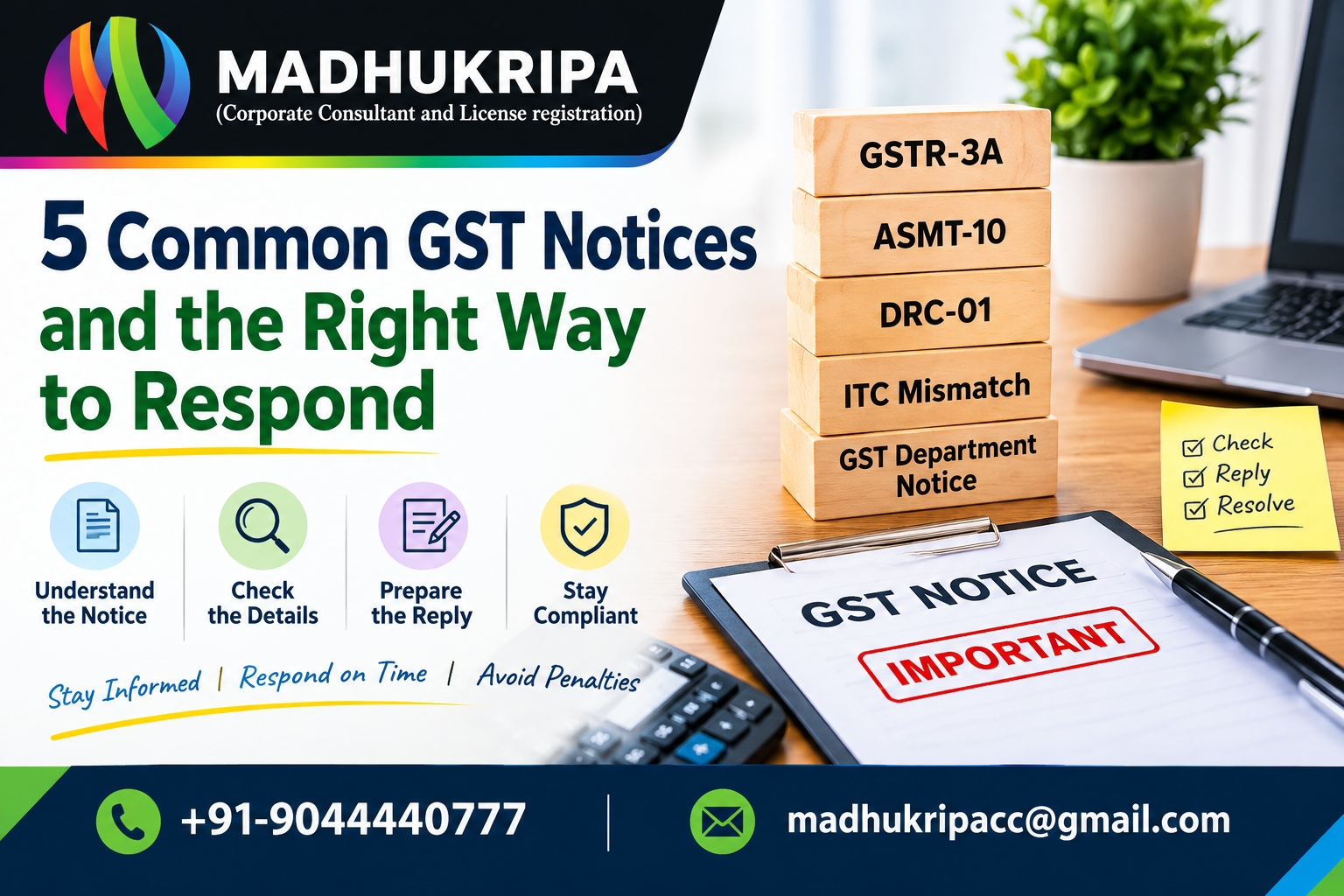
Receiving a notice from the GST Department can make a business owner concerned, especially when the reason or next step is not clear. A notice does not always mean that tax has been wrongly paid or that a penalty is certain. It may relate to a missed return, a difference in reported figures, an input tax credit issue, or a clarification required by the tax officer.
The first step is to read the notice carefully, check the tax period, understand the issue raised, and note the date by which a response is required. The GST portal provides different forms and procedures depending on the nature of the matter. For example, an ASMT-10 notice is used to communicate discrepancies found during scrutiny of a return, while GSTR-3A is issued when a required return has not been furnished.
Madhukripa MKC Consultant helps businesses understand GST-related documentation and compliance requirements. This guide explains the GST Notice Meaning, common notices, important response steps, and points taxpayers should check before submitting an explanation.
GST Notice Meaning and Types of GST Notices
The GST Notice Meaning depends on the form, section, tax period, and issue mentioned in the communication. In simple words, a GST notice is an official communication asking a registered person to provide information, explain a discrepancy, file a pending return, or respond to a proposed tax-related action.
The Types of GST Notices can vary because GST authorities may issue different forms for different compliance situations. Some notices are mainly related to return filing, while others may concern return discrepancies, input tax credit, tax liability, or other matters.
Before preparing a response, check these details:
GSTIN and taxpayer name
Notice reference number
Date of notice
Relevant financial year and tax period
Section or rule mentioned
Issue or discrepancy identified
Tax, interest, penalty, or other amount mentioned
Due date for submitting the response
Documents or information requested
A taxpayer should not respond only by copying figures from the notice. The explanation should be based on the taxpayer’s actual books, invoices, returns, payment records, and other supporting documents.
How to Reply to GST Notice: GST Notice Reply and GST Notice Response
A GST Notice Reply should directly address the issue raised by the officer. Start by identifying the notice and then explain the facts clearly. If the discrepancy is genuine, the taxpayer should examine whether tax, interest, or another amount is payable and take the appropriate action.
The GST Notice Response should be factual, concise, and supported by relevant records. Avoid making statements that cannot be supported by invoices, returns, books of accounts, reconciliation statements, or other documents.
Step-by-step approach
Read the complete notice, including attachments.
Identify the exact discrepancy or reason for the notice.
Compare the notice with GST returns and accounting records.
Collect invoices, ledgers, payment details, reconciliation statements, and other relevant documents.
Decide whether the discrepancy is correct, partly correct, or based on an error or misunderstanding.
Prepare a point-by-point explanation.
Attach supporting documents wherever required.
Submit the response within the prescribed time.
Save the acknowledgement or submission details for future reference.
For an ASMT-10 proceeding, the GST Rules provide for the taxpayer to furnish an explanation in FORM GST ASMT-11. If the explanation is accepted, the officer may issue FORM GST ASMT-12.
GST Notice Reply Format and GST Notice Reply Online
A GST Notice Reply Format should be organised so that the officer can easily connect each explanation with the corresponding point in the notice. A good reply normally contains the taxpayer’s details, notice reference, tax period, issue-wise explanation, supporting documents, and verification.
A GST Notice Reply Online can be submitted through the GST portal when the particular notice or proceeding provides an online reply facility. The exact process and form depend on the type of notice. The GST portal also provides facilities through which taxpayers can view notices and orders and, for applicable proceedings, submit replies and supporting documents.
Basic reply structure
Subject: Reply to Notice – [Notice Reference Number]
GSTIN: [GSTIN]
Tax Period: [Relevant Period]
Notice Date: [Date]
Respected Sir/Madam,
With reference to the above notice, we submit the following explanation regarding the discrepancy or issue mentioned in the notice:
Point 1: Explanation of the issue.
Point 2: Relevant facts and reconciliation.
Point 3: Supporting documents attached.
Based on the above explanation and supporting records, we request that the submission may kindly be considered.
Authorised Signatory
Name:
Designation:
Date:
This is only a general structure. The actual response should be prepared according to the contents and requirements of the specific notice.
GST Notice Reply Time Limit: What Taxpayers Should Check
The GST Notice Reply Time Limit is not identical for every type of notice. The taxpayer should always check the deadline specifically mentioned in the communication and the relevant GST provisions.
For example, under Rule 99, an ASMT-10 notice seeks an explanation within a period not exceeding 30 days from the date of service, unless a further period is permitted by the proper officer.
For a GSTR-3A notice, CBIC has prescribed a 15-day period for furnishing the pending return. If the return remains unfurnished after that period, the proper officer may proceed with assessment under the applicable provisions.
Therefore, do not assume that every notice gives the same number of days. Check the notice carefully and take action before the stated deadline.
GSTR-3A Notice and ASMT-10 Notice
A GSTR-3A Notice is generally associated with failure to furnish a required return. CBIC guidance states that a system-generated GSTR-3A notice is issued electronically to a registered person who fails to furnish a return, requiring the return to be furnished within 15 days.
If you receive a GSTR-3A communication, first check which return is pending. If the return can still be filed, the taxpayer should examine the applicable late fee, interest, and other consequences before filing it.
An ASMT-10 Notice is different. It is issued when the proper officer identifies discrepancies during scrutiny of a return. The taxpayer may accept the discrepancy and pay the applicable amount or submit an explanation in FORM GST ASMT-11.
How to handle these notices
For a return-default notice:
Identify the missing return.
Check whether there are any filing restrictions or outstanding compliance issues.
File the return as applicable.
Review interest and late fee implications.
Keep the filing acknowledgement safely.
For an ASMT-10 notice:
Compare the discrepancy with your return.
Reconcile the figures with books and supporting records.
Prepare an issue-wise explanation.
Submit ASMT-11 where applicable.
Attach relevant supporting documents.
DRC-01 Notice and GST Notice for ITC Mismatch
A DRC-01 Notice is associated with a summary of a show-cause notice and can contain details such as the tax period, grounds, tax, interest, penalty, fee, and other amounts involved.
A taxpayer receiving DRC-01 should not treat it like a routine return reminder. The taxpayer should carefully examine the section mentioned in the notice, the allegations or grounds, the calculation of liability, and the period involved.
A GST Notice for ITC Mismatch may require careful reconciliation of input tax credit records. A difference can arise for several reasons, such as differences in invoice reporting, timing differences, amendments, credit notes, or information reported by suppliers.
What to check in an ITC-related matter
Purchase register
Tax invoices
GSTR-2B and other relevant GST records
GSTR-3B figures
Supplier-reported details
Credit and debit notes
ITC reversals, if applicable
Payment and accounting records
Do not automatically accept an ITC difference as an incorrect claim. First identify why the difference occurred and whether the supporting documents and applicable GST provisions support the credit.
GST Department Notice: Common Reasons
A GST Department Notice can arise for different compliance reasons. Some common situations include non-filing or delayed filing of returns, differences between returns and other available information, questions regarding tax liability, or discrepancies identified during scrutiny.
Common reasons may include:
Non-filing of a GST return
Difference between GSTR-1 and GSTR-3B
ITC differences
Turnover mismatch
Tax payment differences
Incorrect or incomplete information
Questions raised during return scrutiny
Registration-related issues
Documents or explanations requested by the officer
The reason should always be confirmed from the actual notice rather than assumed from its form number.
How to Respond to GST Notice: Practical Checklist
When deciding How to Respond to GST Notice, focus on facts rather than preparing a lengthy explanation without evidence. A clear response is generally easier to understand when every point is connected with a document or reconciliation.
Use this checklist before submission:
1. Verify the notice
Make sure the GSTIN, tax period, reference number, and notice date belong to your business.
2. Understand the issue
Read the notice carefully and identify exactly what the officer has asked you to explain or provide.
3. Check your records
Compare the notice with your books, invoices, GST returns, bank records, and other relevant documents.
4. Prepare an issue-wise reply
If the notice contains three points, respond to all three separately. Avoid leaving an important point unanswered.
5. Support your explanation
Attach documents that actually support your explanation. More documents do not necessarily make a reply better; relevance is more important.
6. Check the deadline
Make sure the reply is submitted within the time specified in the notice or applicable law. If additional time is legally available or permitted, follow the prescribed process rather than simply ignoring the deadline.
7. Keep proof of submission
After submitting the response, save the acknowledgement, ARN or reference details, uploaded documents, and a copy of the final reply.
Final Thoughts
A GST notice should be dealt with carefully rather than ignored. The correct response depends on the notice type, the issue raised, the relevant tax period, and the documents available with the taxpayer.
Whether the matter involves a missed return, scrutiny discrepancy, ITC difference, or a show-cause proceeding, the safest approach is to first understand the issue and then prepare a factual, document-supported response within the applicable deadline.
Madhukripa MKC Consultant provides practical assistance with GST compliance, documentation, return-related matters, and notice-related support. For complex matters involving significant tax demand, interest, penalty, or legal interpretation, taxpayers should consider taking advice from a qualified GST professional based on the specific notice and facts of the case.