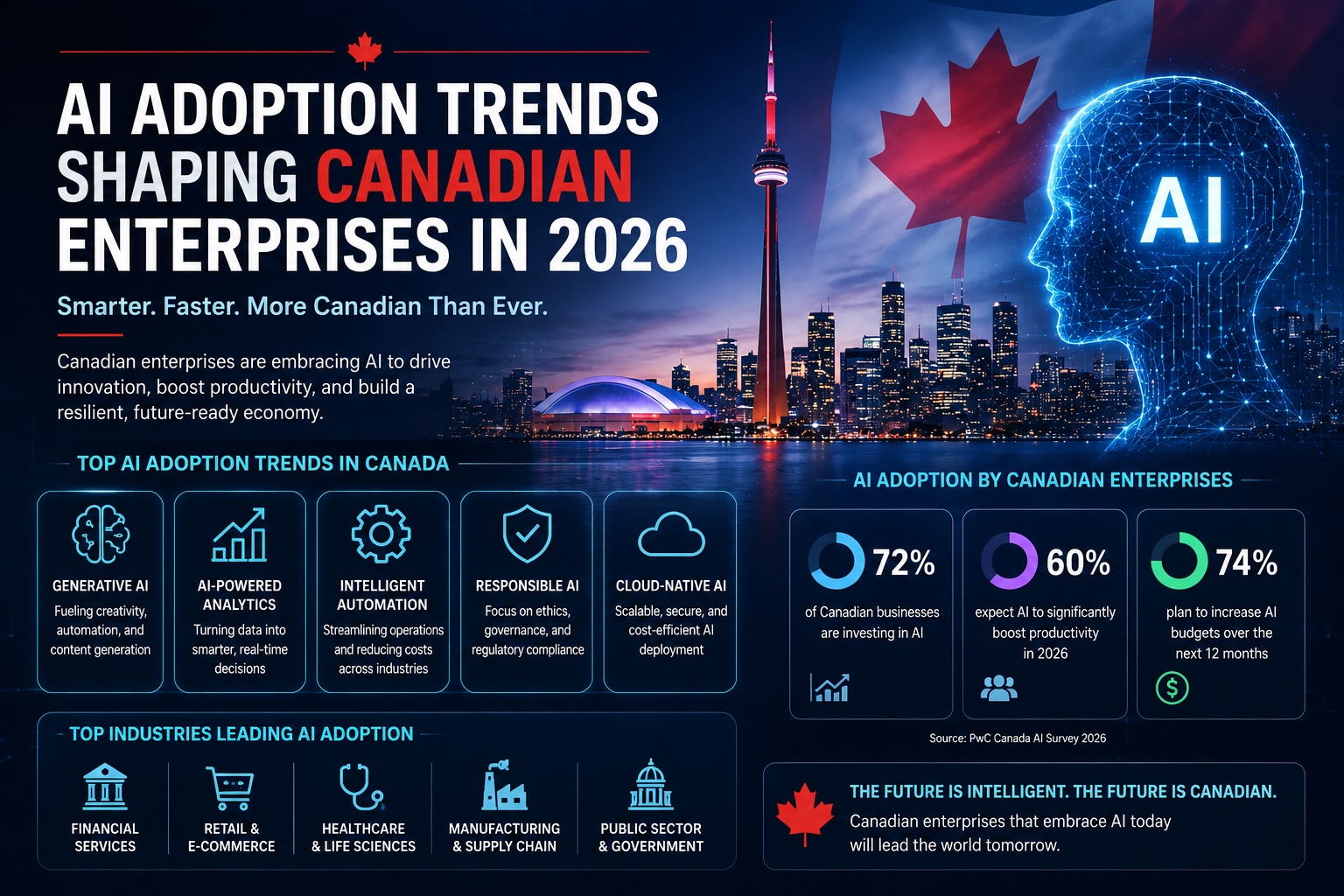
Canadian companies spent most of the last two years watching AI headlines come out of San Franc
This matters for anyone budgeting an AI initiative in 2026. The trends below aren't abstract; they show up directly in vendor selection, project timelines, and where companies choose to build.
Compliance Is Now a Design Requirement, Not a Final Step
A few years ago, privacy and data-residency review happened near the end of a project, right before launch. That sequence has flipped. Canadian enterprises, particularly in finance, healthcare, and the public sector, now bring compliance teams into the room during the architecture phase. They decide data routing, storage location, and access logging before training a single model.
This shift is a direct response to painful lessons. Companies that treated governance as an afterthought have had to rebuild pipelines mid-project once legal flagged a data-residency issue. Firms working with a partner that builds AI development capabilities in Vancouver around PIPEDA and FIPPA considerations from day one are avoiding that rework entirely, which is one reason demand for compliance-first AI development has grown alongside stricter data governance expectations.
Agentic AI Is Moving From Pilot to Production
Chatbots and copilots dominated 2023 and 2024. In 2026, the bigger story is agentic systems, AI that doesn't just answer questions but takes multi-step action inside a business process. Supply chain coordination, document-heavy compliance workflows, and financial reconciliation are the areas where Canadian mid-market and enterprise teams are furthest along.
What's different this year is the caution built into these deployments. Early agentic pilots ran with minimal oversight and produced unpredictable results. The current generation of production agentic AI systems includes scoped permissions, human-in-the-loop checkpoints, and audit trails that compliance teams can actually read. That combination, autonomy paired with visibility, is what has made agentic AI viable for regulated Canadian industries rather than just a novelty for tech-forward startups.
Model-Agnostic Strategies Are Replacing Single-Vendor Bets
Two years ago, a company choosing an AI stack often meant choosing a single foundation model provider and building around it. That approach is losing ground. Enterprises have learned that model performance, pricing, and even availability shift quickly, and locking into one vendor creates operational risk.
The trend now is toward routing logic that sends different tasks to different models based on cost, latency, and accuracy requirements. A customer support agent might route simple queries to a smaller, cheaper model and escalate complex cases to a more capable one. This flexibility also gives Canadian companies a practical hedge against U.S. export policy changes or pricing shifts from any single provider. It also changes procurement conversations: instead of asking "which model should we standardize on," technical leaders are asking "which routing layer gives us the most flexibility as models change."
Governance Gaps Are the Leading Cause of Failed Projects
Ask any AI development team what kills a project after launch, and the answer is rarely the model itself. It's governance: unclear accountability for AI decisions, no monitoring for model drift, and no defined process when an AI system produces a wrong or biased output. These governance gaps that stall AI programs show up repeatedly in post-mortems, and they're preventable with the right planning upfront.
Canadian enterprises are responding by building governance frameworks before scaling, not after a public failure forces the issue. That includes defined escalation paths, documented decision boundaries for autonomous systems, and regular audits of model outputs against expected behavior. Boards are also starting to ask for this documentation directly during budget approval, which has quietly become one of the more effective forcing functions for good governance practice.
Regional Hubs Are Specializing, Not Just Growing
AI development isn't concentrating in one Canadian city. Toronto has leaned into fintech and enterprise SaaS applications. Vancouver's ecosystem, shaped by its clean technology, gaming, and logistics sectors, has developed particular strength in computer vision and data-heavy automation for physical operations. Ottawa's public-sector proximity has pushed compliance-first AI tooling. This specialization means the "best" AI development partner increasingly depends on your industry and geography, not just general AI expertise.
It also means talent is clustering differently than it did a few years ago. Engineers with experience building PIPEDA-compliant systems, rather than generic AI experience, have become the more sought-after hire for enterprises in regulated sectors, and that talent is concentrated in a handful of specific cities rather than spread evenly across the country.
Budget Ownership Is Shifting Toward Operations, Not IT Alone
AI budgets used to sit almost entirely with IT departments. That's changing. Operations, finance, and customer experience leaders are now co-owning AI budgets because the systems being built directly affect their workflows. This shift has practical consequences: procurement cycles are shorter when the business unit championing the project also controls funding, and success metrics are increasingly tied to operational KPIs rather than technical benchmarks alone.
This also changes how vendors are evaluated. A pitch built entirely around technical capability tends to land less well with an operations leader than one built around measurable time savings, error reduction, or throughput gains, which is pushing AI vendors generally to get sharper about quantifying outcomes rather than just describing features.
Procurement Cycles Are Getting Shorter, Not Longer
It might seem counterintuitive given the compliance emphasis above, but procurement timelines for AI vendors have actually compressed for many Canadian enterprises this year. The reason is preparation: companies that have already done the internal work of mapping data flows, defining governance requirements, and getting compliance sign-off on general AI use cases can move through vendor evaluation much faster than companies still figuring out those basics for the first time with each new project.
This shows up most clearly at larger enterprises that have run two or three AI initiatives already. The second and third projects move noticeably faster than the first, not because the technology got simpler, but because the organizational groundwork, approved vendor criteria, established data-handling policies, and a known internal review process only had to be built once.
Open-Source Models Are Gaining Ground in Cost-Sensitive Deployments
Alongside the shift toward model-agnostic routing, more Canadian enterprises are seriously evaluating open-source and open-weight models for specific workloads, particularly where data sensitivity makes an externally hosted API a harder sell, or where the volume of requests makes proprietary API pricing add up quickly. Running a fine-tuned open-source model on private infrastructure gives companies more control over both cost and data handling, at the expense of needing more in-house or contracted infrastructure expertise to manage it well.
This isn't a wholesale replacement for proprietary frontier models, which still lead on raw capability for complex reasoning tasks. It's a more nuanced picture: proprietary models for the hardest problems, open-source models for high-volume, well-defined tasks where the cost and control tradeoff favors self-hosting.
What This Means for the Year Ahead
None of these trends suggest AI adoption in Canada is slowing down. If anything, the opposite: enterprises that spent 2024 and 2025 running cautious pilots are now moving into scaled deployment, informed by lessons about governance, vendor flexibility, and regional talent. The companies pulling ahead are the ones treating compliance and architecture as inseparable from the AI strategy itself, rather than a hurdle to clear after the fact.
Looking further out, the enterprises best positioned for 2027 will likely be the ones that used this year to build durable infrastructure, monitoring, governance, and model-agnostic routing, rather than chasing the most impressive-sounding pilot. That's a less exciting story than a flashy demo, but it's the one that actually shows up in retained AI investment a year from now.
FAQs
1: What is driving AI adoption in Canada right now?
A combination of factors: falling costs for foundation model access, maturing agentic AI frameworks, and competitive pressure from U.S. peers. Regulatory clarity around PIPEDA compliance has also removed a hesitation point for many enterprises.
2: Are Canadian companies behind the U.S. in AI adoption?
Not meaningfully at the enterprise level. Canadian companies tend to move more deliberately due to privacy law, but adoption rates in finance, logistics, and SaaS are comparable to U.S. peers once you control for company size.
3: What industries in Canada are adopting AI fastest?
Financial services, logistics and supply chain, and enterprise SaaS are currently leading, with healthcare technology close behind as PIPEDA-compliant frameworks mature.
4: Why does data residency matter so much for Canadian AI projects?
Provincial and federal privacy law often requires that sensitive data remain within Canadian jurisdiction or under strict access controls. Building this into the architecture from the start avoids costly redesigns later.
5: How is agentic AI different from a standard chatbot?
A chatbot answers questions. An agentic AI system can take multi-step actions across systems, like pulling data, making a decision, and updating a record, within defined permission boundaries and with human oversight built in.
Conclusion
AI adoption in Canada in 2026 looks less like experimentation and more like infrastructure planning. Enterprises are past the question of whether AI belongs in their operations; the real work now is building it in a way that survives an audit, scales past the pilot stage, and doesn't create new operational risk. Companies that get the governance and architecture right early will spend far less time firefighting later.