The global AI Agent Orchestration Platform Market is expanding as enterprises move beyond standalone AI assistants toward coordinated systems capable of managing complex business workflows. Increasing adoption of generative AI, autonomous agents, and cloud-native infrastructure is creating demand for platforms that connect multiple AI systems with business applications and human oversight.
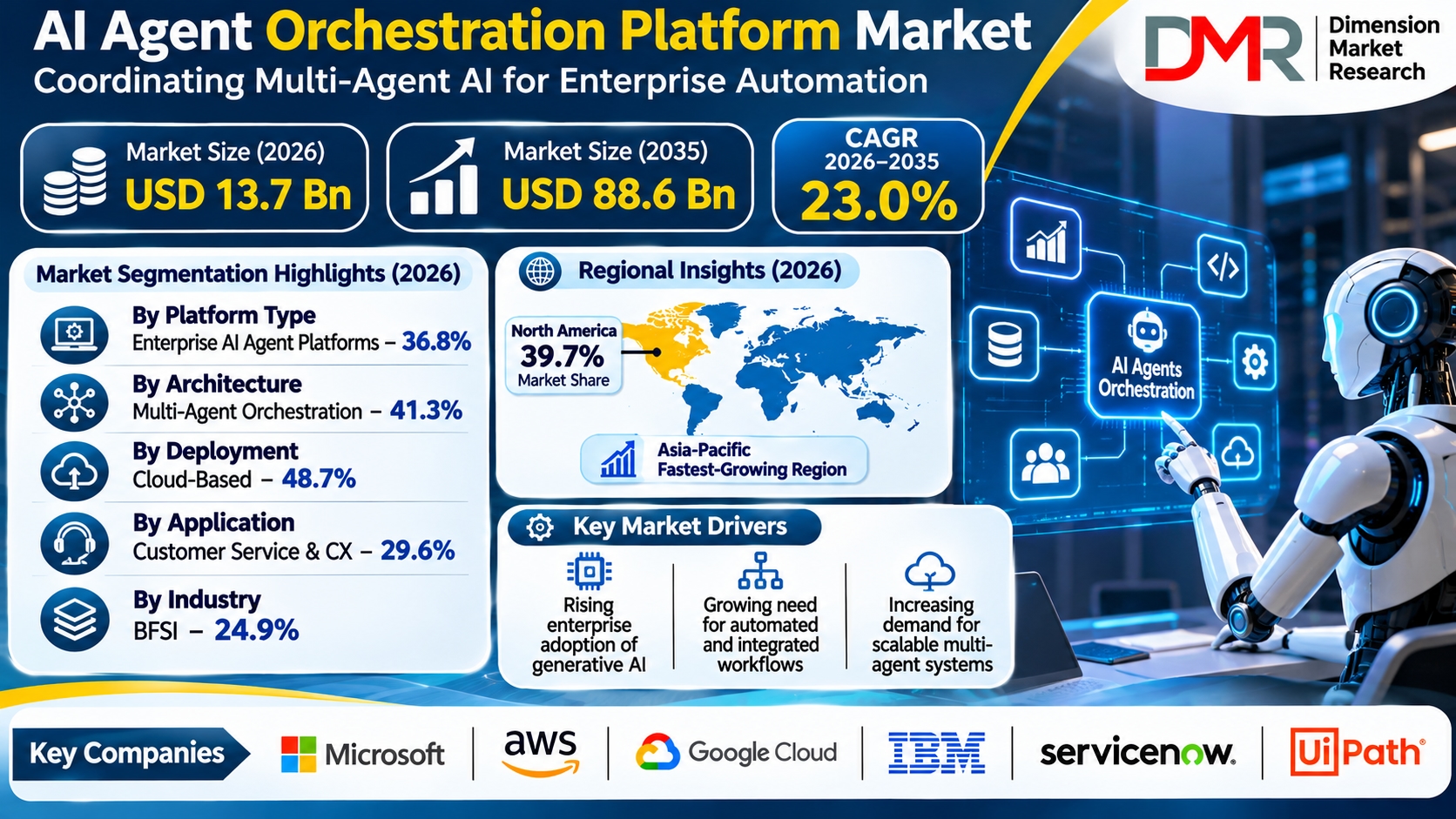
According to Dimension Market Research, the global AI Agent Orchestration Platform Market is estimated at USD 13.7 billion in 2026 and projected to reach USD 88.6 billion by 2035, expanding at a CAGR of 23.0% during 2026 to 2035.
Businesses across banking, healthcare, manufacturing, retail, and technology services are investing in orchestration platforms to improve workflow efficiency, manage autonomous operations, and establish stronger control over enterprise AI deployments.
What Is the AI Agent Orchestration Platform Market?
The AI Agent Orchestration Platform Market covers software solutions that coordinate, monitor, and manage multiple artificial intelligence agents operating across business applications and enterprise systems.
These platforms connect large language models, APIs, databases, automation tools, and business software through centralized workflow management.
An AI agent may independently perform a particular task, while an orchestration platform coordinates multiple agents to complete broader business processes.
Core capabilities include task distribution, agent communication, memory and context management, workflow monitoring, system integration, and governance.
Such capabilities are becoming increasingly important as enterprises seek to deploy autonomous AI systems reliably across complex operational environments.
Why Is the AI Agent Orchestration Platform Market Growing?
Increasing Enterprise Adoption of Generative AI
Businesses are expanding generative AI applications across customer support, software development, financial operations, and business analytics.
As organizations deploy multiple AI agents, coordinating their activities becomes more complex.
AI orchestration platforms provide infrastructure for integrating different AI models and automating interactions between enterprise applications.
This creates demand for scalable solutions capable of supporting coordinated AI workflows rather than isolated automation tasks.
Growing Demand for Enterprise Workflow Automation
Organizations are increasingly automating repetitive and complex processes in human resources, finance, procurement, IT operations, and customer service.
Orchestration platforms help coordinate task execution, manage dependencies, and improve workflow consistency.
For enterprise technology providers, this creates opportunities to develop platforms integrating AI capabilities with existing software infrastructure.
Get a Free Sample of the AI Agent Orchestration Platform Market Report
Evaluating opportunities in enterprise AI automation, multi-agent coordination, or intelligent workflow platforms? Request a free sample to review market segmentation, competitive coverage, regional forecasts, and emerging technology trends.
https://dimensionmarketresearch.com/request-sample/ai-agent-orchestration-platform-market/
Which Segments Lead the AI Agent Orchestration Platform Market?
Enterprise AI Agent Platforms Lead Platform Type
Enterprise AI agent platforms are projected to account for approximately 36.8% of market revenue in 2026.
Their leadership reflects demand for centralized workflow automation, low-code development, enterprise copilots, and governance capabilities.
Cloud-native orchestration platforms are expected to experience rapid growth as organizations adopt distributed AI solutions.
Multi-Agent Orchestration Dominates Architecture
Multi-agent orchestration is anticipated to capture approximately 41.3% of market revenue in 2026.
These systems enable multiple AI agents to collaborate, exchange information, assign tasks, and coordinate complex operational processes.
Hybrid orchestration is expected to be the fastest-growing architecture category, combining AI agents with rule-based automation and robotic process automation.
Cloud-Based Deployment Holds the Largest Share
Cloud-based deployment is projected to account for 48.7% of the market in 2026.
Scalable infrastructure, software-as-a-service availability, and integration with cloud enterprise applications support adoption.
Hybrid deployment is expected to experience the fastest growth, particularly among organizations balancing scalability with data security requirements.
Customer Service and CX Leads Applications
Customer Service and CX is anticipated to represent approximately 29.6% of market revenue in 2026.
Enterprises use orchestration platforms to coordinate conversational AI, customer relationship management tools, analytics, and automated support workflows.
Cybersecurity automation is expected to record the fastest application growth as organizations invest in autonomous threat detection and incident response.
BFSI Dominates Industry Adoption
Banking, Financial Services, and Insurance is projected to account for approximately 24.9% of market revenue in 2026.
Financial institutions are adopting orchestration solutions for fraud detection, customer service, regulatory compliance, and transaction-related automation.
Healthcare and life sciences also represent an important high-growth industry category.
Regional Analysis: Where Is AI Agent Orchestration Platform Demand Growing?
North America Leads Global Revenue
North America is projected to account for 39.7% of global market revenue in 2026.
Its leadership reflects advanced cloud infrastructure, enterprise AI investment, and a well-established technology ecosystem.
The United States market is estimated at USD 4.8 billion in 2026, with an anticipated CAGR of 21.6%.
Europe Focuses on Enterprise Governance
Europe's market is estimated at USD 3.6 billion in 2026, with a projected CAGR of 21.9%.
Enterprise automation, digital sovereignty requirements, and AI governance initiatives are encouraging investment in secure orchestration technologies.
Asia-Pacific Offers the Fastest Growth
Asia-Pacific is expected to be the fastest-growing regional market.
Increasing enterprise digitalization, cloud adoption, industrial automation, and AI investment across China, India, Japan, and South Korea are supporting demand.
Japan's market is estimated at USD 685 million in 2026, with a projected CAGR of 22.1%.
Emerging Technology Trends and Market Opportunities
Human-in-the-Loop Orchestration
Enterprises are incorporating human approvals into autonomous workflows to improve oversight, accountability, and governance.
This approach is particularly relevant in regulated industries where AI-generated decisions require additional validation.
Industry-Specific AI Orchestration
Specialized platforms are emerging for banking, healthcare, manufacturing, and retail applications.
Industry-specific integrations can simplify deployment and support sector-specific security and operational requirements.
Cloud-Native and Multi-Agent Systems
Cloud-native platforms enable organizations to coordinate distributed agents while supporting flexible deployment and scalable computing resources.
However, data privacy concerns, regulatory requirements, and integration complexity remain important adoption barriers.
Competitive Landscape of the AI Agent Orchestration Platform Market
The market includes cloud providers, enterprise software companies, automation specialists, and open-source framework developers.
Prominent companies identified in the report include Microsoft, Amazon Web Services, Google Cloud, IBM, Salesforce, ServiceNow, UiPath, Databricks, LangChain, CrewAI, Oracle, SAP, OpenAI, and Anthropic.
Competition centers on interoperability, enterprise integration, workflow management, scalability, security, and governance capabilities.
In May 2026, UiPath introduced UiPath for Coding Agents, supporting the deployment and management of coding agents within enterprise automation workflows.
The report also highlights Accenture's Physical AI Orchestrator announcement in October 2025 and Adobe's AI agent personalization developments in September 2025.
These developments illustrate increasing investment in coordinated AI operations.
Future Outlook: What Will Shape the Market Through 2035?
The market is expected to evolve as enterprises move from experimental AI applications toward production-scale autonomous workflows.
Multi-agent collaboration, cloud-native infrastructure, human oversight, and industry-specific automation will remain important development areas.
For software vendors, investors, and enterprise technology leaders, opportunities will depend on delivering interoperable platforms that support reliable, secure, and manageable AI operations.
View the AI Agent Orchestration Platform Market Report and Purchase Options
Explore the complete AI Agent Orchestration Platform Market report to evaluate technology categories, application demand, regional growth opportunities, competitive positioning, and enterprise automation trends.
https://dimensionmarketresearch.com/checkout/ai-agent-orchestration-platform-market/
Frequently Asked Questions About the AI Agent Orchestration Platform Market
1. What is the global AI Agent Orchestration Platform Market size?
The market is estimated at USD 13.7 billion in 2026 and projected to reach USD 88.6 billion by 2035.
2. What is the projected AI Agent Orchestration Platform Market CAGR?
The market is forecast to expand at a CAGR of 23.0% during 2026 to 2035.
3. Which orchestration architecture leads the market?
Multi-agent orchestration is projected to lead with a 41.3% revenue share in 2026.
4. Which region dominates the AI Agent Orchestration Platform Market?
North America is expected to account for 39.7% of global revenue in 2026.
5. What factors are driving AI Agent Orchestration Platform Market growth?
Enterprise generative AI adoption, workflow automation, multi-agent collaboration, cloud deployment, and demand for AI governance are major growth factors.
Conclusion
The AI Agent Orchestration Platform Market is positioned for substantial expansion as businesses adopt increasingly sophisticated autonomous AI systems.
Growing demand for coordinated multi-agent workflows, enterprise automation, scalable deployment, and responsible AI governance is transforming the competitive environment.
Technology providers capable of combining interoperability, workflow reliability, security, and industry-specific functionality may find meaningful opportunities through 2035.
Related Artificial Intelligence and Agentic Automation Market Insights
AI Agent Orchestration Market
The AI Agent Orchestration Market Size is estimated at USD 11.0 billion in 2026 and projected to reach USD 115.1 billion by 2035, expanding at a CAGR of 29.8%. The report examines orchestration engines, agent frameworks, state management, monitoring, and intelligent workflow coordination.
AI Agents Market
The AI Agents Market Share analysis provides broader insight into autonomous AI software adoption. The global market is projected to increase from USD 7.5 billion in 2025 to USD 231.9 billion by 2034, growing at a CAGR of 46.3%. Applications include customer service, software development, finance, healthcare, and business automation.
Agentic AI Orchestration and Memory Systems Market
The Agentic AI Orchestration and Memory Systems Market Growth report projects revenue of USD 10.9 billion in 2026, reaching USD 210.5 billion by 2035 at a 38.9% CAGR. It examines orchestration frameworks, memory layers, vector databases, workflow engines, context management, and observability technologies.