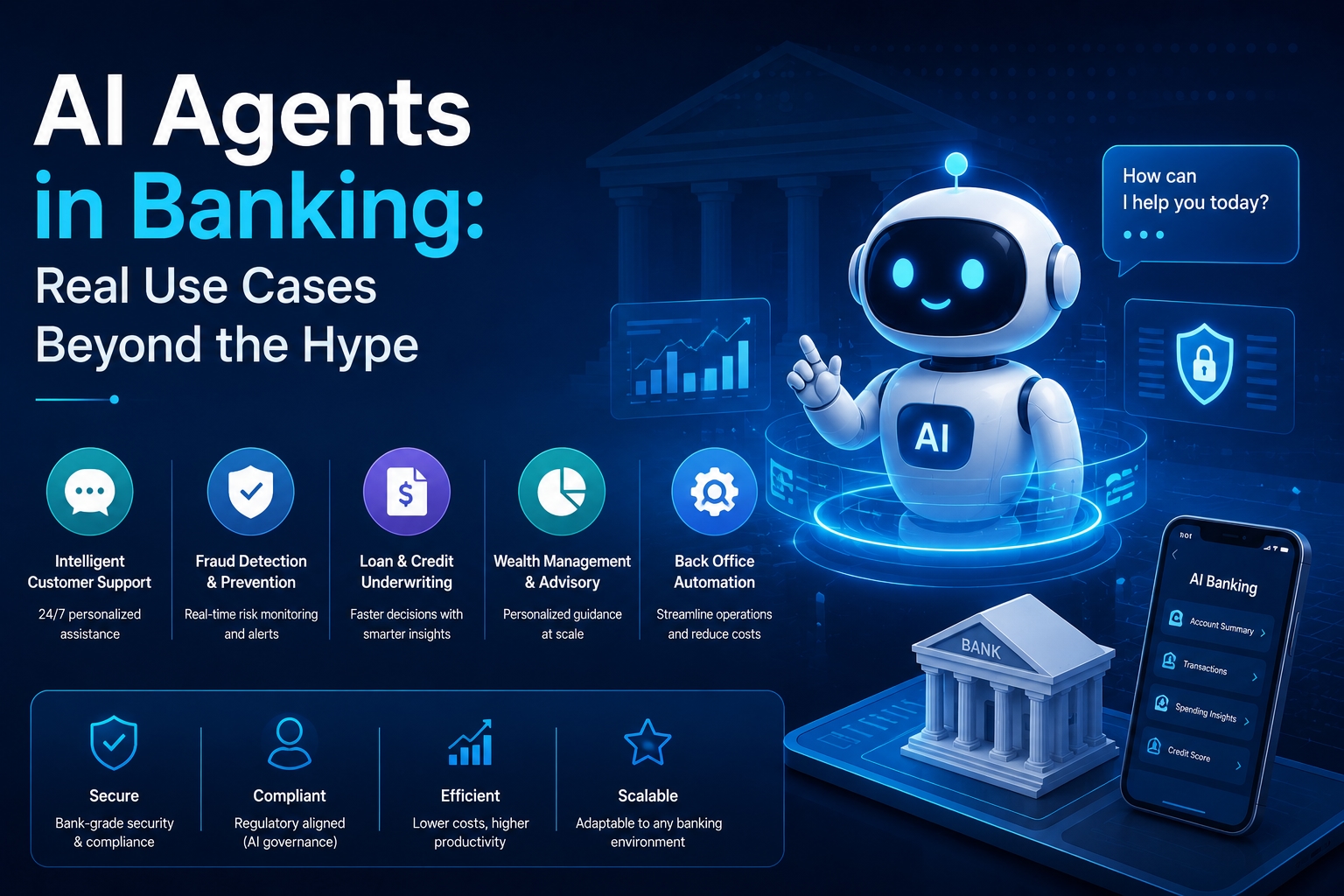
Banks have talked about artificial intelligence for the better part of a decade, but most of that conversation stayed in the pilot stage: a proof of concept here, a chatbot demo there, rarely anything that touched a production ledger. What has changed in the last two years is the shift from AI that answers questions to AI that takes action inside a workflow. It chases down a stalled approval, flags an unusual transaction pattern, or reconciles data across three systems without a person moving it by hand. Financial institutions exploring these capabilities with Mobcoder AI, an AI development company in Riyadh, can approach agentic AI as production infrastructure, with workflow integration, defined decision boundaries, auditability, and regulatory requirements considered from the architecture stage rather than after deployment.
That distinction, action versus conversation, is the one most coverage of "AI in banking" skips over. It's worth being precise about it before looking at where these systems are actually earning their budget.
What Makes an AI Agent Different From a Chatbot
A chatbot waits. A user types a question, the bot searches for an answer, and the interaction ends. An AI agent is built around a goal rather than a single exchange: it can call internal tools and APIs, hold state across multiple steps, decide what to do next based on what it finds, and escalate to a human when it hits the edge of its authority.
In a bank, that difference shows up clearly in something like invoice reconciliation. A chatbot can tell an employee where the reconciliation policy document lives. An agent can pull the invoice, check it against the purchase order and the ledger, flag the discrepancy, draft an explanation, and route it to the right approver, only stopping for a human when the discrepancy exceeds a defined threshold. The agent isn't smarter than the chatbot in any abstract sense. It's simply been permitted to act, within limits someone deliberately set.
Fraud Detection and Transaction Monitoring
This is the area where agentic AI has moved fastest in banking, largely because the economic case is so direct. Traditional fraud rules are static: if a transaction crosses a threshold or matches a known pattern, it gets flagged. The problem is that fraud patterns shift constantly, and static rules generate a steady stream of false positives that burn analyst time.
An agent-based monitoring system behaves differently. It can hold context across a customer's transaction history, cross-reference behavioral signals like device fingerprinting or login geography, and make a risk judgment that adjusts as new information arrives during a single session, rather than waiting for a batch review overnight. When it flags something ambiguous, it can open an investigation workflow and pull supporting evidence automatically instead of leaving that assembly work to a human analyst.
Compliance Monitoring and Regulatory Reporting
Regulatory reporting is repetitive, deadline-driven, and unforgiving of small errors, which makes it a strong fit for automation, but only if the audit trail holds up to scrutiny. This is where a lot of early banking AI projects ran into trouble: a model could produce a plausible-looking compliance summary, but no one could reconstruct exactly how it got there, which is a nonstarter for a regulator.
Well-built Agentic AI development services solve this by designing the audit trail into the system from the start rather than bolting it on afterward. Every decision an agent makes gets logged with the data it used and the reasoning path it followed, so a compliance officer can trace a flagged transaction back through the exact sequence of checks the agent ran. For institutions operating under frameworks like SAMA's Cybersecurity Framework, that traceability isn't optional. It's the difference between a system that passes an audit and one that gets shut down after the first review.
Customer-Facing Banking Agents
On the retail side, the highest-value use cases aren't the flashiest ones. Bilingual customer service agents that can handle account queries, card disputes, and basic onboarding questions in both Arabic and English relieve pressure on call centers dealing with high-ticket volume. KYC document collection agents can walk a new customer through required paperwork, check it against compliance rules in real time, and only hand it off to a human when something doesn't match.
Interaction quality matters as much as automation rate here. Every exchange between a customer and a banking agent should be archived and reviewed, both to improve the system and to satisfy the documentation standards regulators expect from financial institutions. A bank that can't show what its agent said to a customer eighteen months ago has a problem that goes beyond product quality.
Underwriting and Credit Decisioning Agents
Underwriting agents pull data from multiple sources- income verification, credit history, existing exposure- and assemble a recommendation faster than a manual process while keeping a human underwriter in the approval loop for anything above a defined risk tier. The value isn't replacing underwriters. It's removing the data-gathering bottleneck that used to eat most of an underwriter's day, leaving the actual judgment call to the person best positioned to make it.
What Banks Get Wrong When Adopting Agentic AI
Most stalled banking AI projects fail for the same reason: the agent was designed around an idealized workflow instead of the one that actually exists inside the organization. A fraud monitoring agent built without input from the compliance team ends up generating alerts nobody trusts. An underwriting agent that doesn't map to the bank's real approval hierarchy creates more friction than it removes.
The fix isn't more sophisticated AI. It's mapping the real decision chain, including its inefficiencies and informal exceptions, before writing a line of code. Banks and Riyadh-based AI development teams that get this right start with the workflow, not the model.
Wealth Management and Treasury Agents
A less discussed but fast-growing category is agents built for treasury and wealth operations. Treasury teams spend a significant share of their week reconciling cash positions across accounts, currencies, and subsidiaries, then flagging anything that looks off before it becomes a reporting problem. An agent that continuously monitors cash positions, applies the bank's own reconciliation rules, and surfaces exceptions before end-of-day close removes a large share of that manual checking without touching the actual investment or lending decisions, which stay with the treasury team.
Wealth management desks are seeing something similar on the advisory side. An agent can pull a client's portfolio, cross-reference it against risk tolerance and recent market movement, and draft a rebalancing recommendation for an advisor to review, rather than the advisor building that analysis from scratch for every client on their book. The advisor still makes the call and has the client's conversation. The agent just removes the hours of preparation that used to sit between the two.
How to Evaluate a Banking AI Agent Vendor
Not every vendor claiming "agentic AI" capability has actually built for the constraints banking requires. A few questions separate the vendors worth a serious conversation from the ones selling a chatbot with better marketing:
Can they show a working audit trail for a past deployment, not just describe one conceptually?
Do they have direct experience with the specific regulatory framework your institution operates under, rather than general AI experience only?
How do they handle the handoff between agent and human when a decision exceeds the agent's defined authority?
What happens to the system's accuracy over time, and what monitoring do they put in place to catch drift before it causes a compliance issue?
A vendor that can answer these concretely, with specifics rather than general reassurance, is usually the one that has actually shipped systems in a regulated environment before.
FAQs
Is AI agent technology mature enough for regulated banking environments? Yes, when it's built with audit logging, defined escalation thresholds, and human oversight at decision points that carry regulatory weight. The technology itself isn't the limiting factor; the governance design around it is.
How is an AI agent different from robotic process automation (RPA)?
RPA follows a fixed script and breaks when the input format changes. An AI agent can interpret unstructured input, make context-aware decisions, and adjust its next action based on what it finds, which makes it far more resilient to real-world variation.
Do AI agents replace fraud analysts or underwriters?
No. They remove the repetitive data-gathering and first-pass screening work, freeing human specialists to focus on the judgment calls that actually require their expertise.
What's the biggest compliance risk with agentic AI in banking?
Deploying a system without a traceable audit trail. Regulators need to see exactly how a decision was reached, not just what the decision was.
How long does it typically take to deploy a banking AI agent?
It depends heavily on integration complexity, but a well-scoped single-workflow agent, like invoice reconciliation or KYC document review, can often move from discovery to production in six to ten weeks when the underlying data and systems are already accessible.
Conclusion
The banks pulling ahead with AI agents aren't the ones with the most advanced models. They're the ones that mapped their actual workflows honestly, built audit trails that satisfy regulators before deploying, and kept humans in the loop wherever judgment genuinely matters. That discipline is what turns a promising pilot into a system a bank can actually run in production, and it's a more reliable predictor of success than any benchmark score.