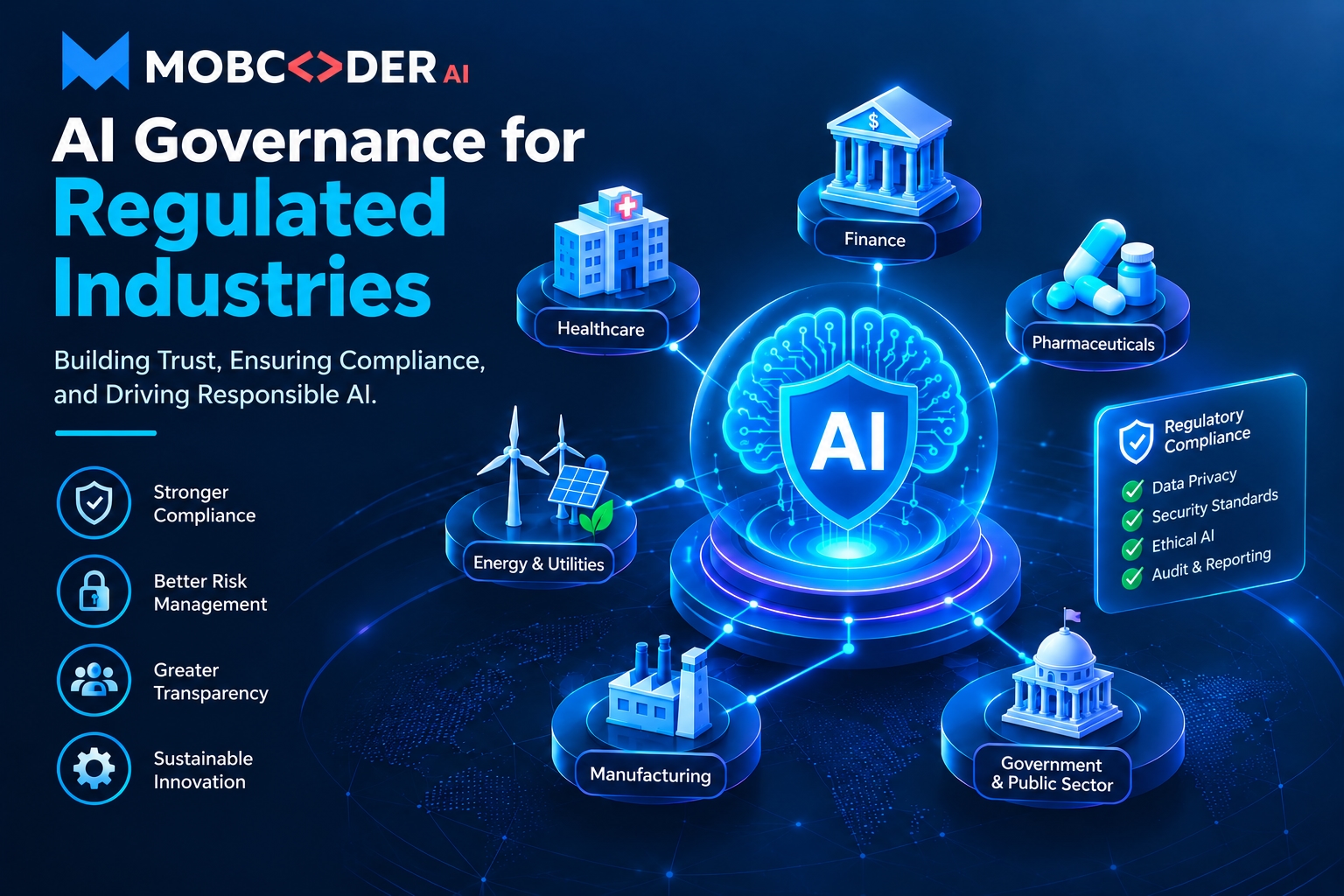
Most companies do not lose control of an AI system because the model was bad. They lose control because nobody defined who was responsible for the model once it left the lab. A regulated enterprise, whether it operates in finance, healthcare, or insurance, can survive a mediocre model. It cannot survive a governance gap that surfaces during an audit or a client complaint.
AI governance is the set of policies, roles, and technical controls that determine how an organization builds, deploys, monitors, and retires AI systems. It answers practical questions: who approves a model before it touches customer data, how decisions get logged, what happens when a model's output looks wrong, and who is accountable when it does. For companies exploring AI development capabilities in New York, governance is often the deciding factor between a pilot that quietly dies and a system that survives contact with legal, compliance, and the board.
What AI Governance Actually Covers
AI governance is broader than a single policy document. It spans four connected layers.
Model oversight. Every model needs a documented owner, a defined purpose, and a review cadence. Without this, teams lose track of which models are running in production and why they were approved in the first place.
Data controls. Where does training and inference data come from, who can access it, and how long is it retained? Regulated industries face specific obligations here, from HIPAA in healthcare to state-level data security laws in finance.
Decision accountability. When an AI system denies a loan application, flags a claim, or recommends a treatment pathway, there needs to be a clear record of the inputs, the model version, and the human who can override the outcome.
Monitoring and drift detection. Models degrade. A fraud detection model trained on 2024 transaction patterns will miss new fraud tactics in 2027 unless someone is watching for performance drift and retraining on schedule.
Why Governance Gaps Show Up Late
The uncomfortable truth is that governance gaps rarely show up during development. They show up during an audit, a regulator inquiry, or a customer dispute, months after the system has been running quietly in the background. By then, the fix is expensive: retroactive documentation, emergency retraining, and sometimes a full system shutdown while the gaps get patched.
This is why mature engineering teams build governance into the architecture from day one rather than bolting it on afterward. A model that logs its own decisions, flags low-confidence outputs for human review, and ships with a documented rollback plan is far cheaper to operate long-term than one that was rushed to production without those guardrails.
Governance for New York's Regulated Industries
New York's financial and insurance sectors face some of the most specific compliance requirements in the country, including the NYDFS Cybersecurity Regulation (23 NYCRR 500) and the state's SHIELD Act. Firms operating in this environment cannot treat governance as an afterthought, because a model failure with a data security angle is not just a technical problem; it is a regulatory one.
Healthcare providers and health-adjacent SaaS companies face a parallel challenge with HIPAA. And any company handling consumer data at scale, regardless of industry, is increasingly expected to demonstrate that its automated decisions are explainable, not just accurate.
Practical steps that hold up under scrutiny include:
Maintaining a model inventory that lists every production model, its purpose, and its last review date
Defining explicit human-in-the-loop checkpoints for high-stakes decisions
Running scheduled bias and drift audits, not one-time checks
Documenting a rollback procedure before launch, not after an incident
Governance Does Not Have to Slow You Down
There is a common misconception that governance and speed are opposites. In practice, the companies that scale AI fastest are usually the ones with the clearest governance structure, because their teams are not stuck re-litigating the same risk questions on every new project. A documented framework turns "can we build this?" into a checklist rather than a months-long debate.
FAQs
1: What is the difference between AI governance and AI ethics?
AI ethics deals with the principles behind responsible AI use, such as fairness and transparency. AI governance is the operational structure, policies, roles, and controls that puts those principles into practice and makes them auditable.
2: Do small and mid-size businesses need formal AI governance?
Yes, though the scope should match the risk. A company using AI for internal document summarization needs lighter governance than one making automated credit or hiring decisions. The core discipline, knowing what models are running and who owns them, applies at any size.
3: How often should AI models be reviewed after deployment?
Most regulated industries review high-stakes models quarterly at minimum, with continuous automated monitoring for drift in between. Lower-risk internal tools can be reviewed less frequently, but should never go unreviewed indefinitely.
4: What happens if a company skips AI governance and gets audited?
Regulators and auditors typically ask for documentation: model inventories, decision logs, and evidence of human oversight. Without it, companies often face remediation orders, fines, or forced suspension of the AI system until controls are added retroactively.
5: Can governance frameworks be added to AI systems that are already in production?
Yes, though it takes more effort than building it in from the start. It usually involves an audit of existing models, retrofitting logging and monitoring, and formalizing ownership and review processes that may currently exist only informally.
Conclusion
Governance is not the department that says no to AI projects. It is the structure that lets a company say yes with confidence, because the risks have already been mapped and the controls are already in place. Enterprises that treat governance as core infrastructure, rather than paperwork, are the ones still running their AI systems confidently three years after launch, not the ones quietly retiring them after the first compliance scare.