
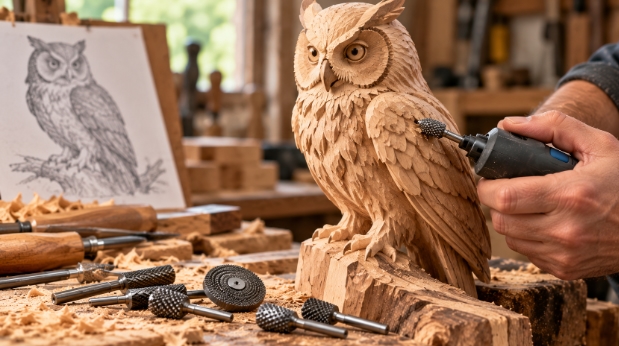
Creating a realistic animal sculpture from a block of wood requires more than simply removing material. The animal wood carving process involves understanding anatomy, proportions, grain direction, depth, texture, and the subtle transitions that make a carved figure appear natural. Power carving can complement traditional hand tools by helping artists shape organic forms and develop detailed surfaces with greater control.
Starting With the Right Wood
The choice of timber can influence almost every stage of a carving project. Softwoods can be easier to remove quickly, while hardwoods may provide a more durable surface for detailed finished pieces. Grain direction should also be considered because it affects how cutting tools move through the material.
Before carving begins, artists can study the intended subject from multiple angles. Establishing the overall silhouette first makes it easier to maintain correct proportions as the sculpture develops.
Blocking Out the Main Form
The first stage is generally focused on removing excess material and establishing the basic anatomy. Rather than immediately carving small details, artists can concentrate on major elements such as the head, body, limbs, tail, and overall posture.
Power carving tools are particularly useful during this stage because sculptors can remove material rapidly and create flowing contours. Kutzall's sculptural-art collection includes shaping wheels, contour wheels, burrs, and hand rasps intended for different stages of sculptural work.
Developing Anatomical Details
Once the primary form is established, the carving can move towards more refined anatomical transitions. The position of muscles, joints, facial structures, paws, claws, ears, or other defining characteristics depends on the animal being represented.
At this stage, smaller rotary burrs can provide greater control than larger shaping tools. Taper burrs, for example, can be used for outside shaping, rounded edges, concave cuts, undercuts, and access to tighter areas.
For animal wood carving, this controlled approach helps the artist gradually refine proportions instead of removing too much material at once.
Creating Fur, Feathers, and Texture
Surface texture is often what separates a basic animal form from a more expressive sculpture. Fur, feathers, scales, wrinkles, and skin folds each require different marks and patterns.
Power carving can be used to develop these textures after the main anatomy has been established. Kutzall notes that power carving can be used for wildlife and portrait work, including adding fur, feathers, and organic surfaces to carved pieces.
Artists should avoid treating texture as a uniform pattern. Natural surfaces change direction around muscles, joints, facial features, and other anatomical structures, so following the underlying form can create a more convincing result.
Choosing Burr Shapes for Detail Work
Different burr profiles can produce different cuts. Ball nose burrs, for instance, can create concave surfaces and hollowed areas with their rounded ends, while their sides can be used for flatter surfaces and rounded edges.
Rotor saw burrs provide another option where grooves, reliefs, hollows, or undercuts are required. Their wheel-shaped design allows controlled cutting in multiple directions.
Using several profiles rather than relying on one tool can give the artist more flexibility throughout the carving process.
Refining the Surface
After the major details have been established, the surface can be refined to remove unwanted tool marks and blend transitions. Hand rasps can provide multi-directional control, while finer rotary burrs can be useful around detailed anatomical areas.
Tool coarseness should correspond with the task. Coarser tools are generally useful for more substantial material removal, while finer options provide greater control during detail work. The sculptural collection includes fine, medium, coarse, and very coarse options across its tools.
Working With the Grain
Wood grain should remain an important consideration throughout the process. Cutting against difficult grain can cause tear-out, while changing the angle of the tool can sometimes produce a cleaner result.
Artists should also avoid forcing a rotary tool through the material. Controlled movements, appropriate pressure, and awareness of the grain can help maintain both the surface quality and the intended shape.
Conclusion
Successful animal wood carving combines careful observation, anatomical planning, controlled material removal, and thoughtful surface detailing. Kutzall offers a range of power-carving tools designed for shaping, contouring, detailing, and refining sculptural work. Choosing different burrs, wheels, and rasps for each stage allows artists to move from rough shaping to refined textures without relying on a single tool throughout the process.







