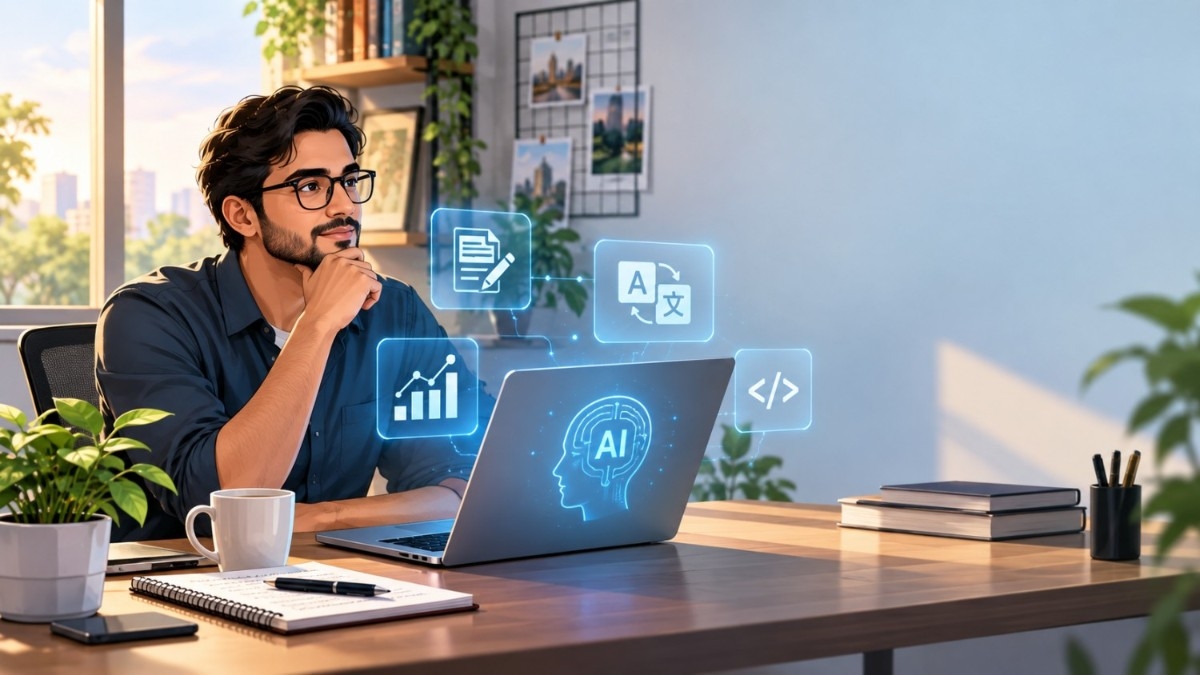
Artificial intelligence used to sound like something from science fiction. Today, it can write an email, summarise a long document, generate an image, translate a conversation, analyse information and help someone write code.
That change has happened surprisingly quickly.
But the more interesting question is no longer simply what artificial intelligence can do. It is what happens when these tools become an ordinary part of everyday life and work.
AI is moving from something people experiment with to something people increasingly need to understand.
AI Is No Longer Just a Technology Story
When people hear "artificial intelligence", they often think about chatbots or robots. In reality, AI is much broader.
It is already being used in recommendation systems, fraud detection, search engines, customer service, translation, navigation, advertising and scientific research.
Generative AI has made the technology much more visible because people can interact with it directly. Instead of needing specialist knowledge, someone can describe what they want and receive a response within seconds.
That accessibility is what makes the current moment particularly interesting.
A student can use AI to explore a difficult concept. A designer can develop early ideas with it. A programmer can use it to investigate a problem. A small business owner can use it to organise information or prepare a first draft.
AI is becoming less like a separate computer tool and more like a general-purpose assistant.
But AI Does Not Automatically Make People Better at Their Work
It is tempting to assume that adding AI to a task will automatically make the task faster and better. Sometimes it does. Sometimes it simply allows mistakes to happen faster.
The quality of the result still depends heavily on the person using the technology.
If someone uses AI to create a first draft, they still need to decide whether the draft makes sense. If AI produces an analysis, someone needs to examine the assumptions behind it. If it generates code, the code still needs to be tested.
The difficult part of working with AI may therefore not be getting an answer. It may be knowing whether the answer deserves to be trusted.
Human Judgement Is Becoming More Important
There is an interesting paradox here.
As machines become better at producing information, human judgement becomes more valuable.
Knowing how to ask a useful question matters. Knowing what context to provide matters. Understanding a particular audience matters. Checking sources matters. And perhaps most importantly, knowing when not to trust an answer matters.
AI systems can sometimes produce responses that sound convincing even when parts of the information are incorrect.
That is why responsible use of AI involves more than learning prompts or discovering new tools. It requires critical thinking.
People still need to question information, compare sources and understand the consequences of decisions made with AI assistance.
Education Will Have to Change Too
AI is already changing the way people approach learning.
A student who once had to search through several pages of information can now ask an AI system to explain a difficult concept in simpler language. That can be genuinely useful.
But there is also a risk.
If a learner always asks AI for the answer instead of attempting the problem themselves, the technology can remove the struggle through which genuine understanding develops.
The best use of AI in education may therefore be as a learning companion rather than a substitute for learning.
It can explain an idea in another way, provide examples, ask questions or help identify gaps in understanding. The learner still needs to think.
Careers Are Changing, But Not in One Simple Direction
There is plenty of discussion about whether AI will replace jobs.
The reality is more complicated than a simple yes or no.
Some tasks will increasingly be automated. Some roles will change. New roles will emerge. Many existing jobs will probably involve working alongside AI rather than being completely replaced by it.
This makes continuous learning increasingly important.
Someone interested in marketing, for example, does not necessarily need to become an AI engineer. Understanding how AI affects research, content, customer behaviour and marketing workflows may be much more relevant.
The same principle applies to designers, teachers, writers, analysts, developers and business owners.
For someone building a career in a changing digital environment, digital marketing learning can be one way to develop practical skills while also understanding how new technologies are changing the way businesses communicate with customers.
The important point is that AI does not make existing skills irrelevant overnight. In many cases, it changes how those skills are applied.
Small Businesses Have Something to Gain Too
AI is not only relevant to large technology companies.
A small business owner can use AI to organise information, brainstorm ideas, analyse documents, prepare drafts, research customers or explore new markets.
But the same principle applies here: AI should support decision-making rather than replace it.
A business still needs to understand its customers. It still needs a useful product or service. It still needs to communicate honestly.
AI can help with the work around those things, but it cannot remove the need to understand the business itself.
The Real Advantage May Be Adaptability
We are likely to see many exaggerated claims about artificial intelligence over the next few years.
Some tools will disappear. Others will become ordinary features inside software people already use. Capabilities will improve, costs will change, and entirely new applications will emerge.
Trying to predict every development is probably less useful than developing the ability to adapt.
That means understanding the basics of AI, experimenting with new tools, checking information carefully and continuing to strengthen the skills that make someone good at their work.
The people who benefit from AI may not necessarily be those who know the most about the technology itself.
They may simply be the people who learn how to use it without handing over their judgement to it.
AI can produce an answer in seconds.
Understanding what to do with that answer is still a human skill.