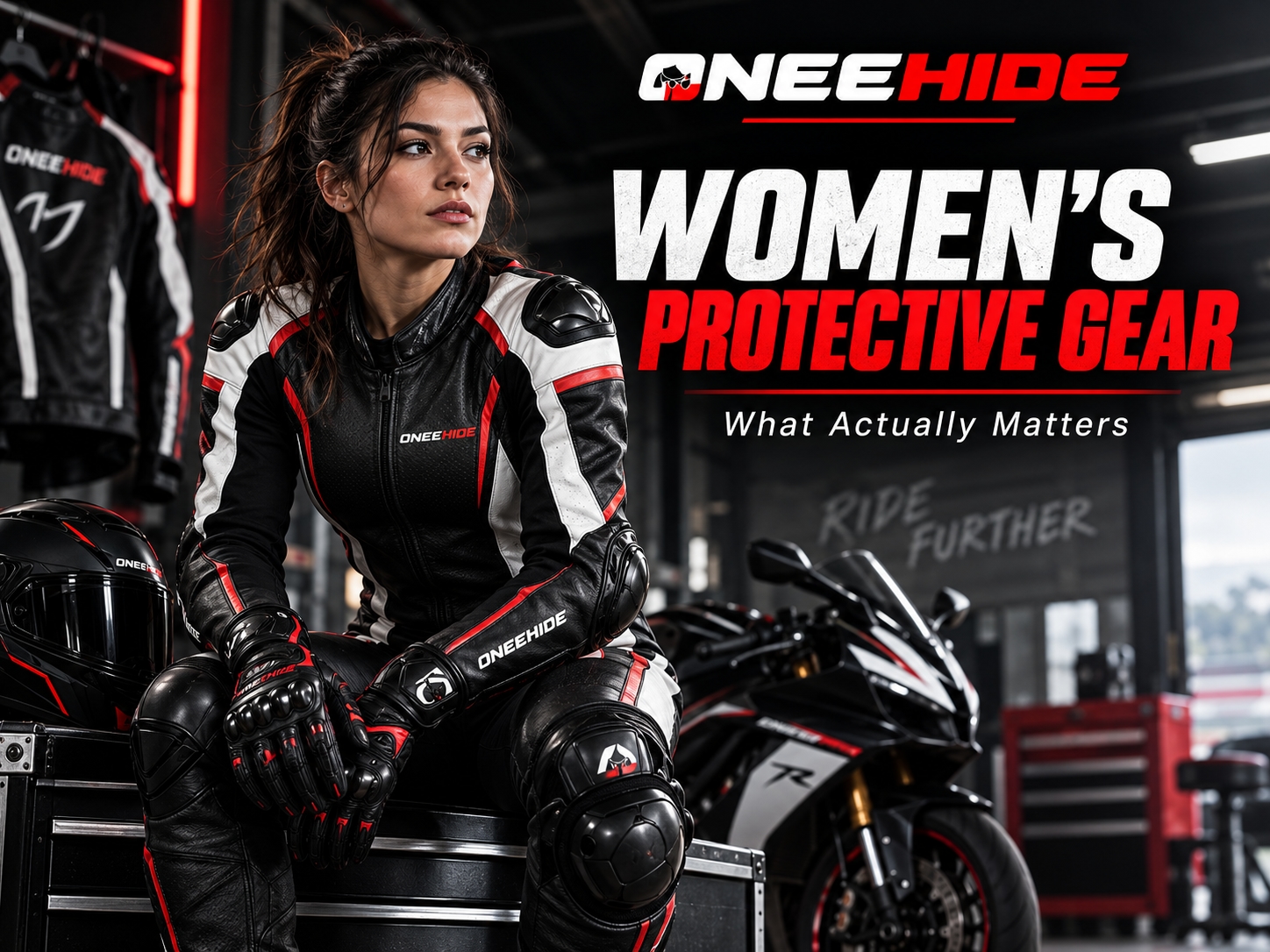
Women’s motorcycle gear has improved considerably, but a smaller size, a more tapered waist, or a different color scheme does not automatically make a garment appropriate for a female rider. Protective motorcycle clothing has a harder job than ordinary apparel. It needs to resist abrasion, keep impact protectors positioned correctly, survive stress at seams and closures, allow normal control of the motorcycle, and remain comfortable enough to wear consistently.
That makes the buying question less about whether a jacket is marketed as “women’s” and more about whether its protection, fit, construction, and ergonomics work for the person wearing it.
A useful women-specific design can accommodate differences in bust, waist, hip, thigh, arm, and torso proportions without compromising protective zones. Riders still need to evaluate each garment individually because body proportions vary far more than a simple men’s-versus-women’s size chart suggests.
Women’s motorcycle gear should be protective gear first
A women-specific cut can be valuable when it solves real fit problems. A jacket that accommodates the chest without leaving excessive material around the waist can help keep elbow and shoulder protection where it belongs. Motorcycle trousers that provide enough room through the hips and thighs without becoming loose at the knees can do the same for knee armor.
That is very different from taking a men’s garment, reducing its dimensions, and changing its styling.
The practical goal is to find equipment designed around both protection and usable fit. Looking through a dedicated range such as can be a starting point, but the same evaluation should follow for every garment: certification, armor coverage, fit in a riding position, construction, and suitability for the type of riding you actually do.
The label on the department page should never replace those checks.
Start with certification, not the label on the hanger
Words such as armored, racing inspired, heavy duty, and protective are marketing descriptions unless they are supported by meaningful specifications.
For jackets, trousers, and one-piece or two-piece road-riding garments sold under European PPE frameworks, EN 17092 is one of the main standards riders are likely to encounter.
Understand the garment protection class
The EN 17092 series separates protective motorcycle garments into several classes. Among full protective garments, AAA represents higher performance requirements than AA and A, while Class A is intended to provide a lower minimum degree of impact and abrasion protection than the higher classes. BSI describes AAA garments as meeting higher material and construction requirements than AA and A garments, while also acknowledging that greater protection can bring weight, thermal, and ergonomic trade-offs.
That does not mean every rider automatically needs AAA for every journey. A track-oriented suit and an urban commuting jacket serve different riding conditions. What matters is understanding what level you are buying rather than assuming two garments offer equivalent protection because both look substantial.
Certification should also be checked on the actual product label or manufacturer documentation. A product page saying that a jacket contains “CE armor” does not by itself tell you the protective classification of the entire garment.
Check the impact protectors separately
Garment certification and armor certification are related, but they are not the same thing.
Elbow, shoulder, knee, and hip protectors may be tested under EN 1621-1, while motorcycle back protectors are covered separately by EN 1621-2. BSI’s description of EN 1621-1 specifically covers impact protectors incorporated into riding clothing or used as separate components.
When comparing gear, check:
Which protectors are included as standard
Whether shoulders, elbows, knees, and hips are covered
Whether the back area contains an actual protector or only an empty pocket
Whether protector height or position can be adjusted
Whether the protectors sit over the correct body area once you are on the motorcycle
That final point is where fit becomes part of the safety discussion.
Fit is not just about comfort
Protective clothing cannot work as intended if its components move away from the areas they are supposed to protect.
European PPE requirements explicitly address adaptation to the wearer’s morphology and the need for equipment to remain correctly positioned during foreseeable use. That is particularly relevant when someone is choosing between a generic cut and a garment proportioned more closely to her body.
Stand in front of a mirror if you want to check the appearance. Sit on a motorcycle, or reproduce your riding posture as closely as possible, if you want to check the protective fit.
Bend your elbows and knees. Reach forward as though holding the bars. Move your shoulders. Check whether the jacket rides dramatically upward or pulls across the chest. The shoulder cups should remain centered, and elbow protectors should cover the elbow rather than sliding toward the forearm.
For trousers, pay close attention to knee armor. A protector that looks correctly positioned while standing may move noticeably once the knee is bent.
A useful fit check asks:
Can the garment close comfortably without compressing movement?
Is there excessive loose material that could allow armor to shift?
Do sleeves and trouser legs remain long enough in the riding position?
Can you operate the controls without restriction?
Does armor stay centered when you move?
Do waist, wrist, and ankle closures secure the garment effectively?
Can intended base layers or thermal liners fit without distorting the protective fit?
Do not solve a serious sizing problem simply by removing the armor because the garment becomes more comfortable without it. That usually means the garment, armor shape, armor position, or size needs reconsideration.
Material matters, but construction matters just as much
The leather-versus-textile argument is often oversimplified.
Good motorcycle leather can provide strong abrasion resistance and is widely used in performance and track-oriented equipment. Modern textiles can offer lower weight, ventilation, waterproofing options, flexibility, and practical everyday features. Neither material name guarantees performance on its own.
A heavy-looking textile jacket can still have weak seams or poorly protected high-risk areas. A leather garment can still fit badly or use unsuitable construction. Protective performance comes from the whole system: material selection, thickness and reinforcement, seam strength, panel layout, closures, impact protection, and how the garment stays on the rider.
Independent testing illustrates why shoppers should look beyond appearance. MotoCAP, a motorcycle clothing assessment program involving Australian and New Zealand government and road-safety organizations, tests garments for factors including abrasion durability, seam or burst strength, impact protection, and thermal performance. Its protocols involve independently obtained retail products rather than relying only on manufacturer-supplied samples.
The practical lesson is simple: “textile” is not one performance level, just as “leather” is not one performance level.
What women should check in jackets and trousers
Women-specific protective gear becomes useful when patterning improves the way the garment works on the bike, rather than simply creating a different silhouette.
Jacket checks that matter on the motorcycle
Start at the shoulders. The jacket should allow normal reach without pulling the protective cups away from the shoulder joint. Then check the chest and waist together. Going up several sizes just to gain enough chest room can leave too much loose material elsewhere.
Sleeve length needs to be judged with your arms forward. A sleeve that appears slightly long while standing may be exactly right once you reach for the handlebars.
Also inspect how the jacket interfaces with gloves and trousers. Large gaps at the wrist or lower back can expose skin if garments separate during a slide. Connection zippers or other secure jacket-to-trouser systems can help prevent separation when the equipment is designed to work together.
Trouser checks that matter in a riding position
For trousers, hip and thigh room should not require accepting loose knee areas.
Sit with the knees bent and locate the center of each knee protector. If the armor sits noticeably above, below, or beside the joint, check whether it is adjustable before changing sizes.
Then look at the waist and rear rise. Protective trousers should remain adequately positioned when you lean forward rather than pulling downward and creating a large gap beneath the jacket.
Stretch panels can improve mobility, but mobility should not be confused with looseness. The best fit allows movement while keeping the protective structure controlled.
Gloves and boots deserve the same attention as jackets
It is easy to spend most of the budget on a jacket or suit and treat gloves and boots as accessories. Crash research gives little reason to do that.
A study involving 951 riders with complete injury and clothing information found that wearing both a motorcycle jacket and gloves was associated with a lower risk of upper-limb soft-tissue injury, while wearing motorcycle trousers together with boots was associated with lower lower-limb soft-tissue injury risk. Motorcycle boots were also associated with a reduced risk of foot or ankle fracture. The authors did not find protective clothing to prevent every type of serious injury, which is an important reminder that gear reduces certain risks rather than making a rider invulnerable.
For gloves, look for secure wrist retention, sufficient coverage, suitable palm construction, and enough dexterity to operate the throttle, brake, clutch, and switches naturally.
For boots, protection should be balanced against control feel. Motorcycle-specific footwear standards such as EN 13634 address protective and ergonomic characteristics for riding footwear, including mechanical properties and performance requirements.
A boot that feels protective but prevents smooth use of the shifter or rear brake is not functioning well as riding equipment.
Heat, layering, and everyday usability affect whether protection gets worn
The most protective garment in your wardrobe provides little benefit on the days you leave it at home because it is unbearable in the conditions.
Ventilation, liner design, perforation, moisture management, waterproof membranes, and room for seasonal layers therefore belong in the buying decision.
That does not mean choosing comfort instead of protection. It means finding the best realistic combination for your environment and riding pattern.
A commuter sitting in slow summer traffic may prioritize airflow differently from a rider spending hours at motorway speed. A track rider may accept weight and heat that would become frustrating during daily urban riding. Cold-weather riders need enough layering room without pushing armor away from the body.
This is also why buying oversized gear for winter can be a poor compromise. If extra space allows impact protectors to float around the joints when lighter layers are worn, seasonal flexibility has created another problem.
Where possible, try the garment with the layers you genuinely expect to use.
Replace “shrink it and pink it” with a better buying order
The strongest women’s motorcycle gear does not need to prove that it is feminine. It needs to prove that it works.
Start with the riding environment and the protection level appropriate to it. Verify the garment certification rather than relying on styling or vague product language. Check what armor is actually supplied. Put the equipment on and evaluate protector placement in a realistic riding position. Then compare construction, coverage, ventilation, weather protection, mobility, and how the pieces work together.
A useful order is:
Protection standard: What has actually been tested or certified?
Correct fit: Does the garment fit your proportions without excessive pressure or looseness?
Armor position: Do the protectors stay over the intended joints while riding?
Construction and coverage: Are vulnerable areas adequately protected and securely closed?
Riding suitability: Is the equipment appropriate for commuting, touring, spirited road riding, or track use?
Climate and comfort: Can you realistically wear it in the conditions you ride in?
Style: Once the protective requirements are satisfied, choose the design you actually enjoy wearing.
Women should not have to choose between motorcycle gear that fits and motorcycle gear that protects. A genuinely useful women-specific design treats body proportions as an engineering and ergonomic consideration, not a reason to make a smaller version of someone else’s jacket and change the color.
That is a much better standard than “shrink it and pink it.”