Imagine a teacher writing two unfamiliar names on the board and asking what they share. Searches for bpc157 tb500 keep growing because both compounds appear in laboratory literature on tissue biology. Many web pages, however, mix genuine science with marketing hype. This guide separates documented facts from assumptions, and it is educational only, because these materials are research reagents and not medicines.
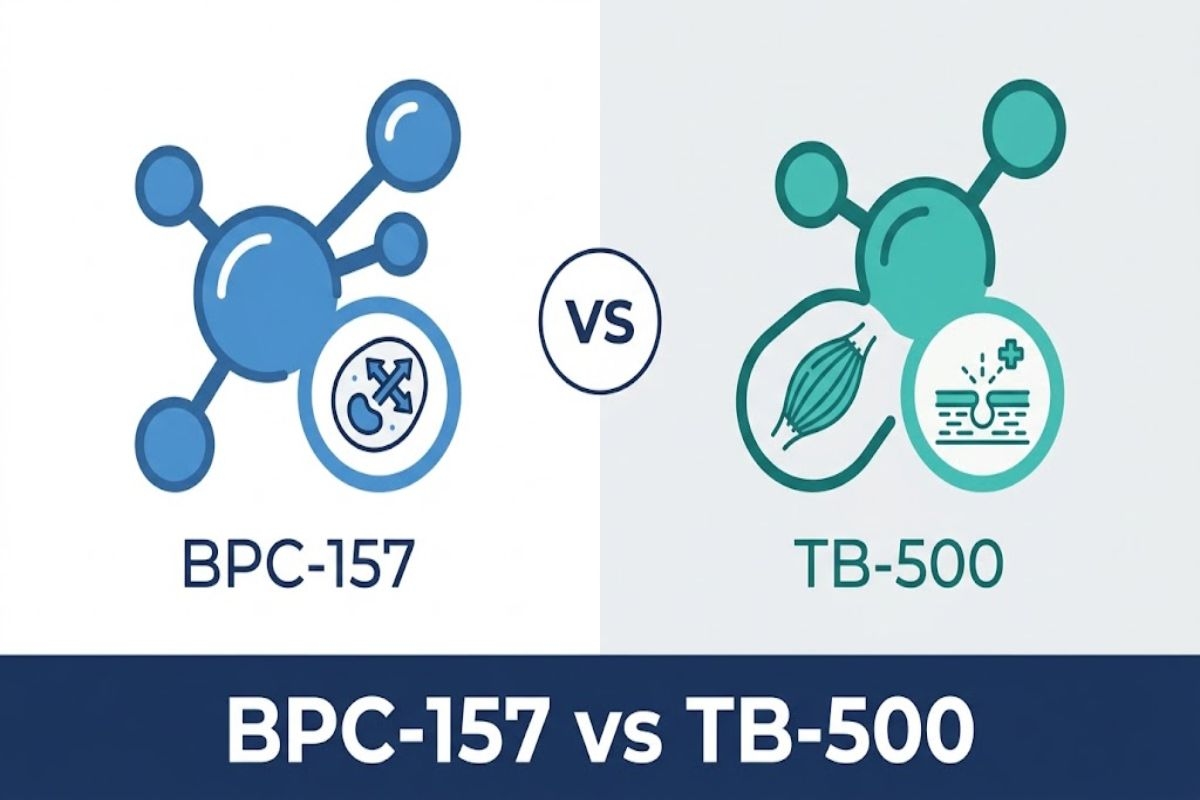
What Are BPC-157 and TB-500?
In short, they are two different synthetic compounds studied in laboratories for tissue biology, and neither is an approved drug. BPC-157 is a chain of 15 amino acids whose sequence comes from a protein found in human gastric juice. TB-500 is a synthetic fragment modelled on thymosin beta-4, a natural protein present in most animal and human cells. Think of the full protein as a long instruction manual and the fragment as the single page scientists find most relevant.
BPC-157 Basics
BPC-157 stands for Body Protection Compound and was first described by a research group in Zagreb led by Predrag Sikiric. It is a small molecule, so chemists can confirm its identity with mass spectrometry and measure purity with HPLC. A certificate of analysis showing both results is the first document a careful researcher requests.
TB-500 Basics
TB-500 is usually described as a synthetic version of the active region of thymosin beta-4, first isolated from the thymus gland in work led by Allan Goldstein. Thymosin beta-4 binds actin, the protein that forms a cell's internal scaffolding, which explains the research interest. Suppliers use the name inconsistently, so two bottles with the same label may contain different molecules.
BPC-157 vs TB-500: Key Differences
The direct answer is that the two compounds are not interchangeable, even though both appear in tissue-repair literature. They differ in origin, size, and the biological pathways researchers link to them. Comparing bpc157 and tb500 is like comparing a screwdriver and a spanner, since both sit in one toolbox but do different jobs. Students should therefore read their studies separately and never merge two bodies of evidence into one.
Quick Comparison
The list below summarises what review articles usually emphasise. Each point describes laboratory research and not benefits for people. Checking every line against a primary source is a good study exercise.
Origin: BPC-157 is based on a gastric protein sequence, while TB-500 is modelled on thymosin beta-4 from the thymus.
Size: BPC-157 has 15 amino acids, while thymosin beta-4 has 43 and TB-500 is a shorter fragment.
Research focus: BPC-157 appears in gut, tendon, and angiogenesis models, while thymosin beta-4 appears in actin, cell migration, and wound models.
Status: neither is an approved medicine, and both are restricted in competitive sport.
What Does the Research Evidence Show?
Most findings on tb500 bpc157 come from cell cultures and rodents, and animal results often fail to carry over to people. In rat studies, BPC-157 has been reported to influence blood vessel formation and growth factor signalling in tendon and gut tissue. Thymosin beta-4 research focuses on cell migration and inflammation in wound and heart models. A useful rule for students is that a mechanism seen in a rat is a hypothesis for a human, never a proven outcome.
Animal Findings
A 2003 rat study by Staresinic and colleagues in the Journal of Orthopaedic Research reported faster tendon-to-bone healing after surgical injury. Much of the BPC-157 literature comes from a small cluster of connected laboratories, so independent replication is still an important gap. Honest authors state this limitation, and reports on bpc157 / tb500 should do the same.
The Human Data Gap
A small uncontrolled knee-pain report published in 2021 is often quoted online, yet it cannot establish effectiveness. Real proof needs randomised, placebo-controlled trials with predefined outcomes, and such trials are not available at scale for bpc157 and tb500. Clinical trials of full-length thymosin beta-4 used a medical-grade protein under supervision, so those results must not be transferred to research-grade TB-500.
Safety, Legal Status, and Regulation
Neither compound has completed the large human trials needed for approval, so regulators do not recognise either as a proven treatment. Anyone reading about tb500 bpc157 should treat personal stories as anecdotes and not as clinical evidence. The FDA has placed BPC-157 on its list of bulk substances that may carry significant safety risks for compounding. Whenever bpc157 tb500 is discussed, a trustworthy source reports regulatory status first and laboratory findings second.
FDA and Anti-Doping Rules
An FDA listing does not prove harm; it reflects limited safety data and risks such as impurities. The World Anti-Doping Agency prohibits both compounds, so athletes can face suspension even when a product was labelled as a research material. Because rules change, readers should verify the current FDA and WADA lists before relying on any summary, including this one, and the same caution applies to bpc157 / tb500.
Quality and Purity: What Researchers Check
Quality control decides whether an experiment produces reliable data or meaningless noise. A supplier offering bpc157/tb500 should show batch-specific testing, a clear molecular identity, and transparent contact details. Researchers also check storage conditions, packaging, and test dates, because degraded material behaves differently from fresh material. It is like baking: even a perfect recipe fails if the flour is spoiled.
Reading a Certificate of Analysis
A certificate of analysis is a short laboratory report, and reading one is a core research skill. For any bpc157/tb500 material, check the items below, and pause the purchase if any is missing or looks edited. Consider a technician who finds that a vial's reported molecular weight does not match its label; she quarantines it and protects her data.
Identity: mass spectrometry data matching the expected molecular weight.
Purity: an HPLC chromatogram with a stated percentage and a clean main peak.
Traceability: a lot number printed on both the report and the vial.
Testing details: the laboratory name, test date, and method used.
Conclusion
BPC-157 and TB-500 are different synthetic compounds with different origins and no approval as medicines. Anyone researching bpc157 tb500 should rely on primary sources, demand batch-specific analytical data, and treat anecdotes with healthy scepticism. The strongest scientists ask what the evidence shows, who it was tested on, and who checked the result. Use this guide as a starting framework and keep reading peer-reviewed literature as the field evolves.
Research-Use Notice
AVP products are chemical reagents for research purposes only and are not intended for human use. They are not intended to diagnose, treat, cure, or prevent any disease. AVP is a chemical supplier, not a 503A compounding pharmacy or 503B outsourcing facility, and it does not sell to patients. Nothing here is medical advice or a statement of therapeutic benefit.
Frequently Asked Questions
What is BPC-157?
It is a synthetic chain of 15 amino acids derived from a gastric protein. It is studied in laboratories and is not an approved medicine.
What is TB-500?
It is a synthetic fragment modelled on thymosin beta-4. Researchers study it for actin binding and cell migration in laboratory models.
Are these two compounds the same?
No, they have different origins and separate research literature. Each must be read on its own.
Are they banned in sport?
Yes, the World Anti-Doping Agency lists both on its Prohibited List. Always check the latest list before any competition.
How can I verify supplier quality?
Request a batch-specific certificate of analysis with mass spectrometry and HPLC results. Match the lot number on the report to the vial.
Where can I find reliable studies?
PubMed and ClinicalTrials.gov are dependable free starting points. Prefer reviews and randomised trials over single animal studies or testimonials.