Tadalafil has become a familiar name in men's health, primarily recognized as a treatment for erectile dysfunction (ED) and benign prostatic hyperplasia (BPH). In recent years, however, a different question has been circulating in fitness circles: could tadalafil also enhance gym performance by improving blood flow to working muscles? It's an understandable question given how the medication works, but the honest, medically grounded answer is more nuanced than fitness forums often suggest. Here's what the science actually says, and why using tadalafil for this purpose carries real risks.
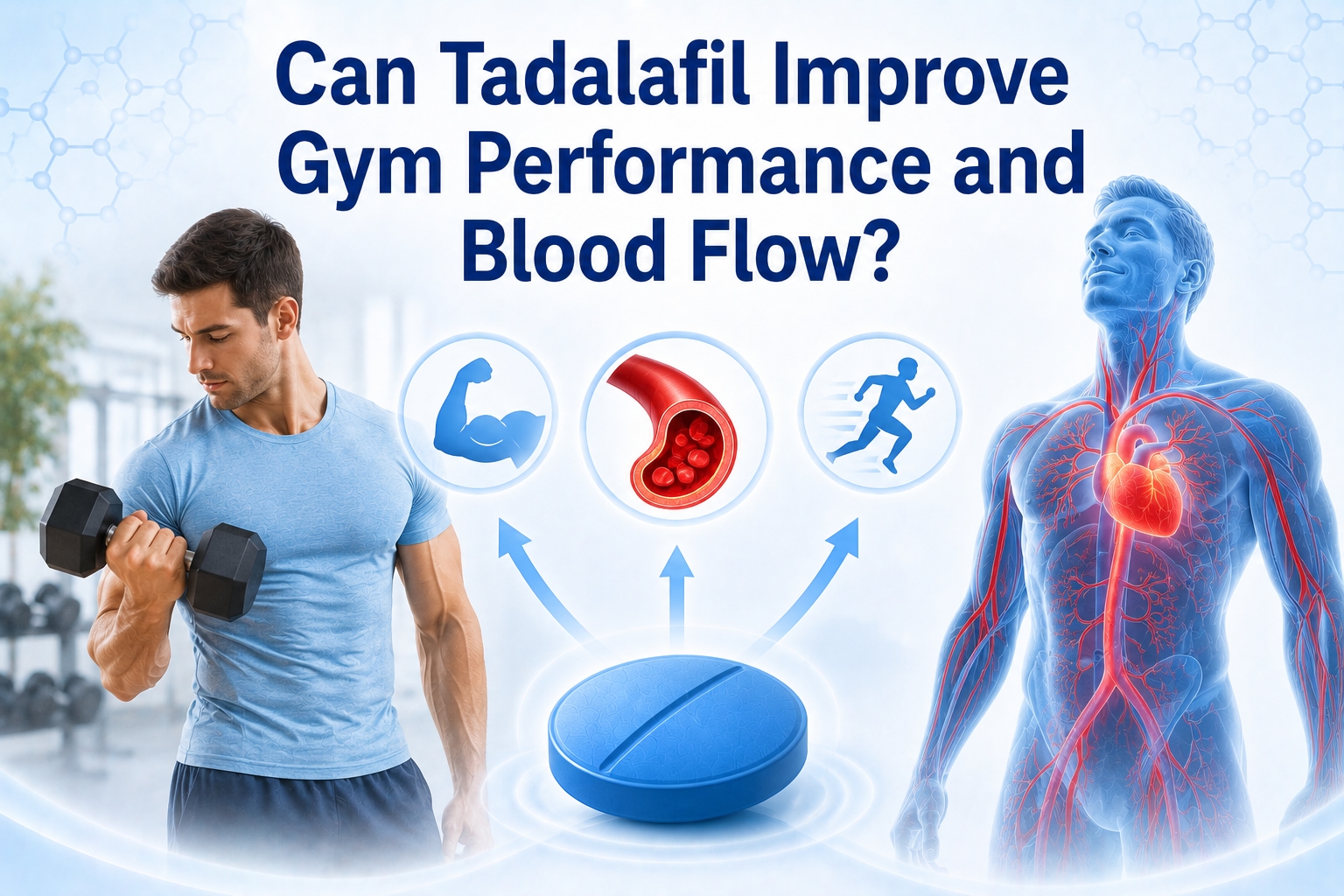
How Tadalafil Works in the Body
Tadalafil belongs to a class of medications called PDE5 inhibitors. It works by blocking the enzyme phosphodiesterase type 5, which allows nitric oxide to remain active longer in blood vessel walls. This leads to relaxation of smooth muscle and improved blood flow specifically in the tissue where nitric oxide signaling is concentrated during sexual arousal. This mechanism is well-documented and is precisely why tadalafil is effective for ED: it doesn't create an erection on its own, but it supports the body's natural blood flow response during stimulation.
Why People Assume It Could Help With Exercise
The connection between tadalafil and gym performance stems from a reasonable, if incomplete, line of thinking: if the medication improves blood flow in one part of the body, could it do the same for skeletal muscle during exercise, potentially improving endurance, muscle pumps, or recovery? Nitric oxide does play a role in exercise physiology, which is part of why nitrate-rich foods and supplements marketed for "pump" effects have become popular in the fitness industry. It's a logical enough hypothesis to test, but logical hypotheses don't always hold up under clinical scrutiny.
What the Research Actually Shows
Despite the theoretical connection, there is no strong clinical evidence that tadalafil meaningfully improves athletic or gym performance in healthy individuals. Several small studies have examined PDE5 inhibitors in the context of exercise, particularly at high altitude, where blood vessel dilation plays a role in oxygen delivery. Still, results in normal, sea-level exercise conditions have generally failed to show a meaningful performance benefit for muscular strength, endurance, or recovery. The vasodilation that tadalafil produces is not uniformly distributed in a way that translates into better exercise capacity, and the body's exercise-induced blood flow response already relies on multiple overlapping systems that a PDE5 inhibitor doesn't necessarily enhance further.
In short, the blood flow improvement that tadalafil provides is real, but it's specific to the physiological context in which it was studied and approved; it isn't a general-purpose circulation booster that carries over predictably into athletic performance.
Why Tadalafil Isn't Approved for Athletic Use
Tadalafil is FDA-approved for three specific indications: erectile dysfunction, benign prostatic hyperplasia, and pulmonary arterial hypertension. Athletic or exercise performance enhancement is not among them, which means any use for that purpose is considered off-label. Off-label use isn't automatically dangerous in every context. Still, it does mean the safety and effectiveness data doctors rely on for approved uses simply doesn't exist for gym performance, and dosing hasn't been studied for this purpose. There's no established guidance on how it might interact with the physiological demands of intense training.
The Real Risks of Using Tadalafil for Gym Performance
Use of tadalafil in any way that is not intended poses various dangers that cannot be overlooked. The biggest danger is that of blood pressure fluctuations.
Blood pressure will definitely be reduced by tadalafil to a certain level and physical exertion causes considerable fluctuations in blood pressure. When both these things combine, there is a danger of fainting or dizzy spells.
Dangerous interactions with pre-workout supplements are an often-overlooked risk. Many pre-workout products contain high doses of nitrates, arginine, or other vasodilating compounds. Combining these with tadalafil compounds the blood-pressure-lowering effect and significantly raises the risk of a serious cardiovascular event.
Undiagnosed heart conditions make this combination particularly risky. Because tadalafil affects blood vessel function, men with undiagnosed cardiovascular issues may not realize they're at elevated risk until they experience symptoms during an intense workout, when the body is already under cardiovascular strain.
Priapism risk, while rare, is a recognized side effect of PDE5 inhibitors and is considered a medical emergency requiring immediate treatment if it occurs.
Nitrate medications — including some supplements — when combined with tadalafil-based medicines such as Tadalista 80 mg, Vidalista D, Tadarise Effervescent, and Tadarise Tablet, can cause a severe, potentially fatal drop in blood pressure, which is why doctors always screen for nitrate use before prescribing it for its approved purposes.
Safer, Evidence-Based Ways to Support Blood Flow and Performance
For those genuinely interested in improving blood flow and gym performance, there are approaches with stronger evidence behind them and none of the off-label risk:
· Dietary nitrates, such as those found in beets and leafy greens, have reasonable evidence supporting modest improvements in exercise efficiency and blood flow.
· Proper hydration directly affects blood volume and circulation and is one of the simplest, most effective ways to support performance.
· Structured warm-up routines improve blood flow to working muscles through the body's natural physiological response, without any pharmacological risk.
· Adequate sleep and recovery significantly influence cardiovascular efficiency and muscular performance over time.
· Progressive training programming remains the most consistently effective driver of strength, endurance, and muscular adaptation, far more impactful than any circulation-focused shortcut.
When Tadalafil Is Appropriate
Tadalafil continues to be a safe and effective drug in cases where it has been prescribed for its indicated, FDA-approved use by a qualified doctor. Men who have received treatment for ED, BPH, or PAH will find that their blood flow benefits greatly from tadalafil in that situation. It is important to note the difference here because there is a distinction between the drug's approved uses and unapproved uses at the gym.
Final Thoughts
This hypothesis about the potential benefits of using tadalafil to improve gym performance through the enhancement of blood circulation seems like a rational question to consider at first glance. However, the hypothesis fails when analyzed in the light of the existing scientific research, not to mention it poses a significant threat to health. Despite being a good drug for what it was prescribed for, tadalafil is not a proper performance-enhancing tool.