
Introduction
The healthcare industry in India is growing rapidly, increasing the demand for safe, effective, and high-quality medical devices. To ensure that medical devices meet prescribed safety and quality standards, the Central Drugs Standard Control Organization (CDSCO) regulates their manufacture, import, sale, and distribution in India.
CDSCO Registration of Medical Devices is a mandatory regulatory requirement for manufacturers and importers dealing with notified medical devices. The registration process ensures that products comply with the Medical Devices Rules, 2017, and other applicable regulations issued by the Ministry of Health and Family Welfare.
Whether you manufacture medical devices in India or import them from overseas, obtaining CDSCO registration is essential before marketing your products in the Indian market. This guide explains the registration process, eligibility, required documents, benefits, and how Agile Regulatory can assist you throughout the compliance journey.
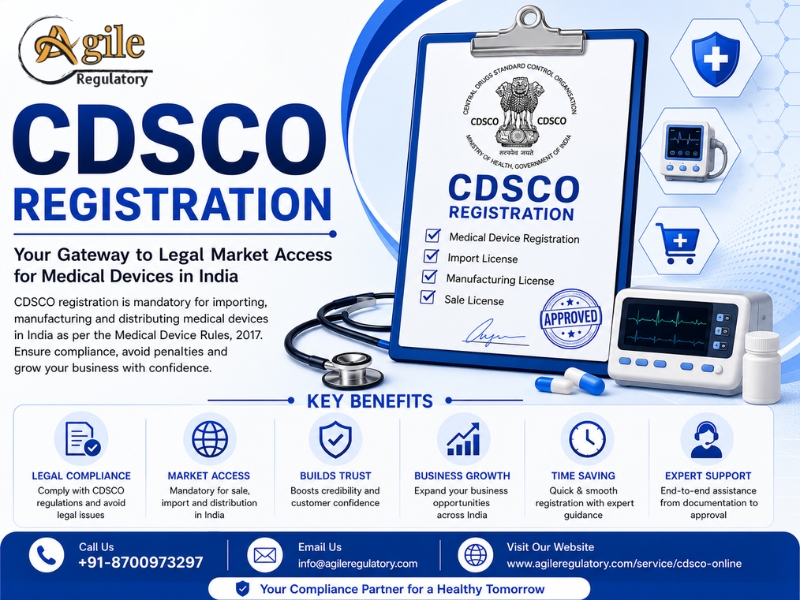
What is CDSCO Registration of Medical Devices?
CDSCO Registration of Medical Devices is the approval process through which manufacturers and importers obtain permission to manufacture, import, or distribute regulated medical devices in India.
CDSCO functions under the Directorate General of Health Services (DGHS), Ministry of Health and Family Welfare, and acts as the national regulatory authority for pharmaceuticals and medical devices.
The registration process evaluates whether a medical device meets the required standards of safety, quality, and performance before it reaches healthcare professionals and patients.
Why is CDSCO Registration Important?
CDSCO registration is essential for ensuring public health and regulatory compliance.
Some major benefits include:
Legal authorization to manufacture or import medical devices.
Compliance with the Medical Devices Rules, 2017.
Improved product credibility.
Increased customer and healthcare provider confidence.
Easier market access across India.
Reduced regulatory risks.
Better opportunities for government procurement.
Enhanced business reputation.
Medical devices without the required registration may be prohibited from being manufactured, imported, or sold in India.
Who Needs CDSCO Registration?
CDSCO registration is generally required for:
Indian Manufacturers
Companies manufacturing notified medical devices for sale in India.
Foreign Manufacturers
International manufacturers exporting medical devices to India through an Authorized Indian Agent.
Importers
Businesses importing notified medical devices into India.
Authorized Indian Agents
Indian representatives appointed by foreign manufacturers for regulatory compliance.
Distributors and Brand Owners
Businesses dealing with regulated medical devices may also require compliance depending on their business activities.
Classification of Medical Devices
Medical devices are classified according to their risk level.
Class A
Low-risk medical devices.
Examples include surgical dressings and simple medical instruments.
Class B
Low to moderate-risk devices.
Examples include hypodermic needles and suction equipment.
Class C
Moderate to high-risk devices.
Examples include infusion pumps and orthopedic implants.
Class D
High-risk medical devices.
Examples include heart valves, pacemakers, and implantable medical devices.
The registration process varies depending on the classification of the medical device.
Documents Required for CDSCO Registration
Applicants generally need the following documents:
Certificate of Incorporation
PAN Card
GST Registration Certificate
Manufacturing License (if applicable)
Import Export Code (IEC) for importers
Device Master File (DMF)
Plant Master File (PMF)
ISO 13485 Certificate
Free Sale Certificate (for imported devices)
CE Certificate/FDA Approval (if applicable)
Power of Attorney (for foreign manufacturers)
Authorized Indian Agent Agreement
Product Specifications
Product Labels and Packaging Details
Test Reports
Clinical Evaluation Data (where applicable)
Declaration and Undertakings
The exact documentation depends on the medical device category and applicable CDSCO requirements.
CDSCO Registration Process for Medical Devices
The registration process generally includes the following steps:
Step 1: Device Classification
Determine the risk classification of the medical device.
Step 2: Document Preparation
Prepare technical documents, quality certificates, and regulatory records.
Step 3: Online Registration
Create an account on the CDSCO SUGAM Portal and submit the online application.
Step 4: Upload Required Documents
Attach all supporting documents along with the application.
Step 5: Application Review
CDSCO reviews the submitted information and technical documentation.
Step 6: Query Resolution
Respond to any clarification requests raised by CDSCO.
Step 7: Registration Approval
After successful evaluation, CDSCO grants the required registration or license.
Benefits of CDSCO Registration
Obtaining CDSCO registration provides several business advantages:
Legal compliance.
Improved market acceptance.
Enhanced customer confidence.
Better business opportunities.
Access to government tenders.
Increased product credibility.
Reduced compliance risks.
Smooth import and manufacturing operations.
Registered medical devices gain greater acceptance among hospitals, healthcare institutions, and distributors.
Common Challenges During Registration
Many applicants face delays because of:
Incorrect device classification.
Incomplete technical documentation.
Errors in application forms.
Missing quality certificates.
Delayed responses to CDSCO queries.
Improper product labeling.
Non-compliance with Medical Devices Rules.
Professional consultancy helps avoid these common issues.
Why Choose Agile Regulatory?
Agile Regulatory is a trusted regulatory consultancy specializing in CDSCO Registration of Medical Devices across India. Our experienced professionals provide complete regulatory support to manufacturers, importers, and Authorized Indian Agents.
Our services include:
Medical device classification assistance
Eligibility assessment
Documentation preparation
Device Master File (DMF) preparation
Plant Master File (PMF) preparation
CDSCO SUGAM Portal registration
Online application filing
Regulatory consultation
Query handling
License approval assistance
Import license support
Post-registration compliance services
At Agile Regulatory, we understand the complexities of medical device regulations and provide customized compliance solutions to help businesses obtain approvals quickly and efficiently. Our dedicated team ensures complete transparency, timely communication, and end-to-end regulatory support throughout the registration process.
Conclusion
CDSCO Registration of Medical Devices is a mandatory requirement for manufacturers and importers dealing with regulated medical devices in India. It ensures that medical devices meet the required standards of quality, safety, and performance while protecting public health.
By obtaining CDSCO registration, businesses can legally market their products, enhance their reputation, and expand their presence in the Indian healthcare industry. Partnering with Agile Regulatory ensures a smooth registration process, accurate documentation, timely approvals, and complete compliance with CDSCO regulations.
Frequently Asked Questions (FAQs)
1. What is CDSCO Registration for Medical Devices?
CDSCO Registration is the regulatory approval required for manufacturing or importing notified medical devices in India.
2. Is CDSCO registration mandatory for all medical devices?
Registration is mandatory for notified medical devices regulated under the Medical Devices Rules, 2017.
3. Who can apply for CDSCO registration?
Indian manufacturers, foreign manufacturers through Authorized Indian Agents, and importers can apply, depending on the product category.
4. How long does the CDSCO registration process take?
The timeline depends on the device classification, document completeness, and CDSCO review process.
5. How can Agile Regulatory help with CDSCO registration?
Agile Regulatory provides end-to-end assistance, including device classification, documentation, online application filing, regulatory consultation, query handling, and post-registration compliance support.




