
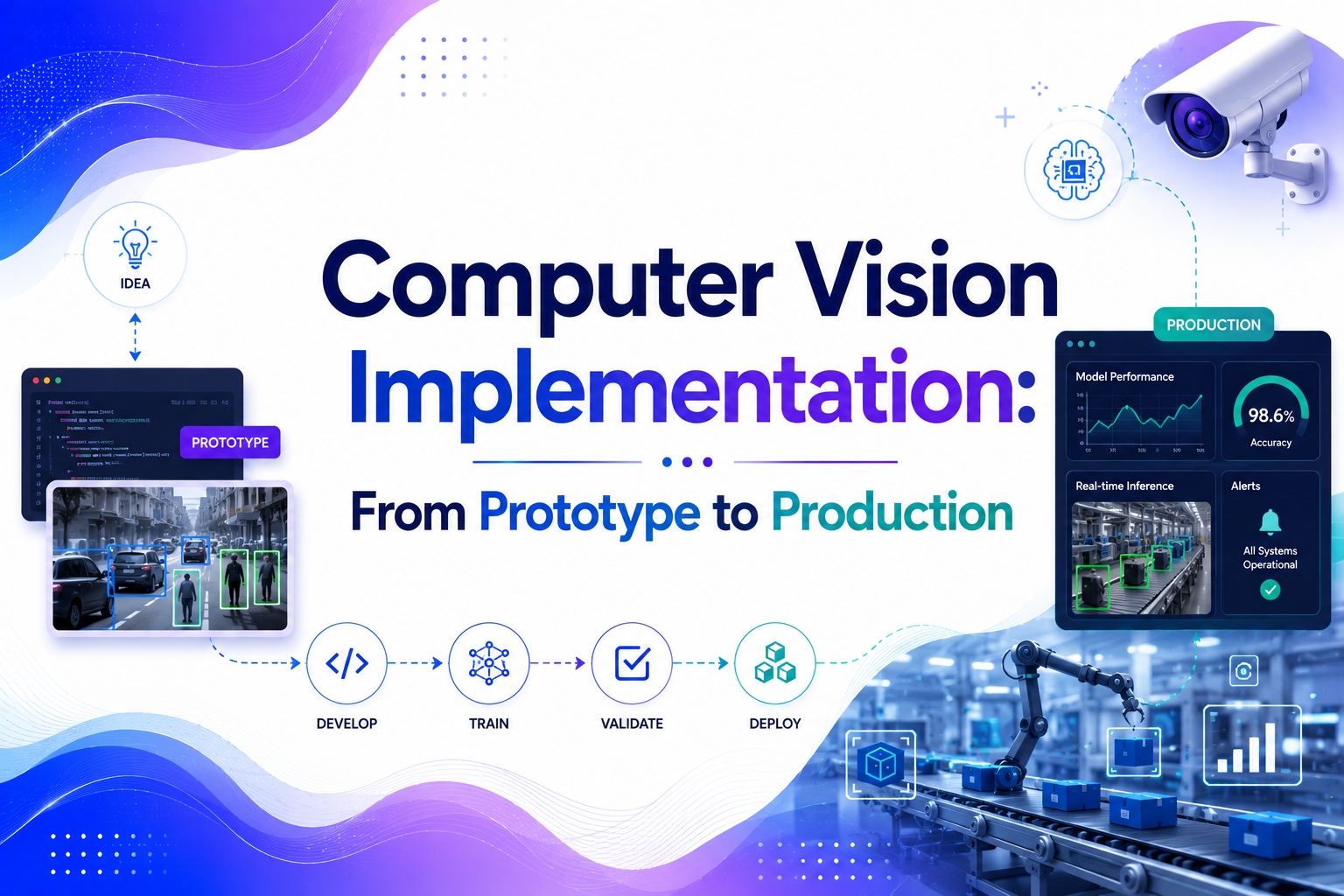
Computer vision has evolved from an experimental technology branch into a practical tool serving a variety of fields — from automating processes to contributing to healthcare, security, and business intelligence decisions. But having a working prototype is only half the battle. Real-world applications of computer vision require a model to perform consistently well on different data, in different environments, and with different infrastructural and business constraints.
This article lists key considerations for turning a proof-of-concept computer vision model into a reliable production system.
1. Define the Business Requirements Before Model Building
Computer vision applications always exist to solve a particular business problem or support specific business objectives. Before building the system, it is vital to identify its purpose. For example, a computer vision application for manufacturing may be built to observe and report defects in products on a conveyor belt. However, the business requirement would be to reduce the number of defective items reaching the consumers while ensuring the production process is not disrupted.
The following factors should be evaluated during this step:
What visual challenge does the system have to resolve?
What degree of accuracy is acceptable?
How quickly do the predictions need to be made?
In what environment and infrastructure will the system reside?
What business process will be affected by the computer vision predictions?
These requirements will be critical in identifying requirements for the prototype or initial proof-of-concept.
2. Build a Practical Prototype
The prototype development stage exists to prove that the technology can resolve the stated business challenge. During this step, a representative sample of the data is prepared and preprocessed, and a computer vision model is trained and evaluated. The model can be based on a range of underlying tasks, including image classification, object detection, image segmentation, OCR, or visual anomaly detection, depending on the requirements.
Once the prototype is ready, it should be used to answer practical questions, such as whether the available images contain sufficient information for the task at hand and whether the chosen model architecture and training approach are viable. Some implementations also make use of this prototype to assess whether there are adequate resources to support the selected solution.
It is important to note, however, that the prototype accuracy is rarely indicative of the production system's accuracy. A model trained on a small sample of highly curated images may behave very differently when exposed to a wider range of lighting conditions, camera perspectives, distortions, objects, and environments. Teams leveraging professional AI app development services during this phase can ensure the prototype is structured with production readiness in mind from the outset.
3. Prepare Production Data
The data used to train and evaluate a computer vision model is often its weak link. Production data will almost certainly be more diverse and less consistent than the carefully curated training data subset. Therefore, the data preparation pipeline should be able to handle images captured under different lighting conditions and angles, various backgrounds, and differing levels of image quality and resolution.
It is advisable to build a robust production data pipeline, including data labeling and augmentation, training/validation/test set creation, and difficult example mining, to ensure model accuracy and reliability. The performance of the model during production will depend on the quality and breadth of training data. In particular, if the production data differs significantly from the data used to train the model, even minor accuracy drops can have severe practical consequences.
4. Optimize the Model
When building a production computer vision system, it is essential to optimize the model based on the selected performance metrics. Accuracy is not the sole consideration — latency, memory footprint, and hardware requirements also need to be taken into account. In some cases, it may not be worth increasing the model accuracy if the changes lead to significantly higher computational or memory requirements.
For real-time applications, latency can become an even more critical consideration. A computer vision model that takes too long to produce predictions for each image can actually negatively impact the business objectives. For example, a manufacturing application that needs to inspect hundreds of items per minute cannot afford to slow down the conveyor belt to make predictions. Specialized computer vision services can help teams identify the right optimization strategies — from model quantization to hardware-specific inference tuning — without sacrificing accuracy beyond acceptable thresholds.
5. Integrate the Solution Into the Business Workflow
Computer vision applications are rarely standalone solutions, meaning they must be integrated into the existing infrastructure and systems understood and used by company employees. It is important to make the application or model accessible via APIs or an event bus where relevant, depending on the technical capabilities of the existing systems. Computer vision systems can also be deployed on edge servers if the network bandwidth or latency is insufficient or if privacy regulations forbid storing images in centralized repositories.
For example, a retail application may need to share inventory-related observations with a separate inventory management system using an API, while an industrial application may need to send predictions about manufacturing defects directly to a quality control database. Engaging professional AI development services at this stage ensures the integration is architected to meet both technical standards and compliance requirements.
6. Deploy the Solution on a Suitable Infrastructure
The computer vision application must be deployed on an appropriate infrastructure that takes into account the predicted image resolution, latency, and volume. Considerations around networking and hardware capabilities are also relevant here. The deployment infrastructure should also be sized correctly to handle the expected traffic.
The following elements should be considered when designing the infrastructure for a computer vision application:
Automated model deployment
Containerization
Load balancing
Infrastructure monitoring at scale
Version management
Hardware utilization tracking
It is vital to design fault tolerance into the system at this stage. If any of the elements in the computer vision application fail — for example, a particular camera or a server that receives and processes images — there must be an appropriate response, such as switching to an alternative camera or suspending predictions.
7. Monitor, Test, and Maintain the System
Production systems for computer vision applications should continuously be monitored for business and technical performance. Business metrics would include elements such as accuracy, latency, and utilization — essentially, everything that reflects how well the application contributes to the business objectives. Technical metrics would involve such aspects as the system's availability and error rates.
It is also essential to look at the application's accuracy trends — for example, whether the prediction accuracy is degrading over time due to model drift. Regular tests should also be conducted to verify that the application can still function correctly and reliably under a variety of different conditions.
A mature maintenance process should also include regular data validation and retraining cycles rather than deploying an entirely new model. Maintenance and model updates should be done regularly and predictably to ensure that the computer vision application continues to operate reliably. Organizations working with providers of artificial intelligence development services benefit from structured maintenance frameworks that cover model drift detection, automated retraining triggers, and performance benchmarking as standard practice.
8. Scale the Application
If the application has met its business objectives successfully, it may be useful to scale the system to include more cameras, locations, objects, or products. It is vital to keep careful track of production performance and regularly compare it to the initial requirements. A successful system should be able to fulfill the minimum requirements stated at the beginning of the project.
Ultimately, an effective computer vision application should become an intrinsic part of the business operations rather than a standalone experiment. This will likely require collaboration between different teams, such as business analysts, data scientists, software developers, and IT administrators.
Conclusion
By developing a working prototype, preparing production data, optimizing and deploying the model, integrating it into the existing systems, and continually maintaining and improving it, businesses can successfully implement a production computer vision application that fulfills its business objectives. Each step in this process builds on the last — ensuring the final system is not only technically sound but deeply aligned with real operational needs.



