
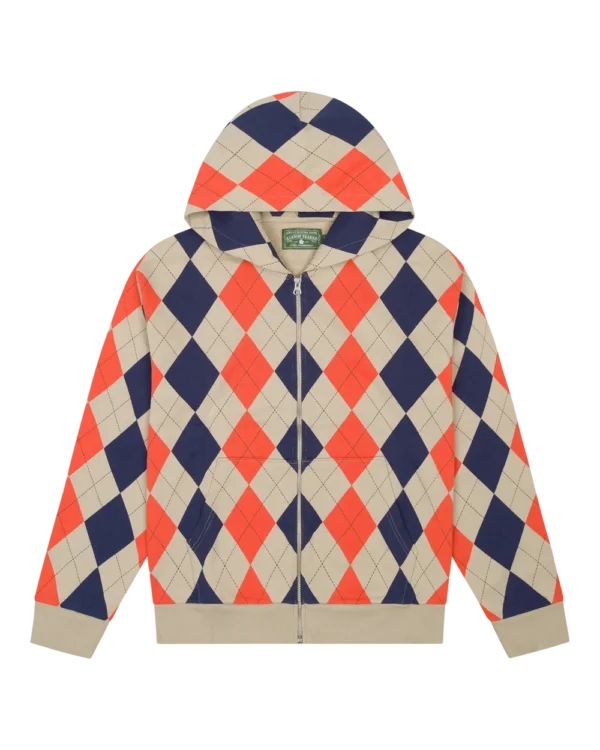
Denim Tears isn't just a clothing brand. It's a history lesson you can wear.
If you've spotted those haunting white cotton wreaths on denim jackets and sweatpants across city streets, you've witnessed something rare in fashion: a label that makes you feel something before you even know what it stands for. That gut reaction? That's the point.
Founded in 2019 by Tremaine Emory, Denim Tears has built a reputation for transforming painful chapters of Black American history into garments that speak volumes without saying a word. And somehow, it's become one of the most coveted names in streetwear while doing it.
This isn't a brand that chases trends. It's a brand that forces you to confront them.
What Exactly Is Denim Tears?
Denim Tears is an American fashion label and creative platform launched by Tremaine Emory in 2019—marking 400 years since the first enslaved Africans arrived in America . The name itself carries weight: denim represents the fabric woven into American labor history, while "tears" acknowledges the human suffering behind that industry.
Emory, born in Atlanta in 1981 and raised in Jamaica, Queens, didn't come to fashion as an outsider. He built his reputation through No Vacancy Inn, a creative collective he co-founded with Ade "Acyde" Odunlami and Brock Korsan, and through high-profile collaborations with Virgil Abloh, Frank Ocean, and André 3000 . He later served as creative director of Supreme before departing in 2023 .
But Denim Tears is his most personal statement. Every collection tells a story that reveals another facet of the African Diaspora, using clothing as what Emory calls a "trojan horse" for cultural education .
The Cotton Wreath: A Symbol You Can't Ignore
The cotton wreath is Denim Tears' signature motif. You've seen it: that ring of white cotton bolls, often printed boldly across denim jackets, jeans, hoodies, and sweatpants.
For Emory, this isn't decoration. It's a direct reference to the cotton plantations where enslaved Black Americans were forced to labor, producing the wealth that built much of America's early economy . The wreath itself—a circular arrangement traditionally associated with celebration and honor—becomes a radical reclamation when applied to cotton, transforming a symbol of oppression into one of resilience and remembrance .
Emory discovered the motif through artist Kara Walker's Instagram and recognized its power immediately . What started as a graphic on a Levi's 501 became the brand's defining image.
The Levi's Collaboration That Changed Everything
Denim Tear partnership with Levi's represents one of fashion's most meaningful collaborations. Launched in 2020, the first collection featured the Cotton Wreath motif on classic Trucker Jackets, 501 jeans, and plantation hats—garments that carry their own historical weight in the American South .
The collaboration wasn't just about putting graphics on denim. It was about reclaiming a garment deeply associated with American labor history and infusing it with a narrative that had been deliberately obscured.
Each subsequent Levi's drop explored different chapters of Black American history:
Season 2 honored the Gullah Geechee people, whose indigo dyeing skills shaped the workwear industry under enslavement . Season 3 explored Black biker culture through Martin Dixon's book Brooklyn Kings . Most recently, the collaboration celebrated the Black Maskers of New Orleans—the Mardi Gras Indians whose elaborate costumes represent a unique intersection of African, Indigenous, and French cultural influences .
Beyond Denim: Denim Tears' Cultural Collaborations
Emory has been selective about partnerships, choosing only brands he believes can authentically support his mission . The results have been consistently powerful.
Converse became a canvas for a print inspired by Marcus Garvey's Pan-African flag and David Hammons' African-American Flag, a project that became intertwined with the 2020 racial justice protests . Dior invited Emory to guest-design a capsule collection that paid tribute to James Baldwin and Miles Davis while referencing Black Ivy League style of the 1950s and '60s . ASICS shoes carried "dirty" markings referencing the red clay roads of Emory's childhood in Georgia .
Dr. Martens became a platform for exploring the Windrush generation—Caribbean people who emigrated to postwar Britain only to face discrimination and wrongful deportation . Even Lauryn Hill joined the fold for a 2026 collaboration that merged two cultural forces into one statement .
The Business of Meaning
Here's what makes Denim Tears Clothing genuinely unusual: it built a multimillion-dollar business without investors, without traditional wholesale distribution, and with only one retail partner—Dover Street Market—where it operates on a concession model .
According to the brand, Denim Tears generates "tens of millions" in annual revenue and has doubled sales every year since its founding . On StockX, sales grew 290 percent in 2024 compared to the previous year, and products sold for 31 percent above retail on average in the first half of 2025 .
The brand opened its first flagship, African Diaspora Goods, in New York City in 2023, followed by a second location in Atlanta . A Tokyo store is planned for 2026, with eventual expansion to Chicago, Houston, Philadelphia, Portland, and Los Angeles on the horizon .
Why Denim Tears Matters for American Culture
In a fashion landscape saturated with logos and empty hype, Denim Tears stands apart because it asks something of its wearers. When you put on a Cotton Wreath hoodie, you're not just making a style choice. You're carrying a story.
Tremaine Emory has been criticized by some who see his work as commercializing Black trauma . His response is characteristically direct: "When I'm making these collections, the only thing that's provocative to me is that these things haven't been talked about before. That's the real provocative thing to me, the lack of knowledge" .
That perspective resonates with customers who want their purchases to align with their values. As Jonathan M. Square, an assistant professor of Black visual culture at Parsons School of Design and a Denim Tears customer, put it: "We're in a moment where people want to support a project and a brand that's aligned with their values" .
The brand's cultural impact has been recognized by institutions that matter. Denim Tears pieces are now part of the permanent collection at The Metropolitan Museum of Art's Costume Institute, featured in exhibitions like "Superfine: Tailoring Black Style" and "America: A Lexicon in Fashion" . In 2026, the SCAD Museum of Art opened "Denim Tears From the Black Pool of Genius," the first solo exhibition dedicated to Emory's work .
How to Wear Denim Tears
Denim Tears pieces are designed to be worn, not preserved. The signature Cotton Wreath jeans and jackets work best when styled with intention—paired with simple basics that let the motif speak. The brand's sweatsuits, available in garment-dyed blacks, greys, and purples, have become a staple of what some call "clean cani" styling: elevated comfort with cultural substance .
Sizing note: Denim Tears denim generally runs true to size. However, raw denim versions may shrink after the first wash, so consider sizing up if you plan to wash them . The brand's sweatshirts and hoodies have a relaxed, comfortable fit.
Top 10 FAQs About Denim Tears
1. Who founded Denim Tears? Tremaine Emory founded Denim Tears in 2019 .
2. What does Denim Tears mean? The name references denim fabric and the tears shed by enslaved people who produced cotton and indigo .
3. What is the Cotton Wreath? It's the brand's signature motif—a wreath of cotton bolls symbolizing the history of slavery and Black resilience .
4. Is Denim Tears a Black-owned brand? Yes, it was founded by Tremaine Emory, a Black American designer .
5. Where is Denim Tears sold? Primarily through its own website, flagship stores in New York and Atlanta, and Dover Street Market .
6. Does Denim Tears run true to size? Yes, generally, though raw denim may shrink after washing .
7. What's the most popular Denim Tears item? The Cotton Wreath denim jacket and 501 jeans from the Levi's collaboration are the brand's most iconic pieces .
8. Is Denim Tears a streetwear brand? It's rooted in streetwear but operates more as an art platform using clothing as its medium .
9. Why is Denim Tears so expensive? The brand uses premium materials, limited production runs, and positions itself as a cultural art project rather than mass-market fashion .
10. What collaborations has Denim Tears done? Levi's, Dior, Converse, ASICS, Dr. Martens, Stüssy, Marc Jacobs, and others .
The Bottom Line
Denim Tears proves that fashion can be both commercially successful and culturally meaningful. It doesn't ask you to choose between style and substance—it demands both.
Whether you're drawn to the clean lines of a Cotton Wreath hoodie or the historical weight behind the brand's collaborations, wearing Denim Tears means participating in a conversation that America has too often avoided.

