Businesses engaging in the importation or exportation of goods in India typically require an Import Export Code (IEC), issued by the Directorate General of Foreign Trade (DGFT).
It's important to know that DGFT registration and a DGFT licence are two different things. An IEC is usually the first step for most businesses engaged in import-expor tactivities. Additional registrations, permissions or authorisation still might be necessary, given the product, the trade policies and the kinds of the transactions being done.
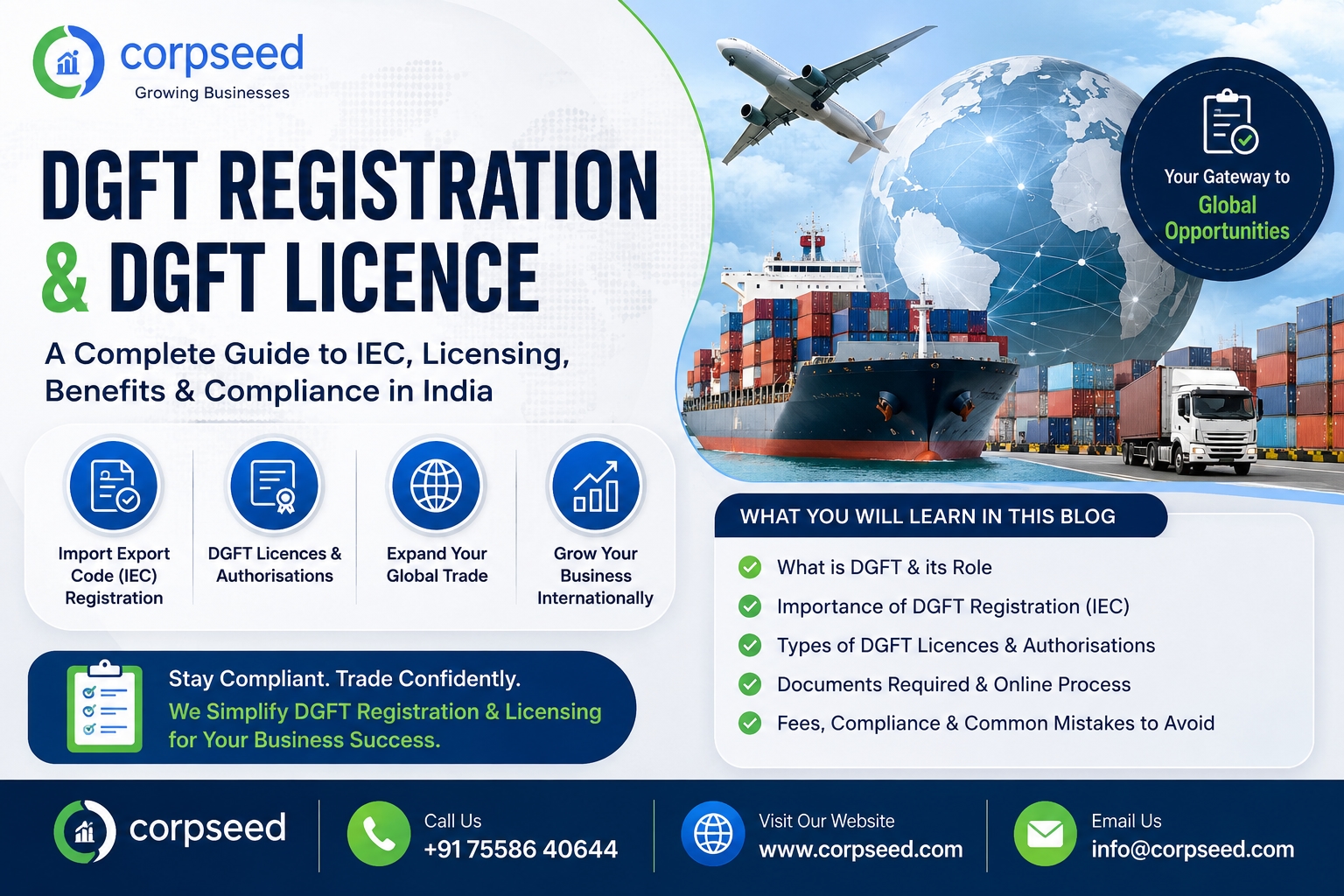
If you've been wondering about what DGFT is, the significance of IEC, the need for it, and so on, this article will provide the answers. You will get to know what DGFT licensing entails, and who qualifies for it; the list of documents to be submitted, online procedures, and fee charges. It will also throw light on extra DGFT permissions and requirements for compliance after the registration. And, it will point out the types of mistakes usually avoided, which will be very helpful to the reader.
What Is DGFT
DGFT stands for Directorate General of Foreign Trade. It is an organisation under the Ministry of Commerce & Industry, Government of India, responsible for administering India's foreign trade policy.
DGFT facilitates international trade through measures such as:
Issuing Import Export Codes (IEC)
Implementing provisions of the Foreign Trade Policy
Granting certain export and import authorisations
Administering applicable export promotion schemes
Regulating restricted or controlled imports and exports
Providing online services for exporters and importers
The official DGFT portal allows businesses to apply for and manage various foreign-trade-related services online.
What Is DGFT Registration
The term "DGFT registration" is commonly used to describe registration with DGFT and, particularly, obtaining an Import Export Code (IEC).
An IEC is generally required for a person or entity undertaking import or export of goods, subject to applicable exemptions under the Foreign Trade Policy and related regulations.
Why Is DGFT Registration Important
Acquiring and maintaining the relevant DGFT registration or authorisation will enable businesses to carry out international trade in accordance with India’s foreign-trade regulations.
Some of the benefits of DGFT registration include:
1. Enabling Import and Export of Goods
IEC is required to import and export goods, with the exception of certain goods that are exempt.
2. Facilitating Customs and Trade Documentation
IEC is required to be quoted in customs and other trade documents pertaining to import and export of goods.
3. Access to Relevant Export Incentive Schemes
DGFT authorisations and schemes can be availed of by eligible exporters, subject to their specific conditions and obligations.
4. Facilitating International Trade
IEC number along with relevant authorisations enables businesses to participate in international trade.
5. Online Application and Management
DGFT offers online services for applying and managing various foreign-trade related services.
Who Needs an IEC
An IEC is generally required by persons or entities importing or exporting goods from India.
This may include:
Manufacturers exporting their products
Merchant exporters
Importers sourcing products from overseas
E-commerce businesses involved in international trade
Traders involved in cross-border goods transactions
Businesses importing machinery, components or raw materials
Export-oriented businesses
Are There Exceptions
Yes. The Foreign Trade Policy and DGFT regulations provide certain exemptions from the IEC requirement in specified circumstances.
Therefore, businesses should not assume that every cross-border transaction automatically requires an IEC. The requirement depends on the nature of the transaction and applicable rules.
Types of DGFT Authorisations and Registrations
There is no single "DGFT licence" that applies to each and every exporter or importer. Different types of autorization serve different purposes:
1. Import Export Code (IEC)
IEC is the main identification code of any eligible importer or exporter.
Purpose: It identifies an importer or exporter of goods for foreign trade.
2. Advance Authorisation
Advance Authorisation allows duty-free imports of inputs used in the manufacturing of export goods subject to fulfilment of conditions and export obligations.
Purpose: To enable the duty free import of the eligible inputs required for export production.
3. EPCG Authorisation
The Export Promotion Capital Goods (EPCG) Scheme allows import of specified capital goods against an export obligation.
Purpose: To assist exporters in upgrading production facilities.
4. Product-Specific Registrations or Permissions
Some products may have additional restrictions for import and export, and hence may need registrations or permissions.
Such requirements may change constantly with new government notifications or amendments in the Foreign Trade Policy.
Hence, it is essential to verify the compliance requirements of the specific product before importing or exporting it.
Which Products May Require Additional DGFT Permissions
Products classified as restricted, prohibited, regulated or subject to special conditions may require additional authorisation or compliance.
Depending on current policy, additional requirements can apply to areas such as:
Certain agricultural commodities
Chemicals
Pharmaceuticals
Medical products
Steel products
Electronics
Telecommunications equipment
Dual-use goods
Defence-related items
Other restricted or controlled products
The requirement should be determined using the applicable ITC(HS) classification and current DGFT policy conditions.
DGFT Post-Registration Compliance
Obtaining an IEC is not necessarily the end of your compliance responsibilities.
Businesses should ensure that their DGFT information remains accurate and that they comply with applicable trade requirements.
Key areas to monitor include:
Updating business information when required
Maintaining correct bank account details
Keeping IEC information current
Complying with applicable export/import conditions
Meeting obligations attached to specific authorisations
Maintaining transaction and supporting records
Complying with customs, GST and other applicable laws
Completing required declarations or filings within prescribed timelines
Annual IEC Update
IEC holders should pay attention to the annual IEC updation requirement prescribed by DGFT and complete the applicable update within the prescribed period.
The exact process and deadlines should be checked on the DGFT portal for the relevant year.
What Happens If You Do Not Comply With DGFT Requirements
Non-compliance can have significant consequences depending on the nature and seriousness of the violation.
Possible consequences may include:
Regulatory action
Penalties under applicable laws
Suspension or cancellation of an authorisation
Delay or rejection of applications
Restrictions on certain trade benefits
Customs-related action
Recovery of applicable duties or amounts
Other action prescribed under the Foreign Trade (Development and Regulation) Act, Foreign Trade Policy or related regulations
The consequence depends on the specific violation. Businesses should therefore assess compliance requirements before beginning regulated import or export activities.
DGFT Registration vs IEC: What's the Difference
Particular | DGFT Registration | IEC |
|---|---|---|
Meaning | Commonly used term for registration/services under DGFT | Import Export Code |
Issuing authority | DGFT | DGFT |
Primary purpose | Access to applicable DGFT trade services | Identification of eligible importers/exporters |
Applies to | Depends on the service/authorisation | Generally required for import/export of goods, subject to exemptions |
Additional authorisation | May be required for specific products/schemes | Does not replace product-specific licences |
Validity/compliance | Depends on the specific service | Subject to applicable IEC compliance requirements |
Bottom line: An IEC should not be treated as a universal substitute for every import/export licence or product-specific permission.
DGFT Licence vs IEC: Which One Does Your Business Need
The answer depends on what you are importing or exporting.
If you are exporting ordinary goods:
You may generally need an IEC along with other applicable business, customs and product-related compliances.
If you are importing restricted goods:
You may need an IEC plus a specific authorisation or registration applicable to that product.
If you want to use a DGFT export promotion scheme:
You may need the relevant authorisation and must comply with its specific conditions and obligations.
If you export services:
The regulatory framework can differ from the requirements applicable to goods. An IEC is not automatically required for every service-export transaction; applicable exemptions and current regulations should be checked.
Common Mistakes Businesses Make During DGFT Registration
1. Treating IEC as a Product Licence
IEC identifies an importer/exporter. It does not mean that any product can be imported/exported by him/her.
2. Ignoring HS/ITC(HS) Classification
Wrong classification may result in wrong assumption of being freely importable/exportable/restricted and subject to additional conditions, etc.
3. Using Outdated DGFT Information
As per foreign-trade policy and notifications, new procedures are regularly notified by DGFT. The information available on various articles published earlier may be out-dated.
4. Missing Out on IEC Compliance
Businesses must stay updated with DGFT notifications and requirements related to IEC.
5. Assuming One-stop-shop Registration
Depending upon products/services proposed to be imported/exported, one may also need to get registered with other authorities like Customs, GST, FSSAI, CDSCO, BIS, WPC, environment clearances etc. besides IEC.
How Corpseed Can Help With DGFT Compliance
Corpseed assists businesses with regulatory and compliance requirements relating to import-export activities.
Our support can include:
IEC application and related services
IEC updation and compliance support
DGFT application assistance
Advance Authorisation support
EPCG-related assistance
Product-specific import/export compliance
Documentation and application preparation
Regulatory consultation
Post-approval compliance support
Our approach focuses on understanding the business activity, identifying the applicable regulatory requirements and supporting the documentation and application process.
Important: The exact registration, authorisation and compliance requirements depend on the applicant, product, transaction and current government regulations.
Frequently Asked Questions
What is DGFT registration?
DGFT registration usually means getting registered with the Directorate General of Foreign Trade, and getting services such as the Import Export Code. What type of registration or authorisation you will need for DGFT depends on your particular purpose for imports/exports.
What is IEC?
IEC stands for Import Export Code. It is a unique code allocated by DGFT, which generally needs to be provided while importing or exporting goods, subject to exemptions.
Is IEC mandatory for import and export?
IEC registration is generally required to make or receive imports or exports of goods from/to India, subject to exemptions.
Is IEC different from DGFT Licence?
IEC is an Importer/Exporter Code, while there are various other licences or authorisations which may be required for specific activities relating to imports/exports.
How can I apply for IEC?
IEC can be applied for electronically on the DGFT website. The application needs to be completed by providing the required information, documents and fees.
What is the fee for obtaining IEC?
The appropriate Government fee is prescribed by DGFT for various IEC-related applications. You are advised to check the DGFT website for the latest details relating to fees.
Is DSC mandatory for DGFT registration?
Depending on the type of service, a DSC (Digital Signature Certificate) may or may not be required. The requirement for a DSC depends on the particular service and its application process, and it is best to refer to the DGFT website for the most current information.
Does IEC expire?
While an IEC is generally not a licence, it must continue to meet the requirements prescribed by DGFT to remain valid, including annual fee payments, if applicable.
Can I use my IEC to import or export restricted goods?
The ability to import or export restricted or controlled goods using an IEC depends on the specific items and permissions, as IECs alone do not provide authorisation for such transactions.
Does a service exporter need an IEC?
Depending on the type of service export and whether they are exempt, an IEC may be required. It is best to research the latest DGFT guidelines and foreign exchange rules for service exports.
What happens if I applied incorrectly for DGFT?
Depending on the application, you may need to update or correct the information, submit additional documents or clarify any queries from the authorities. It is best to deal with an error as soon as possible to avoid processing delays.
Need Help With IEC or DGFT Compliance
Starting international trade involves more than obtaining an IEC. Your business may also need product-specific approvals, customs registrations, tax compliances, export authorisations or other regulatory permissions.
Corpseed can help you identify the applicable requirements and manage the documentation and application process.
Talk to an Expert Advisor today to understand the DGFT and import-export compliances applicable to your business.
Also Read: https://www.corpseed.com/service/dgft-restricted-import-license-gas-industrial-gas-lpg