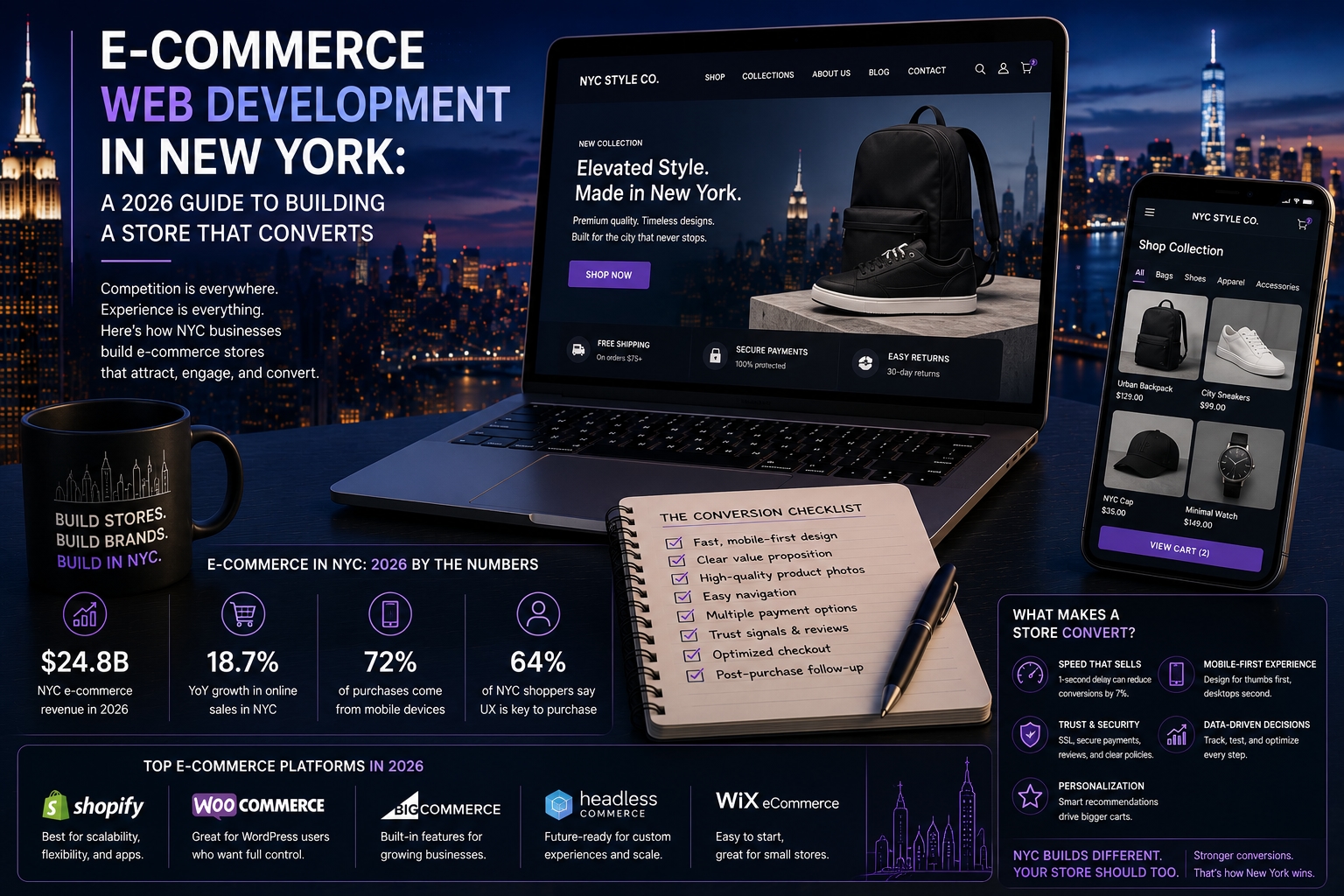
Here's a number that should stop every online retailer in their tracks: roughly 70% of shopping carts are abandoned before checkout completes, according to Baymard Institute's analysis of 50 separate studies, a figure that's barely moved in over a decade despite massive advances in payment technology and site design. If you're running an online store and wondering why traffic isn't translating to revenue, this is very likely where the money is disappearing.
For New York businesses building or rebuilding an online store in 2026, understanding exactly where and why that abandonment happens is the difference between a store that grows and one that just generates traffic.
The Mobile Problem Is Bigger Than Most Retailers Realize
Mobile commerce now represents roughly 73% of all e-commerce traffic, yet mobile cart abandonment sits at nearly 77%, compared to about 65% on desktop, a 12-point gap that's actually widening, according to 2026 e-commerce data. Desktop conversion rates run more than double mobile in some studies, 4.8% versus 2.1%, which is a striking gap given how much traffic mobile actually drives.
The reason is almost always friction: 45% of mobile shoppers cite forms that are too difficult to fill out as a reason for abandoning their cart, according to Baymard's mobile UX research. If your checkout wasn't specifically designed for a thumb on a small screen, you're very likely losing sales you don't even know you're losing.
What Actually Reduces Abandonment
The data is unusually clear on what works:
One-page checkout reduces abandonment by roughly 20% by removing the anxiety of a multi-step process, according to 2026 UX research.
Guest checkout is close to non-negotiable; 24% of shoppers abandon specifically because they're forced to create an account before purchasing.
Digital wallets cut mobile checkout time from over 2 minutes to about 12 seconds, dramatically reducing the window for someone to change their mind.
Buy Now, Pay Later options reduce abandonment by roughly 20% on orders over $100, and by closer to 29% for shoppers aged 18–34.
A 0.1-second improvement in mobile page speed can lift retail conversion by roughly 8%, according to Google's own research.
None of these are radical redesigns. They're specific, measurable fixes, which is exactly why they're worth prioritizing over a full rebuild if your current site is already functional but underperforming. If you're further along and considering a dedicated shopping app on top of your site, a web development agency New York teams have already shipped products can tell you honestly whether your traffic and repeat-purchase rate actually justify that investment yet.
Why New York E-Commerce Businesses Can't Just Copy a Generic Playbook
New York shoppers move fast and compare constantly; there's a reason "showrooming" (browsing in-store, buying online for a better price) originated in dense retail markets like this one. Your online store isn't just competing with other websites; it's competing with the physical storefront three blocks away and the marketplace listing someone's comparing you against in real time.
That means speed and trust signals matter more here than in a slower-moving market. A store that loads slowly or feels unpolished doesn't just lose the sale; it actively damages the brand comparison happening in that moment.
Building It Right the First Time
This is where a capable development partner earns its cost back quickly; checkout friction is one of the highest-ROI things to get right, precisely because fixing it doesn't require more traffic or ad spend, just a better-built store. It's also worth thinking beyond the website itself: a growing number of NYC retailers are pairing their store with a companion shopping app to capture repeat customers through push notifications and saved payment info, which is where working with an established web development agency New York retailers trust becomes relevant. WMD has taken a mobile shopping experience from initial concept through to a fully launched product for a past client, which means they've dealt firsthand with exactly this kind of checkout and conversion friction, not just in theory, but in a live build. If your current store is generating traffic that isn't converting, it's worth having WMD run an audit before you spend more on ads chasing the same leaky funnel.
The Math That Makes This Worth Fixing
Consider a store doing $100,000 a month with a 70% checkout abandonment rate. Reducing that to 50% through UX improvements alone, no additional traffic, no additional ad spend, could theoretically unlock tens of thousands of dollars in additional monthly revenue, based on current e-commerce optimization research. That's the case for treating checkout UX as a growth lever, not a cosmetic afterthought, and it's the same math a good web development agency New York retailers work with will walk you through before recommending an app instead of just a better-optimized site.
A Practical Starting Checklist
Test your own checkout on a phone, start to finish, today. Time it. Count the taps.
Remove forced account creation, offer guest checkout as the default path.
Add at least one digital wallet option (Apple Pay, Google Pay) to cut checkout time dramatically.
Check your mobile page speed; even small improvements compound into real conversion gains.
Audit your cart recovery flow; a simple email or SMS sequence recovers more abandoned revenue than none at all.
FAQs
Is a 70% cart abandonment rate actually normal, or is something wrong with my store?
It's within the documented industry average, so don't panic, but it also means there's real, provable room for improvement, not that it's an unsolvable problem. Even a modest reduction translates directly into revenue without spending more on traffic.
Should I rebuild my entire store or just fix checkout?
Start with checkout and mobile usability specifically; they tend to offer the fastest, most measurable return. A full rebuild makes sense if your platform itself is limiting you technically, but many stores can significantly improve conversion without a ground-up rebuild.
Does requiring an account actually hurt sales that much?
Yes, roughly a quarter of shoppers abandon specifically because of forced registration, according to UX research. Offering guest checkout as the default, with account creation as an optional post-purchase step, consistently performs better.
How important is mobile page speed really?
Very. Research shows even a tenth-of-a-second improvement in mobile load speed can measurably lift conversion rate and average order value. For a store already investing in traffic, speed is often the highest-leverage fix available.
What's the fastest way to know if my checkout has a problem?
Walk through it yourself on your phone as if you were a first-time customer with no prior knowledge of your store. Count every tap, every form field, and every moment of hesitation; that's exactly where real customers are dropping off too.
Bottom Line
Most e-commerce revenue isn't lost to bad products or weak marketing; it's lost in the gap between "add to cart" and "order confirmed." Fix that gap first, and everything else you invest in traffic and marketing works harder for you.