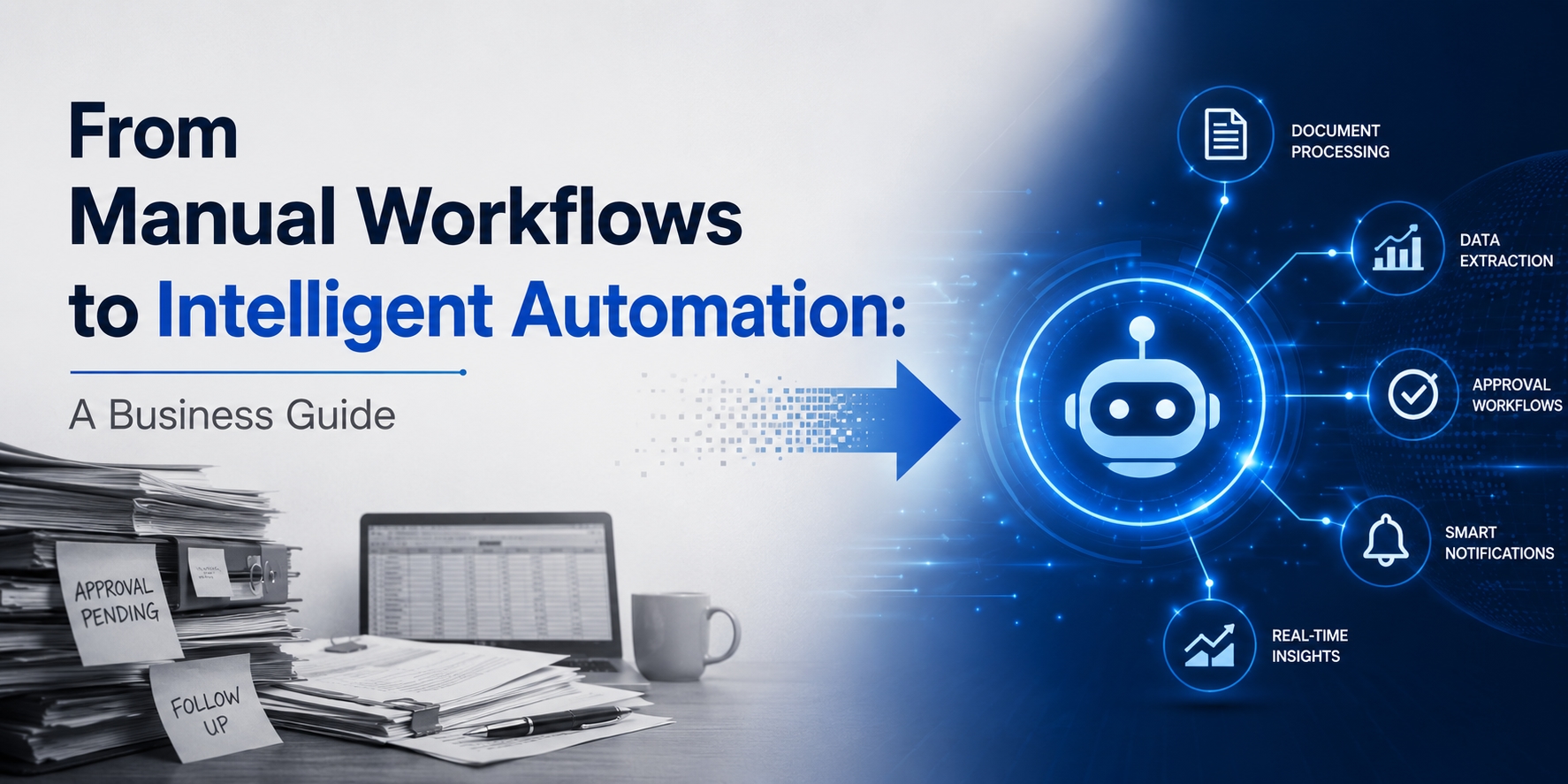
Businesses today operate in an increasingly competitive environment where speed, efficiency, and accuracy are essential for success. Yet many organizations still rely on manual workflows for critical business operations such as approvals, data entry, customer support, invoicing, and reporting. While these processes may have worked in the past, they often lead to delays, higher costs, and human errors.
Intelligent automation combines Artificial Intelligence (AI), Machine Learning (ML), Robotic Process Automation (RPA), and workflow automation to streamline operations and eliminate repetitive tasks. Rather than simply replacing manual work, intelligent automation empowers employees to focus on innovation, strategic planning, and customer engagement.
In this guide, we'll explore how businesses can transition from manual workflows to intelligent automation, the benefits of this transformation, and the steps to implement a successful automation strategy.
What Are Manual Workflows?
Manual workflows are business processes that rely heavily on human intervention to complete routine tasks. Employees perform repetitive activities such as entering data, approving requests, processing invoices, updating spreadsheets, and responding to customer inquiries.
Common examples include:
Manual invoice approvals
Employee onboarding paperwork
Customer support ticket routing
Inventory updates
Sales reporting
HR leave approvals
Contract reviews
Data migration
Although manual workflows may seem manageable initially, they become increasingly inefficient as businesses grow.
Challenges of Manual Workflows
Organizations relying on manual processes often face several operational challenges.
Human Errors
Manual data entry increases the likelihood of mistakes, leading to inaccurate reports, compliance issues, and customer dissatisfaction.
Slow Processes
Approvals and document reviews can take days instead of minutes, delaying business operations.
Higher Operational Costs
Businesses spend significant resources on repetitive administrative tasks that could be automated.
Limited Scalability
As workloads increase, companies need to hire more employees to manage routine operations.
Poor Visibility
Tracking workflow progress manually makes it difficult to identify bottlenecks and improve efficiency.
What Is Intelligent Automation?
Intelligent automation is the combination of AI technologies and automation tools that enable systems to perform tasks, analyze information, make decisions, and continuously improve through learning.
Unlike traditional automation, intelligent automation can process unstructured data, understand natural language, recognize patterns, and adapt to changing business requirements.
Key technologies include:
Artificial Intelligence
Machine Learning
Natural Language Processing (NLP)
Computer Vision
Robotic Process Automation (RPA)
Generative AI
AI Agents
Together, these technologies create smarter, faster, and more adaptive business processes.
Benefits of Intelligent Automation
1. Increased Productivity
Employees spend less time on repetitive tasks and more time on strategic initiatives, innovation, and customer relationships.
2. Reduced Operational Costs
Automation minimizes manual effort, lowers administrative expenses, and improves resource utilization.
3. Improved Accuracy
AI-powered systems reduce human errors by automating data processing and validation.
4. Faster Decision-Making
Intelligent automation provides real-time insights, helping leaders make informed business decisions.
5. Better Customer Experience
Automated customer support, personalized interactions, and faster response times improve customer satisfaction and loyalty.
6. Enhanced Compliance
Automation standardizes processes, maintains audit trails, and supports regulatory compliance.
7. Scalability
Businesses can handle increased workloads without significantly expanding their workforce.
Common Business Processes to Automate
Organizations across industries are using intelligent automation to optimize a wide range of operations.
Finance
Invoice processing
Expense approvals
Bank reconciliation
Financial reporting
Human Resources
Resume screening
Employee onboarding
Attendance management
Payroll processing
Sales
Lead qualification
CRM updates
Proposal generation
Sales forecasting
Customer Support
AI chatbots
Ticket routing
Knowledge base assistance
Automated responses
Operations
Workflow approvals
Document management
Inventory tracking
Procurement automation
Marketing
Email automation
Customer segmentation
Campaign optimization
Lead nurturing
How Intelligent Automation Works
A typical intelligent automation workflow includes:
Step 1: Identify Repetitive Tasks
Analyze business operations to identify manual, repetitive, and time-consuming activities.
Step 2: Collect and Organize Data
Ensure high-quality data is available to train AI models and automate workflows effectively.
Step 3: Develop AI Models
Use machine learning and AI algorithms to analyze patterns and automate decision-making.
Step 4: Integrate with Existing Systems
Connect automation solutions with CRM, ERP, HRMS, accounting software, and cloud platforms.
Step 5: Monitor and Optimize
Continuously evaluate performance, retrain AI models, and improve workflows based on business needs.
Industries Leveraging Intelligent Automation
Intelligent automation is creating value across nearly every industry.
Healthcare
Patient scheduling
Medical documentation
Insurance claims processing
Banking
Fraud detection
Loan approvals
Customer verification
Retail
Personalized recommendations
Inventory optimization
Customer analytics
Manufacturing
Predictive maintenance
Production planning
Quality inspection
Logistics
Route optimization
Shipment tracking
Warehouse automation
Real Estate
Lead management
Property recommendations
Document processing
Why Partner with an AI Automation Agency?
Successfully implementing intelligent automation requires expertise in AI, software development, cloud technologies, and business process optimization.
A trusted AI automation agency in USA can help businesses:
Assess automation opportunities
Design AI strategies
Develop custom AI solutions
Integrate automation with existing systems
Ensure data security and compliance
Provide ongoing optimization and support
Working with an experienced partner reduces implementation risks and accelerates time-to-value.
Why Choose Devstringx Technologies?
Devstringx Technologies is a leading AI development company in USA helping organizations transform manual workflows into intelligent, AI-powered business processes.
Our expertise includes:
AI Automation Services
AI Agent Development
Workflow Automation
AI Chatbot Development
Intelligent Document Processing
Machine Learning Solutions
Generative AI Development
AI Consulting
Custom Software Development
Enterprise AI Integration
We help businesses identify automation opportunities, implement scalable AI solutions, and achieve measurable improvements in productivity, efficiency, and customer satisfaction.
Best Practices for Successful Intelligent Automation
To maximize the benefits of automation, businesses should:
Start with high-impact, repetitive processes.
Define clear business objectives and KPIs.
Involve stakeholders across departments.
Ensure data quality before automation.
Choose scalable AI solutions.
Monitor performance continuously.
Train employees to work alongside AI systems.
Partner with an experienced AI development company.
Future of Intelligent Automation
The future of intelligent automation lies in autonomous AI agents, hyperautomation, predictive analytics, and generative AI-powered workflows.
Businesses that embrace these technologies today will be better equipped to:
Respond to market changes faster
Improve operational resilience
Deliver personalized customer experiences
Increase profitability
Maintain a competitive advantage
Conclusion
The transition from manual workflows to intelligent automation is no longer optional—it is a strategic necessity for businesses aiming to thrive in a digital-first economy. By automating repetitive tasks, enhancing decision-making, and improving operational efficiency, organizations can unlock new levels of productivity and innovation.
Partnering with a trusted AI development company in USA or AI automation agency in USA ensures a smooth and scalable transformation. With the right strategy and technology partner, businesses can future-proof their operations, empower employees, and deliver exceptional value to customers.
Frequently Asked Questions (FAQs)
1. What is intelligent automation?
Intelligent automation combines AI, machine learning, and robotic process automation (RPA) to automate repetitive tasks, optimize workflows, and improve business decision-making.
2. How is intelligent automation different from traditional automation?
Traditional automation follows predefined rules, while intelligent automation uses AI to analyze data, learn from patterns, and make context-aware decisions.
3. Which business processes can benefit from intelligent automation?
Finance, HR, customer service, sales, marketing, procurement, operations, and supply chain management are among the most common areas where intelligent automation delivers value.
4. Is intelligent automation suitable for small businesses?
Yes. Cloud-based AI automation tools make intelligent automation affordable and scalable for startups and small businesses, helping them improve efficiency without significant upfront investment.
5. Why should I work with an AI automation agency?
An experienced AI automation agency provides strategic consulting, custom AI development, seamless system integration, and ongoing support to ensure successful implementation and measurable ROI.
6. How can Devstringx Technologies help?
Devstringx Technologies delivers end-to-end AI automation services, including workflow automation, AI agents, chatbot development, intelligent document processing, and custom AI solutions that help businesses streamline operations and accelerate digital transformation.