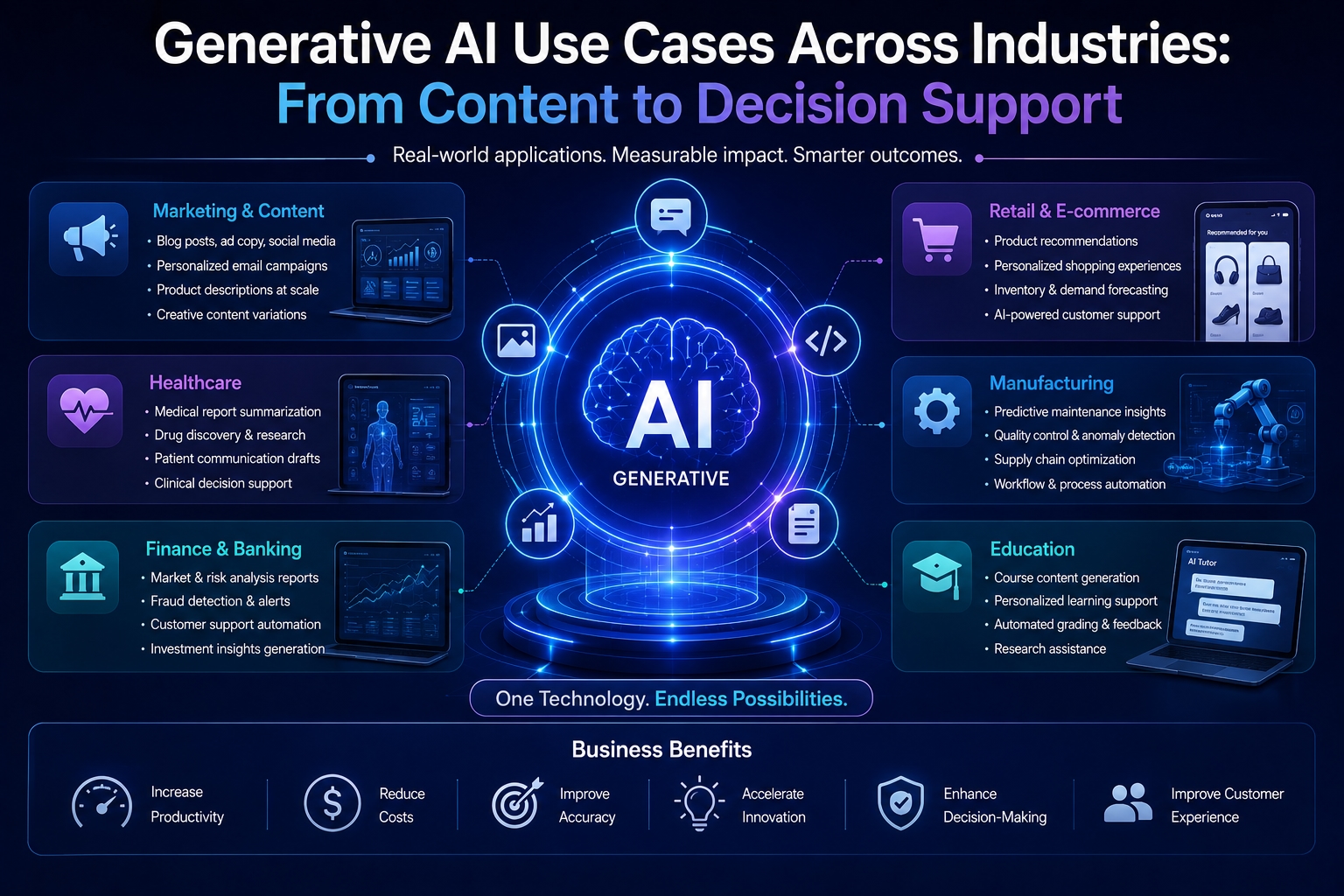
Generative AI coverage tends to collapse into two categories: chatbots and image generators. That's a narrow slice of what these systems are actually doing inside businesses right now. The more interesting use cases are quieter; they live inside marketing pipelines, clinical documentation systems, and product design workflows, doing work that used to require a much larger team or a much longer timeline.
What ties these use cases together isn't the underlying model. It's a specific pattern: generative AI compresses the distance between an idea and a testable version of it, whether that idea is a piece of content, a product feature, or a first draft of a legal document. The judgment about whether the result is actually good still belongs to a person. For organizations evaluating these applications in Saudi Arabia, Mobcoder AI provides generative AI development expertise that can help translate specific business workflows into practical AI solutions, from content and documentation to decision-support applications. This fits within Riyadh's growing AI technology ecosystem and the broader push toward digital transformation under Vision 2030. The system gets a rough version onto the table faster, while people remain responsible for the decisions that require human judgment.
Marketing and Content Operations
This is the most mature generative AI use case, and also the most misunderstood. The value isn't a model writing final copy unsupervised. It's a bilingual content pipeline that produces a strong first draft calibrated to a brand's actual voice, which a human editor then refines rather than starting from a blank page.
For organizations operating in multilingual markets, this matters more than it might elsewhere. Producing consistent Arabic and English content at the volume modern marketing requires used to mean either doubling headcount or accepting inconsistent quality between languages. A well-built generation pipeline, grounded in a company's existing brand guidelines and past content, closes that gap without either compromise.
Product Design and Prototyping
Generative AI has changed how quickly a product team can move from a rough idea to something a user can actually react to. Interface mockups, feature copy variations, and even early code scaffolding can be generated in a fraction of the time it used to take, giving teams more iterations before committing engineering resources to a direction.
The judgment about what customers actually need, and whether an idea is worth building at all, still sits entirely with the people on the team. Generative AI shortens the distance between having an idea and having a testable version of it. It doesn't make the underlying decision for you, and treating it like it does is where these projects tend to go wrong.
Healthcare Documentation and Clinical Support
Clinical settings have been slower to adopt generative AI, for good reason: accuracy requirements are strict, and the cost of a wrong answer is high. Where it has taken hold is in documentation support, drafting visit summaries or discharge instructions from a clinician's notes for review and sign-off, rather than generating clinical guidance independently.
This kind of application requires grounding the model in verified medical reference material through retrieval-augmented generation, rather than relying on a general-purpose model's training data alone, which can be outdated or imprecise for specialized medical terminology. Systems built without that grounding step tend to produce plausible-sounding but unreliable output, which is a serious problem in a clinical context.
Financial and Investor Documentation
Large infrastructure and giga-project entities generate enormous volumes of stakeholder and investor documentation, reports, updates,d and technical summaries translated for different audiences. Generative AI trained on an organization's existing document style and terminology can draft these faster while maintaining the specific tone and technical accuracy that institutional audiences expect.
This isn't about replacing the analysts and writers who produce this material. It's about giving them a faster starting point on repetitive document types, freeing their time for the higher-judgment writing that actually requires their expertise.
Where Generative AI Meets Agentic AI
The most significant recent shift is generative AI moving from a standalone output generator into a component inside a larger agentic system. Instead of a person prompting a model and manually acting on the output, an agent can generate content or a decision recommendation and then act on it directly, drafting a document, submitting it for review, and routing it to the right approver without human intervention at each step.
Agentic AI development services that combine generation with autonomous execution represent where most of the practical value is heading now. A marketing agent that doesn't just draft a campaign but schedules and monitors it. A documentation agent that doesn't just summarize a report but files it in the right system and flags anomalies for review. The generation step becomes one part of a longer, more autonomous workflow rather than the entire deliverable.
Multimodal Applications
Text-only generation is increasingly the baseline rather than the ceiling. Multimodal systems that work across text, image, and audio are opening use cases that didn't exist a couple of years ago: generating draft training materials that combine written instructions with illustrative diagrams, or producing audio versions of written content for accessibility without a separate production process.
For teams evaluating generative AI development investment, multimodal capability is worth weighing even for projects that start text-focused, since the same underlying architecture often extends to other formats with far less rework than starting a separate project later.
Legal and Contract Support
Legal teams have been cautious adopters of generative AI, and for good reason given the cost of an error in a signed agreement. Where it has taken hold is in first-pass contract review and drafting: generating a redline against a standard playbook, summarizing key terms in a long agreement for a business stakeholder who isn't going to read the full document, or drafting boilerplate sections of a routine contract from a template.
None of this replaces a lawyer's review before anything gets signed. What it does is compress the hours spent on the repetitive first pass, flagging unusual clauses or missing standard language, so the lawyer's actual time goes toward the judgment calls that matter rather than reading through routine sections that follow a predictable pattern.
Measuring Generative AI ROI
Because generative AI output feels immediately impressive, it's easy for organizations to skip measuring whether it's actually saving time or improving quality compared to the process it replaced. That gap shows up later when a project loses budget support because nobody can point to concrete evidence of its value.
The more reliable approach tracks a small number of specific metrics from the start: time from request to first draft, the percentage of generated content that survives to final publication with only light editing, and error or correction rates compared to the previous manual process. Teams that track this from day one catch quality drift early and have a much easier time justifying continued investment than teams relying on general impressions of whether the tool "feels" useful.
FAQs
Does generative AI replace the need for human writers and designers? No. It removes the blank-page problem and speeds up first drafts, but the judgment about what's actually good, on-brand, or strategically right still requires human review and decision-making.
How accurate is generative AI for specialized industries like healthcare or finance? General-purpose models without industry-specific grounding can be unreliable on specialized terminology. Systems built with retrieval-augmented generation, referencing verified internal or industry data, perform significantly better and are the standard approach for regulated use cases.
What's the difference between generative AI and agentic AI? Generative AI produces an output- text, image, or code- in response to a prompt. Agentic AI can take that output and act on it autonomously across multiple steps, calling tools, making decisions, and completing a workflow rather than stopping after generating content.
Is multimodal generative AI worth the investment for a text-focused project? Often yes, since the underlying architecture can extend to other formats later with much less additional work than building a separate system from scratch when the need arises.
How do companies keep generative AI content consistent with their brand voice? By grounding the generation pipeline in the organization's existing content, style guides, and terminology through fine-tuning or retrieval-augmented generation, rather than relying on a general-purpose model's default tone.
Conclusion
The organizations getting real value from generative AI aren't the ones chasing the most impressive demo. They're the ones that identified a specific, repetitive piece of work- content drafts, documentation, prototypes- and built a grounded, well-integrated pipeline around it, with people still making the calls that actually matter. As these systems increasingly merge with agentic execution, that same discipline, starting with a real workflow instead of a flashy capability, will keep being what separates a useful deployment from an expensive experiment.