
The global hospitality industry generates over $4.7 trillion in annual revenue and employs more than 330 million people, yet most hotels still make their biggest decisions on pricing, staffing, and purchasing using intuition, spreadsheets, and software that hasn't changed since 2005. Thin margins, high turnover, and rising guest expectations make that a dangerous way to operate.
Agentic AI is changing that equation. The agentic AI for hospitality operations market was valued at $500 million in 2025 and is projected to reach $3.4 billion by 2034 at a 26% annual growth rate. BCG's 2026 global analysis found 25% of hospitality firms already have AI strategies producing real returns, but fewer than 10% qualify as fully "future-built," which means the growth ceiling here is still wide open.
This article covers:
What agentic AI actually means in a hospitality context
How it's changing hotel operations department by department
The revenue impact of personalization and dynamic pricing
What Agentic AI Actually Means for a Hotel
Most people have encountered AI chatbots. That's not what this is.
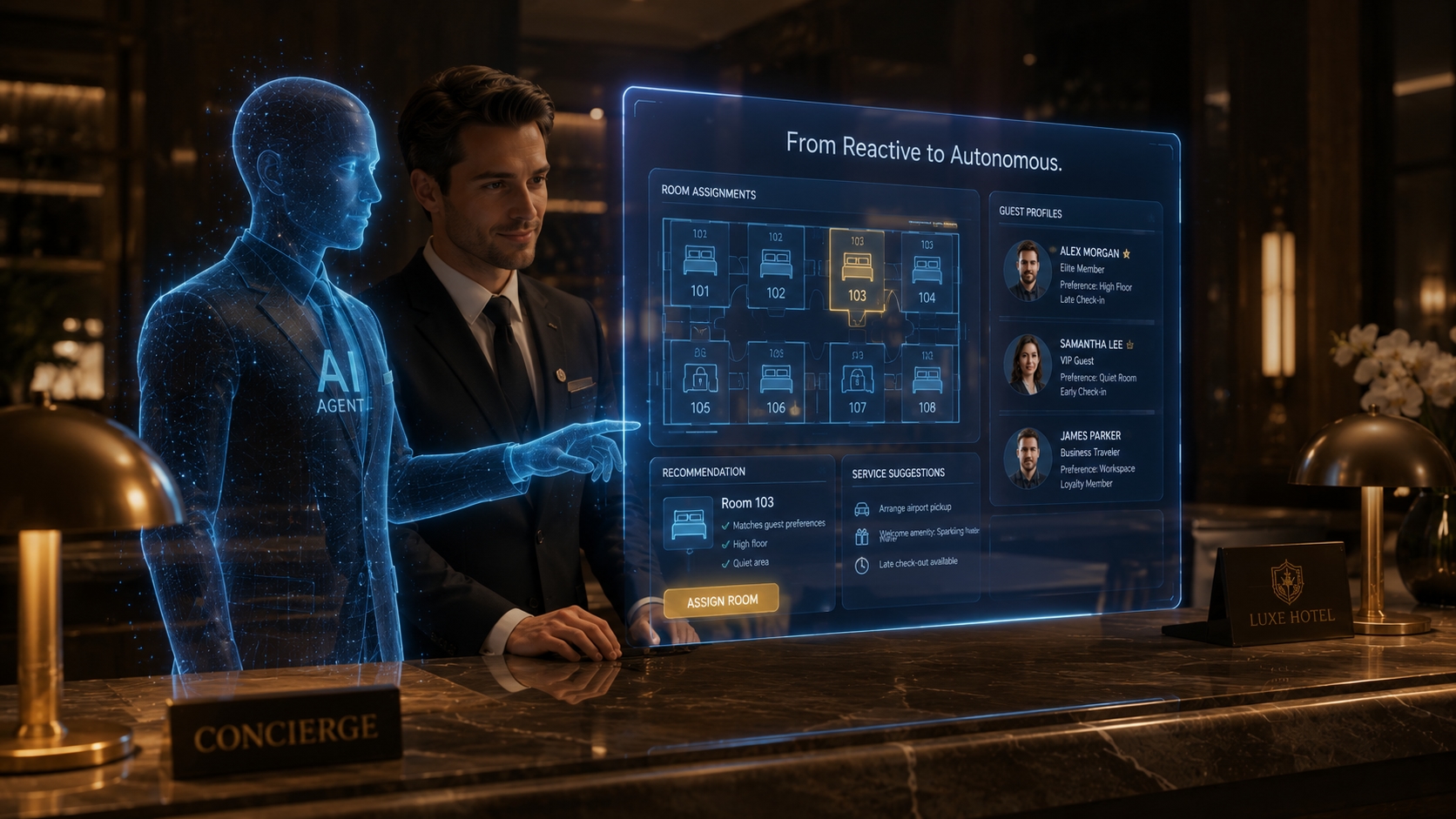
"Agentic AI" refers to systems that plan, reason, and execute multi-step tasks autonomously without a human approving each action. A chatbot answers a question. An agentic AI system notices a guest booked a corner suite last February, ordered the same wine three times during that stay, checks tonight's inventory, and places a room service pre-order automatically. Nobody told it to. It was decided.
That gap between reactive and autonomous is what makes this structurally different from anything hospitality has tried before. As EHL Group CEO Markus Venzin put it, "These autonomous systems can anticipate needs, make decisions, and execute complex tasks, freeing up staff to concentrate on what matters most in hospitality: the human touch."
IDC's FutureScape 2026 went further, describing agentic AI as fundamentally changing the distribution funnel itself, not just improving it.
Operations: Where It's Already Working
Front desk staff and reservation agents spend 40–60% of their time on repetitive inquiries. Check-in questions, room availability, local recommendations, and billing clarifications. All necessary. None requiring a trained hospitality professional to handle personally.
AI chatbots now handle up to 80% of routine customer service inquiries without human intervention. AI virtual concierges resolved 92% of queries without escalation in 2025, boosting guest satisfaction scores by 18%. The back-of-house results are equally real, just less visible.
Operational Area | What Agentic AI Does | Measured Impact |
Housekeeping Management | Dynamically assigns tasks using real-time check-out data and staff availability | Reduces required work hours; optimizes room turnover sequences |
Predictive Maintenance | IoT sensors on HVAC, elevators, and kitchen equipment feed anomaly detection models | Cuts maintenance costs 15–20%; prevents emergency failures |
Food & Beverage | Analyzes ordering patterns and profitability to auto-order inventory and suggest menu pricing | Reduces food waste; improves F&B margins |
Staff Scheduling | Forecasts demand from bookings, events, and historical occupancy | Nordic chain Scandic uses Quinyx to align labor costs with live occupancy |
Guest Communication | Handles pre-arrival, in-stay, and post-stay messaging across multiple languages | Reduces friction for international guests; fewer language-related negative reviews |
Booking Conversion | LLM-powered agents replace traditional search-and-filter booking interfaces | 15–28% improvement in direct booking conversion rates |
Predictive maintenance was the single largest agentic AI application segment in 2025 at 24.5% of market share. The ROI case is blunt: an HVAC bearing about to fail produces a distinctive vibration signature days before it stops working. An AI model flags it. A technician fixes it on Tuesday. Without AI, 200 guests discover the problem on Saturday night.
Personalization: The Revenue Case
68% of frequent business travelers and 61% of leisure travelers said in 2025 research they would switch hotel brands for demonstrably more personalized experiences. That's not theoretical loyalty risk. That's revenue walking out the door at properties that haven't built personalization infrastructure.
Artificial Intelligence enabled personalization and dynamic pricing can increase hotel revenue by 3–10% annually with no increase in occupancy, per McKinsey research. Hotels using AI revenue management saw 15–20% RevPAR uplift in deployment studies. For a 200-room property doing $8 million in annual revenue, a 5% RevPAR improvement adds $400,000 from the same rooms.
Traditional rate management responds to broad seasonal patterns. AI revenue management analyzes historical data, real-time occupancy, competitor pricing, local events, and weather, adjusting rates continuously and running thousands of micro-predictions per hour rather than broad seasonal guesses.
IDC's 2026 FutureScape made the deeper point clearly: in an agentic world, personalization is no longer a marketing tactic. It becomes an operating model. First-party guest data, what they ordered, how they prefer to communicate, what their complaint was two stays ago is the asset that determines whether the AI agent serves them well or defaults to generic. Hotels treating guest data as a strategic asset are building a competitive advantage their competitors can't easily buy.
Where the Profit Actually Shows Up
BCG's February 2026 AI-first hotels report identified the clearest financial gains:
OTA commission reduction: AI-powered booking agents improved direct booking conversion 15–28% over traditional interfaces. Every booking shifted from OTA to direct saves 15–25% in commission on that transaction.
Revenue management uplift: AI-driven revenue management accounted for more than 30% of total AI hospitality market value in 2025. The margin between a strong hotel year and a poor one is often 3–5 percentage points of revenue; AI revenue tools consistently operate within that range of impact.
Maintenance cost reduction: AI anomaly detection cuts maintenance spend 15–20% at large properties. Emergency repair costs dwarf scheduled maintenance costs. The difference between fixing something before it fails and fixing it mid-peak-season is not marginal.
Labor optimization: During demand surges, AI tools screen and onboard qualified gig workers automatically. AI "copilots" coach new hires in real time, compressing the typical four-month training ramp significantly.
What's Holding Hotels Back
Only 10% of hospitality companies are "future-built" on AI per BCG. The gap isn't budget; 62% of hospitality executives planned to invest over $1 million in AI by 2025, per Deloitte. The gap is data.
IDC's 2026 Future Scape identified fragmented data as the single biggest obstacle. Without a unified view connecting property management systems, loyalty programs, guest profiles, and on-property interactions, AI agents produce generic outputs. A hotel with booking data in one system, loyalty data in another, and in-stay requests logged nowhere has no foundation for personalization, no matter how sophisticated the AI layer sitting on top. The hotels that moved early on data integration are compounding that advantage. The ones still on disconnected systems aren't being left behind slowly.
FAQs: Agentic AI in Hospitality
What is agentic AI in hospitality?
Systems that autonomously plan and execute multi-step tasks without human approval at each step, coordinating housekeeping, maintenance, pricing, and guest personalization simultaneously.
How much does agentic AI improve hotel revenue?
McKinsey research shows 3–10% annual revenue uplift from AI personalization and dynamic pricing alone. Hotels using AI revenue management report 15–20% RevPAR improvement. Direct booking conversion improves 15–28% with AI booking agents.
Does agentic AI replace hotel staff?
Not in high-touch areas. It handles repetitive tasks, inquiries, scheduling, and maintenance monitoring, freeing staff for guest interactions that need human judgment. At luxury properties, it lets concierge staff spend more time on personalized service.
What is the agentic AI hospitality market worth?
$500 million in 2025, projected to reach $3.4 billion by 2034 at 26% CAGR. Total investment in AI and automation across travel and tourism is expected to reach $27 billion by 2027.
What do hotels need to deploy agentic AI effectively?
Unified data infrastructure, property management, guest profiles, loyalty data, and on-property interactions are all connected. Without clean first-party data, AI agents default to the generic outputs they're supposed to replace.