
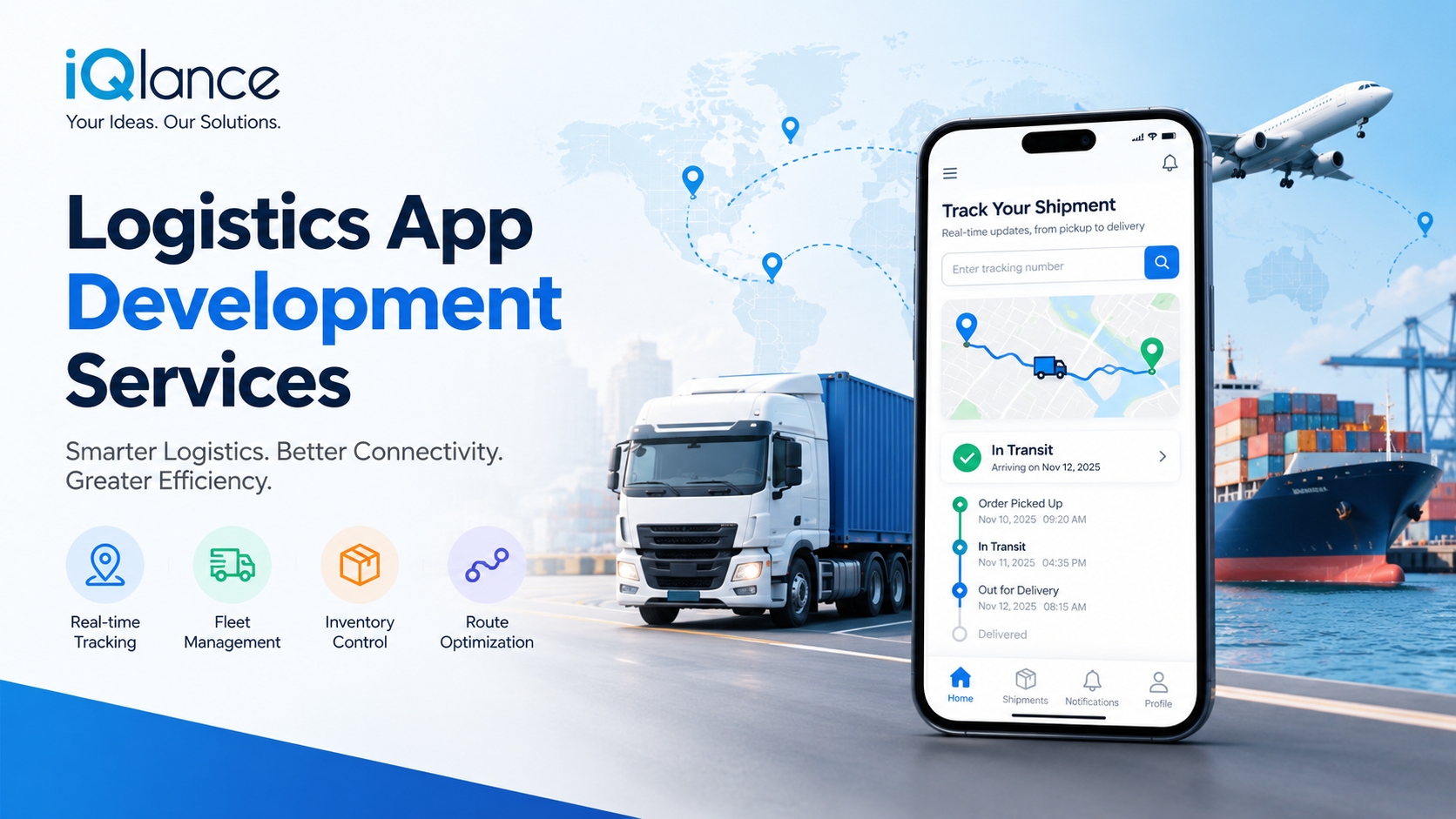
The logistics industry is moving beyond traditional tracking systems and disconnected spreadsheets. Businesses now need real-time shipment visibility, accurate delivery estimates, automated workflows, and faster responses to unexpected disruptions. Cloud computing makes these capabilities possible by connecting vehicles, warehouses, drivers, customers, and supply chain partners through a shared digital infrastructure.
For companies investing in digital transformation, cloud technology provides the foundation for smarter logistics operations. When combined with GPS tracking, artificial intelligence, Internet of Things sensors, and logistics app development services, it helps businesses turn operational data into actionable insights.
Whether you manage a transportation company, a third-party logistics (3PL) operation, a warehouse, or a growing delivery business, cloud-powered applications can improve visibility and coordination without requiring extensive on-premises infrastructure.
But how does cloud computing actually work in logistics, and what makes it valuable for modern supply chains? Let's explore its applications, benefits, implementation process, and costs.
What Is Cloud Computing in Logistics?
Cloud computing in logistics refers to using internet-based computing resources to store, process, manage, and share logistics data. Instead of maintaining every server and software system on company premises, businesses can use cloud platforms to run applications, manage databases, analyze information, and coordinate operations.
For example, a transportation company can use a cloud-based logistics platform to monitor vehicles, assign deliveries, track shipments, and share estimated arrival times with customers. Dispatchers can access the same information as drivers and warehouse managers, even when they work from different locations.
Cloud computing supports several essential logistics functions:
Shipment tracking: Monitor deliveries and shipment status as events occur.
Fleet management: Track vehicle locations, utilization, fuel consumption, and maintenance requirements.
Warehouse coordination: Synchronize inventory, picking, packing, and dispatch activities.
Route optimization: Evaluate traffic, delivery priorities, and road conditions to recommend efficient routes.
Data analytics: Identify recurring delays, operational bottlenecks, and cost-saving opportunities.
Customer visibility: Provide shipment updates, estimated delivery times, and proof of delivery.
The biggest advantage is connectivity. Rather than operating separate systems with inconsistent information, businesses can build a connected environment where relevant data moves between teams and applications.
Why Cloud Computing Is Becoming Essential for Modern Supply Chains
Supply chains involve multiple stakeholders, including suppliers, manufacturers, carriers, warehouse operators, distributors, and customers. Each participant generates information that can affect the next stage of an order.
When these systems operate independently, information gaps can cause delayed shipments, inaccurate inventory records, missed delivery windows, and unnecessary administrative work.
Cloud computing helps address these challenges by making operational data available across connected systems.
1. Greater Supply Chain Visibility
Cloud platforms consolidate information from transportation management systems (TMS), warehouse management systems (WMS), enterprise resource planning (ERP) software, and tracking devices.
This gives authorized users a clearer view of shipments, inventory levels, vehicle movements, and order progress. Managers can identify problems earlier instead of waiting for manual updates.
2. Faster Operational Decisions
Cloud-based dashboards can present current performance indicators, delivery exceptions, and inventory changes in one place.
If a vehicle is delayed, a dispatcher can review its location, assess alternative routes, and notify the customer. If inventory falls below a defined threshold, the system can alert the purchasing team.
3. Flexible Infrastructure
Logistics demand often changes with seasonal sales, promotional events, weather disruptions, and business growth. Cloud infrastructure can scale computing capacity according to workload, subject to the selected service configuration and costs.
This flexibility helps businesses avoid investing in fixed infrastructure sized for their busiest operating periods.
4. Better Collaboration
A shared platform helps drivers, dispatchers, warehouse staff, managers, and customers work with consistent information. Role-based access can ensure that each participant sees the information relevant to their responsibilities.
For businesses expanding across states or international markets, this can make coordination significantly easier.
Key Cloud Technologies Transforming Logistics Operations
Cloud computing is not a single technology. It combines infrastructure, software, connected devices, and data services that work together to improve logistics performance.
1. Internet of Things for Real-Time Tracking
IoT devices collect information from vehicles, cargo, warehouses, and storage facilities. Depending on the equipment, they can report location, temperature, humidity, fuel levels, door openings, or other operational conditions.
A cloud platform processes and distributes this information to relevant users.
For example, a pharmaceutical distributor transporting temperature-sensitive products can receive an alert when a shipment moves outside its permitted temperature range. The operations team can investigate before the issue affects product quality.
2. Artificial Intelligence and Predictive Analytics
AI systems can analyze historical delivery data, traffic patterns, weather conditions, vehicle availability, and order volumes to identify patterns that traditional reporting may miss.
Common applications include:
Predicting delivery delays before scheduled arrival times.
Forecasting demand and inventory requirements.
Recommending delivery routes based on operational constraints.
Identifying unusual fuel consumption or vehicle performance.
Estimating warehouse staffing requirements during peak periods.
These capabilities depend on data quality, suitable models, and reliable integrations. AI recommendations should also account for business rules, driver hours, vehicle capacity, and customer delivery windows.
3. Cloud-Based GPS and Route Optimization
GPS tracking combined with cloud processing enables dispatchers to monitor vehicles and coordinate deliveries from a central dashboard.
When traffic congestion, road closures, or a new priority delivery changes the plan, route optimization software can evaluate alternative routes. Drivers can receive updated instructions through a mobile application.
Effective route optimization should consider more than distance. Delivery deadlines, tolls, vehicle restrictions, fuel consumption, and loading capacity can all influence the best route.
4. APIs and System Integration
Modern logistics operations rarely rely on one application. Businesses may already use accounting software, ERP platforms, e-commerce systems, carrier services, and warehouse management tools. Application programming interfaces (APIs) allow these systems to exchange information.
For example, an e-commerce platform can send a confirmed order to a logistics system, which then assigns a carrier, updates the shipment status, and sends tracking information back to the customer.
This integration reduces manual data entry and helps prevent inconsistencies between departments.
How Cloud Computing Enables Real-Time Supply Chain Intelligence
The real value of cloud technology emerges when data leads to action.
Consider a shipment traveling from a distribution center to a customer. A connected logistics platform can collect GPS updates, compare the vehicle's progress against its delivery schedule, identify a potential delay, and notify the dispatch team.
The process typically works as follows:
1. Data collection
GPS devices, drivers, warehouses, orders, and IoT sensors
2. Cloud data processing
Centralized data storage, event processing, and system integration
3. Intelligent analysis
ETA prediction, route recommendations, and exception detection
4. Action and communication
Driver instructions, dispatcher alerts, and customer notifications
This workflow turns raw operational data into useful decisions. However, real-time performance depends on device connectivity, data processing speed, application design, and the availability of external services.
An Authoritative Statistic on Cloud Adoption
Cloud adoption is expanding across the business sector. According to Eurostat, 52.7% of EU enterprises used paid cloud computing services in 2025, an increase of 7.4 percentage points compared with 2023. The data were published on February 3, 2026.
This statistic covers enterprises across industries, not logistics companies alone. It nevertheless demonstrates the broader shift toward cloud-based business infrastructure.
Major Benefits of Cloud Computing for Logistics Companies
Lower Infrastructure Burden
Traditional infrastructure may require upfront investment in servers, maintenance, upgrades, and dedicated IT resources. Cloud services allow businesses to use managed infrastructure and pay according to their selected service model.
This can reduce initial infrastructure commitments, although subscription charges, data transfers, software licenses, and ongoing support still need to be budgeted.
Improved Operational Efficiency
Automated shipment updates, digital proof of delivery, electronic dispatching, and centralized order management reduce repetitive administrative tasks.
Teams can spend less time collecting status information and more time resolving exceptions, coordinating deliveries, and improving service quality.
Scalability for Business Growth
A growing logistics business may add vehicles, warehouses, delivery regions, customers, and operational users over time.
Cloud-based applications can scale with these requirements without necessarily requiring a complete infrastructure replacement. Good architecture and capacity planning remain essential to prevent performance bottlenecks.
Better Customer Experience
Customers increasingly expect to know where their shipments are and when they will arrive.
A cloud-connected customer portal or mobile application can provide:
Live or frequently refreshed shipment locations.
Estimated arrival times.
Automated delivery notifications.
Digital invoices and delivery confirmations.
Access to shipment history and support requests.
Greater transparency can reduce repetitive customer service inquiries and help businesses build trust.
Stronger Business Continuity
Cloud platforms can support backups, replicated data, disaster recovery, and redundant services. These capabilities can help logistics operations recover from hardware failures or other disruptions.
However, cloud hosting does not automatically guarantee uninterrupted service. Recovery procedures, backup testing, access controls, and appropriate redundancy must be planned and maintained.
Essential Features of a Cloud-Based Logistics Application
A successful logistics platform should address actual operational problems rather than simply include every available technology. Businesses planning custom logistics app development can prioritize features based on their workflows, fleet size, delivery model, and integration requirements.
Feature | Primary purpose | Business value |
Real-time GPS tracking | Monitor vehicle and shipment locations | Better shipment visibility |
Route optimization | Recommend efficient delivery routes | Lower avoidable travel costs |
Fleet management | Track vehicle utilization and maintenance | Improved asset management |
Order management | Coordinate orders, assignments, and status updates | Fewer manual errors |
Driver mobile app | Manage tasks, navigation, and proof of delivery | Faster field operations |
Warehouse integration | Synchronize inventory and dispatch data | Better inventory accuracy |
Predictive analytics | Identify potential delays and operational trends | Proactive decisions |
Customer portal | Share tracking and delivery updates | Greater transparency |
Reporting dashboard | Monitor delivery times, costs, and performance | Measurable improvements |
Security and access control | Protect business and customer information | Reduced security exposure |
Not every business needs all these capabilities immediately. A regional courier service may prioritize driver tracking and delivery confirmation, while a large third-party logistics provider may require advanced analytics, multi-warehouse coordination, and integrations with several enterprise systems.
Cloud Deployment Models for Logistics Businesses
Choosing the right deployment model affects security, flexibility, maintenance, and operating costs.
Public Cloud
Public cloud platforms provide computing resources through a third-party provider. They are often suitable for businesses that need flexible infrastructure, rapid deployment, and access to managed services.
Private Cloud
A private cloud provides cloud infrastructure dedicated to a single organization. It may suit businesses with specialized security, governance, or operational requirements, but it can involve greater management and infrastructure costs.
Hybrid Cloud
A hybrid model combines public cloud services with private infrastructure or on-premises systems. It can help logistics businesses modernize selected operations while retaining existing systems that cannot easily be replaced.
Which model is best? The decision should depend on data sensitivity, existing technology, compliance obligations, integration requirements, expected workload, and the team's ability to manage the environment.
Cloud Computing Implementation Challenges and Solutions
Cloud technology can improve logistics operations, but implementation requires careful planning.
Data Security and Privacy
Logistics applications may handle customer addresses, driver information, commercial agreements, shipment records, and payment-related data.
Recommended safeguards include encryption in transit and at rest, multi-factor authentication, role-based access, audit logging, secure API authentication, and tested incident response procedures.
For companies operating in the United States, applicable privacy obligations, contractual requirements, and relevant industry regulations should be assessed before deployment.
Integration With Legacy Systems
Older warehouse, fleet, and accounting systems may use outdated interfaces or inconsistent data formats.
A phased integration strategy can help. Start by mapping existing systems, identifying authoritative data sources, and defining how information should move between applications. API gateways, middleware, and event-driven integration can help connect systems where appropriate.
Unreliable Connectivity
Drivers and warehouse teams may work in areas with weak internet coverage. Mobile applications should therefore consider offline capabilities, local data storage, synchronization, and conflict handling.
For example, a driver should be able to record a delivery confirmation while offline and synchronize it when connectivity returns.
Unexpected Cloud Costs
Cloud expenses can rise when applications generate large amounts of location data, store extensive tracking histories, or run resource-intensive analytics.
Businesses can manage these risks through budget alerts, usage monitoring, data retention policies, workload optimization, and regular cost reviews.
Vendor Dependency
Relying heavily on one cloud provider's proprietary services can make future migration more difficult.
Documented APIs, portable data formats, clear exit procedures, and appropriate architectural choices can reduce this risk.
How to Build a Cloud-Based Logistics Application
A structured development process helps businesses move from an operational problem to a dependable production application.
Define business requirements
Identify the main problems to solve, such as delivery delays, limited fleet visibility, manual dispatching, or fragmented warehouse data. Establish measurable goals before choosing technologies.Plan the application architecture
Select an appropriate cloud model, database strategy, integration approach, and security framework. Decide which functions belong in the mobile application, backend, and administrative dashboard.Design the user experience
Create practical workflows for dispatchers, drivers, warehouse managers, administrators, and customers. Each role should have access to the functions and information it needs.Develop core features
Begin with essential functions such as order management, GPS tracking, dispatching, notifications, and delivery confirmation. Add advanced analytics and AI capabilities when the data and business case support them.Integrate external systems
Connect GPS services, mapping APIs, ERP or WMS platforms, carrier systems, payment services, and customer communication tools as required.Test security and performance
Validate application behavior under heavy workloads, weak network conditions, invalid data, and service interruptions. Test access controls, backups, recovery, and synchronization.Launch and continuously improve
Release the application in stages, monitor performance, collect user feedback, and prioritize improvements using operational data.
Working with an experienced logistics app development company can help businesses coordinate these stages and build a platform aligned with their existing workflows.
How Much Does Cloud-Based Logistics App Development Cost?
The cost depends on application complexity, the number of user roles, integrations, tracking requirements, security needs, and the chosen cloud infrastructure.
The following figures are illustrative planning estimates in USD, not verified market averages or vendor quotations.
Application type | Estimated development cost | Typical scope |
Basic logistics MVP | $15,000 to $35,000 | Order tracking, basic dispatching, essential dashboard |
Mid-level logistics platform | $35,000 to $80,000 | Driver app, GPS integration, notifications, reporting |
Advanced logistics solution | $80,000 to $180,000+ | Route optimization, multiple integrations, advanced analytics |
Enterprise logistics platform | $180,000 to $350,000+ | Complex workflows, multi-location operations, enterprise integrations |
Actual quotes may fall outside these ranges. A simple application built around an existing logistics system can cost less, while a sophisticated platform with custom integrations, complex permissions, and high-volume tracking can cost substantially more.
Additional Costs to Budget For
Cloud hosting, storage, and data transfer.
Mapping, GPS, and third-party API usage.
AI processing and analytics infrastructure.
Application monitoring and security services.
Ongoing maintenance, testing, and feature updates.
Technical support, backups, and disaster recovery.
A practical approach is to launch a minimum viable product (MVP) with the features that solve the most urgent business problems, then expand after validating the workflows and measuring results.
How to Choose a Logistics App Development Partner
Selecting a development partner is about more than comparing hourly rates. The team should understand how transportation, inventory, dispatching, and delivery operations work together.
Before making a decision, evaluate the following:
Relevant experience: Look for experience with fleet tracking, logistics workflows, mobile applications, and cloud-based systems.
Integration capabilities: Confirm that the team can connect your existing ERP, WMS, TMS, mapping, and third-party services.
Security practices: Ask about encryption, access control, testing, monitoring, and backup strategies.
Scalability: Understand how the architecture will accommodate additional users, vehicles, warehouses, and delivery regions.
Ongoing support: Establish responsibilities for bug fixes, cloud monitoring, maintenance, and future enhancements.
Transparent delivery planning: Request a clear scope, milestones, acceptance criteria, and cost breakdown.
For organizations seeking logistics application development in USA, also consider communication, time-zone overlap, contractual expectations, and experience supporting US business operations.
Build a Cloud-Powered Logistics Platform With iQlance Solutions
Modern logistics requires reliable technology that connects vehicles, warehouses, dispatchers, and customers. iQlance Solutions can help businesses plan custom logistics mobile app development around their operational requirements, from core shipment tracking to integrated fleet management and scalable cloud-based workflows.
Whether you are validating a new product or modernizing an existing logistics platform, define your priorities, integrations, and growth requirements before committing to a development roadmap.
Get Your Free Quote
People Also Ask About Cloud Computing in Logistics
1. How is cloud computing used in logistics?
Cloud computing supports shipment tracking, fleet management, warehouse coordination, route planning, customer notifications, and supply chain analytics. It allows authorized users to access shared operational information through connected applications.
2. How does cloud computing improve supply chain visibility?
It combines information from GPS devices, transportation systems, warehouses, and order platforms. This gives teams a more consistent view of shipment progress, inventory status, and delivery exceptions.
3. What are the benefits of cloud-based logistics software?
The main benefits include flexible infrastructure, easier system integration, improved collaboration, faster access to operational data, scalable applications, and better customer visibility. Actual savings depend on implementation and ongoing operating costs.
4. How much does it cost to develop a logistics app?
A basic logistics MVP may cost approximately $15,000 to $35,000, while advanced or enterprise applications can cost significantly more. These are illustrative estimates, and the final price depends on features, integrations, security, and infrastructure requirements.
5. Is cloud computing secure for logistics companies?
Cloud computing can support strong security through encryption, access controls, monitoring, backups, and recovery mechanisms. However, security depends on correct configuration, application design, operational practices, and the responsibilities shared between the cloud provider and the business.
Conclusion
Cloud computing is becoming an important foundation for connected, intelligent logistics operations. By bringing together tracking data, warehouse information, fleet activity, and customer updates, cloud-powered applications help businesses make faster decisions and respond to disruptions more effectively.
The greatest value comes from combining cloud infrastructure with practical capabilities such as GPS tracking, API integrations, predictive analytics, and mobile access. Businesses should begin with clearly defined operational needs, select a suitable architecture, and expand capabilities as measurable results emerge.
For companies planning digital transformation, investing in the right logistics app development services can provide a practical path toward greater supply chain visibility, more coordinated operations, and a technology platform that can evolve with business growth.