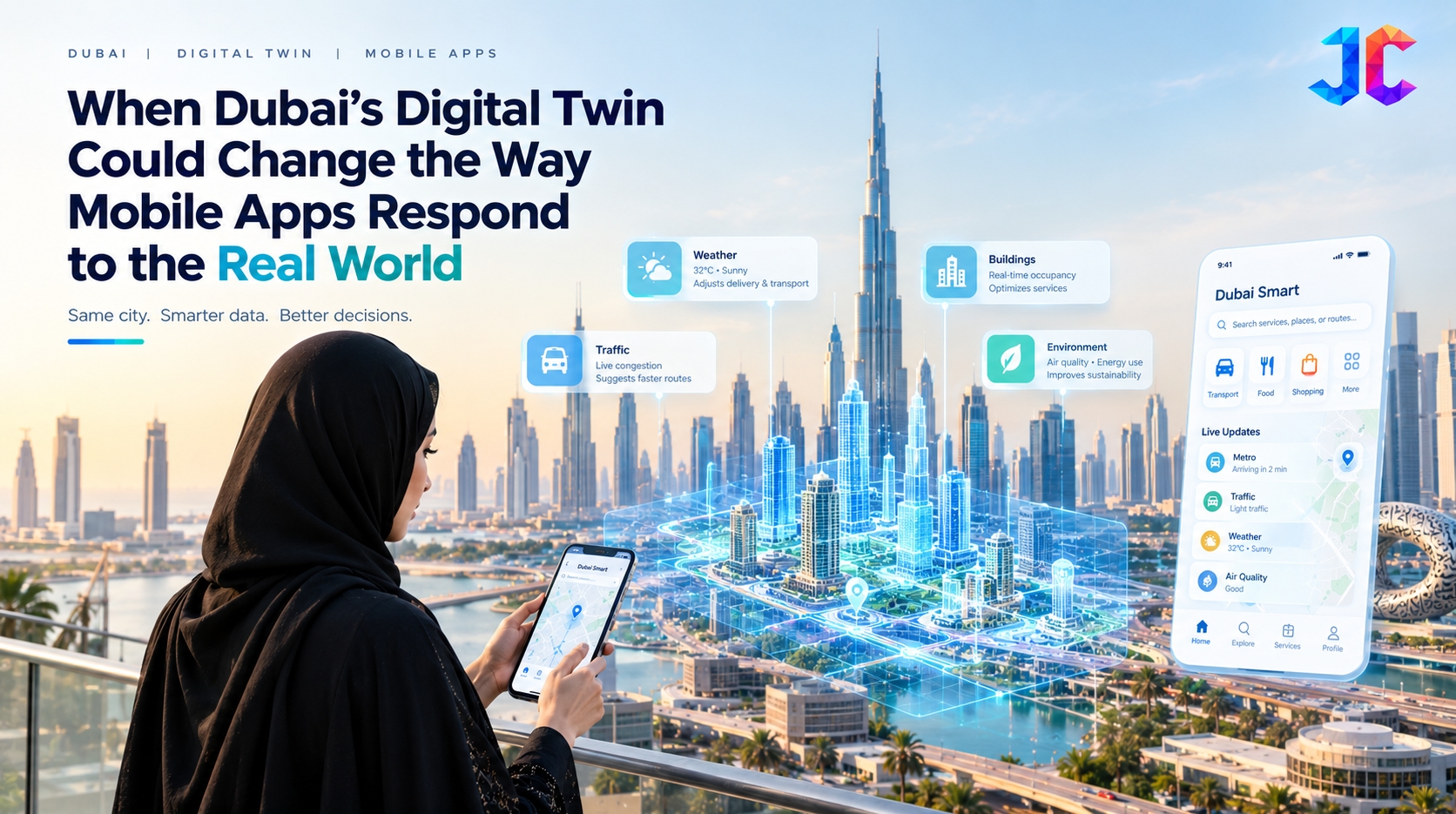
Discover how Dubai’s digital twin technology could help mobile apps deliver smarter building access, parking, mobility and location-aware services.
A mobile app usually reacts to what a user tells it. The next generation of location-aware apps could also respond to what is happening around the user.
Imagine arriving at a large mixed-use development in Dubai. Your parking app knows which spaces are available. Your building app guides you towards the correct entrance. If a facility becomes temporarily inaccessible, the app can suggest an alternative route instead of leaving you to figure it out.
Delivering this experience requires more than GPS and a map. It requires reliable connections between mobile applications, live operational data and the physical infrastructure those applications represent.
Dubai's Digital Twin Platform, launched in July 2026, brings this concept into focus by creating a digital representation of the city to support planning and infrastructure management.
What changes when an app connects to a digital twin?
A digital twin is a virtual representation of a physical asset or environment that can be updated using data. Depending on the implementation, it may represent a building, transport network or wider urban environment.
A mobile app connected to relevant digital-twin data could turn that information into practical user experiences.
For example:
Building access: Guide visitors to the correct entrance when access conditions change.
Parking: Display availability based on reliable, updated facility data.
Mobility: Help users understand disruptions and identify alternative routes.
Facility management: Let occupants report problems against specific locations or assets.
Energy awareness: Show building occupants relevant information about energy use or environmental conditions where suitable data is available.
These are potential applications, not claims that every capability is already available through Dubai's platform. Each depends on data access, integration permissions, and the systems operated by the relevant organisations, particularly as autonomous mobility in Dubai evolves and reshapes app experiences by 2030.
The engineering problem most businesses could underestimate
Connecting an app to a digital twin does not automatically make the app intelligent or accurate.
1. Data freshness matters
If a parking space appears available after another driver has occupied it, users quickly lose confidence. Applications need timestamps, update-frequency rules and clear ways to communicate uncertainty.
2. Different systems must communicate
Building-management software, mapping platforms, access-control systems and mobile applications may use different data formats and interfaces. Integration requires consistent identifiers, documented APIs and reliable error handling.
3. Location is not the whole answer
GPS can be inaccurate inside buildings, underground parking areas and dense urban environments. Depending on the use case, developers may need indoor maps, QR-based checkpoints, Bluetooth beacons or other positioning methods.
4. Physical actions need safeguards
An app may recommend a route or show a facility status, but unlocking a door or controlling building equipment requires additional authorisation, security controls and appropriate operational safeguards.
How should businesses approach digital-twin-enabled apps?
The practical starting point is not to build an entire smart-city application. It is to identify one user problem that better physical-world data could solve.
A property operator, for instance, could begin with visitor navigation or parking information. The team could then measure whether the integration reduces navigation errors, support requests or time spent searching for facilities.
Before expanding, businesses should validate data quality, system availability, access permissions, privacy implications and the cost of maintaining the integration.
A mobile app development company in UAE working on these products needs to consider the complete system: mobile interfaces, backend services, external data sources, authentication and failure recovery.
For a mobile app development company in Dubai, the opportunity is to translate increasingly connected urban infrastructure into applications that solve specific everyday problems rather than simply displaying impressive visualisations.
What could this mean for mobile apps by 2030?
As digital representations of buildings and infrastructure become more capable, mobile applications could evolve from static information tools into interfaces that respond to changing physical conditions.
A visitor might receive updated directions when an entrance closes. A facilities app might suggest a less congested access point. A mobility application could combine relevant transport updates with a user's destination.
However, these experiences will depend on integration quality, reliable data, business adoption and the permissions available to developers. A digital twin alone cannot guarantee real-time accuracy or seamless access to every connected system.
The lasting advantage will belong to applications that turn complex infrastructure data into clear, dependable decisions for users.
The question for product teams: If your mobile app could access a live digital representation of a building or district, which single problem would you solve first: navigation, parking, access or facility management?