
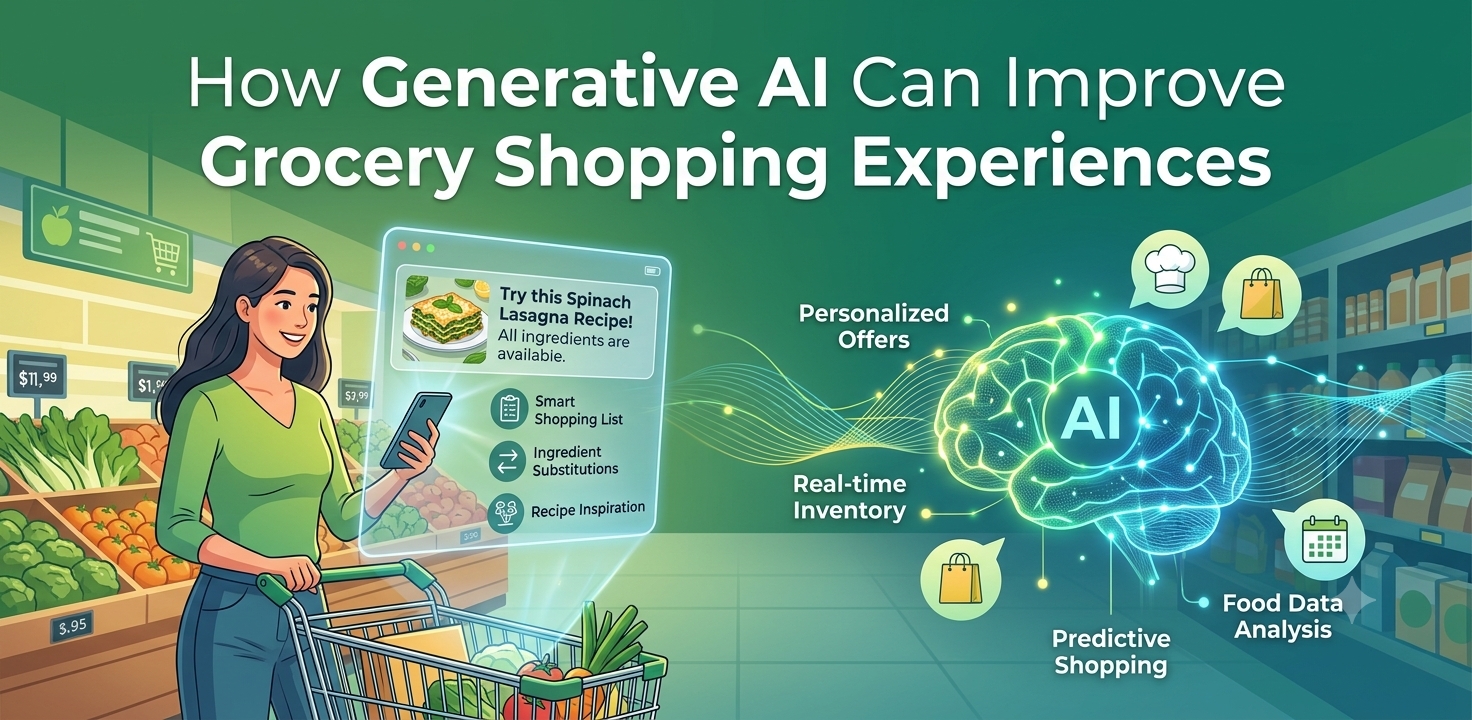
Grocery businesses are shifting rapidly to make their services more intelligent, personalized, and driven by technology. Customers in today’s era require more than just browsing and ordering. They need relevant suggestions, quicker searching capabilities, personalized offers, accurate information, and quick deliveries.
Generative AI stands out as a technology that could help to meet all these needs. In contrast to automated systems, generative AI has the capability to comprehend natural language, analyze customer choices, create suggestions, summarize information, and interact with shoppers.
Generative AI can bring about many changes for grocery businesses through digital platforms, not only in engaging customers but also in making their operations efficient. This can range from shopping assistants to personalized meal planning through AI technology.
What Is Generative AI in Grocery Shopping?
The term “generative AI” is used to refer to systems of artificial intelligence that have the capability of generating responses on the basis of the information processed. The use of generative AI in grocery shopping allows the system to interpret the customer’s queries, buying habits, food preferences, and more.
For example, instead of searching separately for ingredients, a customer could ask an AI assistant:
"What ingredients do I need to prepare a healthy dinner for four people?"
The system could suggest recipes, generate a shopping list, recommend available products, and potentially add those items to the customer's cart.
This conversational approach can make grocery shopping faster and more intuitive.
1. Personalized Product Recommendations
Personalized recommendations are perhaps one of the most important benefits of generative artificial intelligence.
Classic recommendation engines rely either on specific rules or on past purchases made by a particular customer. By combining various data sources, AI generators are capable of understanding the customer’s intention and delivering more contextual recommendations.
If the customer frequently buys healthy breakfast products, then the algorithm will be able to suggest suitable cereal, fruit, non-dairy products, and so on.
This recommendation will also allow companies to promote new products to customers without making them feel as if they are being marketed to.
2. AI-Powered Grocery Shopping Assistants
A conversational shopping assistant can act like a digital personal shopper.
Customers can communicate naturally instead of navigating through multiple categories and filters. They can ask questions such as:
"Find ingredients for a vegetarian dinner."
"Which snacks are suitable for a low-sugar diet?"
"I need groceries for a family breakfast."
"Suggest products under $50."
The AI assistant can understand the request and provide relevant products based on inventory, preferences, price, and availability.
This capability can become a valuable feature when businesses invest in Generative AI development services to integrate intelligent assistants into their grocery platforms.
3. Smarter Search and Product Discovery
Search is among the most critical aspects of an online grocery store. Nevertheless, consumers may not necessarily input the exact name of the item when making searches.
Conversational AI is capable of understanding descriptions that are made in a conversational tone. The consumer does not need to enter the name of the product but can input “something healthy for lunch” instead.
The application of AI will enable consumers to make comparisons between the products and ingredients, find alternatives and complementary items, and many other features.
4. Personalized Meal Planning
Meal planning can be time-consuming, particularly for families and people with busy schedules.
Generative AI can simplify this process by creating personalized meal plans based on factors such as:
Number of family members
Food preferences
Budget
Cooking time
Preferred cuisines
Existing ingredients
Dietary requirements
After generating a meal plan, the system can create a corresponding grocery list. Customers can then purchase the required ingredients directly through the app.
This creates a connected experience between meal inspiration and grocery purchasing.
5. Automated Shopping Lists
Most of the time, consumers write their shopping lists down or simply remember what they need to purchase. Generative AI could change this procedure by making it smarter.
There is an AI helper that will make shopping lists out of recipes, meal planning, past shopping history, or even out of a conversation. It will be able to categorize the products, like fruits, vegetables, dairy, beverages, and home goods.
For instance, it could be enough for the consumer to say something like "Make me a list of groceries for five days of family dinners."
6. Better Product Substitutions
One of the problems that usually arises in grocery delivery services is product availability. In case of unavailability of a product, it might be necessary for the customers to look for an alternate product themselves.
This problem can be solved with the help of generative AI that suggests alternate products depending on product features, cost, brand, dietary needs, and availability.
For instance, if a specific brand of milk is not available, then it would automatically suggest an alternate product with the same or similar product features.
7. Personalized Promotions and Offers
Generic discounts might not have equal relevance for all customers. AI can assist companies in delivering more personalized promotions.
Based on the customer's behavior and interests, AI will be able to find out the relevant products for each particular consumer and offer the corresponding recommendations or discounts.
For instance, a person who often purchases various products for baking could get recommendations about purchasing ingredients for baking instead of generic discounts.
When implemented carefully, personalization can make promotions more useful rather than intrusive.
8. Improved Customer Support
Customer support is another area where generative AI can deliver significant value.
AI-powered assistants can answer common questions about:
Order status
Delivery times
Product availability
Refund policies
Payment issues
Product information
Cancellation requests
Instead of waiting for a support representative, customers can receive immediate responses to routine questions.
More complex issues can be transferred to human agents with relevant conversation details, helping support teams resolve cases more efficiently.
9. Voice-Based Grocery Shopping
The benefits of generative AI are that grocery shopping could become more convenient for customers since they would have the ability to look up items, make shopping lists, place items in their cart, and view their order details through natural language voice commands.
Voice shopping is especially useful for customers when they are cooking or driving, or doing other tasks when typing is difficult.
10. AI-Driven Customer Insights
With the help of AI, it is possible to make an analysis of customer reviews, searches, buying history, feedback, and communication with customers to identify trends in their preferences and buying behavior. Grocery stores can utilize these insights for knowing the trends in the demands of certain products, such as organics, healthy snacks, or alternative products made of plants.
How Grocery Businesses Can Implement Generative AI
Successful AI implementation requires more than adding a chatbot to a grocery application. Businesses should identify specific customer and operational problems that AI can solve.
A practical implementation approach can include:
Identify business goals: Determine whether the priority is personalization, customer support, search, recommendations, or another area.
Analyze customer data: Evaluate purchasing patterns, product catalogs, reviews, and customer interactions.
Select appropriate AI models: Choose models based on performance, scalability, cost, and business requirements.
Integrate AI with existing systems: Connect the AI layer with product catalogs, inventory, customer accounts, and order management systems.
Test responses: Ensure generated recommendations and information are accurate and useful.
Monitor performance: Track customer engagement, conversion rates, satisfaction, and operational improvements.
Continuously optimize: Improve prompts, models, data quality, and workflows based on real-world results.
Businesses can work with a specialized grocery delivery app development Company to integrate AI capabilities while ensuring the technology aligns with their broader platform architecture.
Integrating Generative AI Into Grocery Delivery Apps
When it comes to businesses intending to incorporate AI features in their operations, it is recommended that they integrate the technology with the rest of the application environment.
Professional services for grocery delivery app development will assist businesses in linking AI functionalities with their product catalogs, inventories, payment systems, customer accounts, delivery management, and analytics solutions.
In such a way, AI may be incorporated in several customer interactions, such as discovery, recommendations, shopping lists, customer service, and post-purchase interactions.
Building AI-Powered Grocery Platforms
Each grocery store has its own clientele, range of products, working procedures, and goals for growth. It means that a one-size-fits-all app may lack the necessary level of flexibility to use the latest AI features.
When it comes to grocery delivery app development services, each firm will be able to create apps that will have various AI features based on their unique needs. These apps may offer such elements as personalized dashboards, intelligent search, AI shopping assistants, intelligent recommendations, automatic lists, and conversational interfaces.
Role of Grocery App Development Services
AI represents just one element of what it takes for an efficient digital grocery platform. Companies also require a stable application architecture, intuitive user experience design, secure payment solutions, inventory management, delivery tracking, and a scalable back end.
Comprehensive grocery app development services can bring these components together while creating a foundation for future AI capabilities.
This approach allows businesses to introduce generative AI gradually and expand its functionality as customer adoption increases.
Future of AI-Powered Grocery Shopping
A conversational shopping experience will be an essential part of grocery shopping in the coming years. Consumers can shop using AI-powered assistants who know about consumer preferences and recommend grocery shopping based on those preferences, repeat purchases, meal ideas, comparison of items, etc.
AI-powered technology also helps businesses integrate customers' shopping experience with inventory management, merchandising, marketing, and other operations.
As on-demand grocery delivery app development continues to evolve, integrating intelligent technologies can help businesses deliver faster, more personalized, and more convenient shopping experiences.
Conclusion
AI Generation could revolutionize the experience of grocery shopping by taking it out of its traditional role of ordering products and turning it into a customized online experience through recommendations, conversational search, meal planning, automatic generation of grocery lists, product substitutions, personalized offers, and customer service powered by artificial intelligence.
The possibilities for grocery companies do not end at customer experience but include insights about customers, improved efficiency, and better engagement.
Businesses that strategically integrate AI into their grocery platforms can build more intelligent and customer-focused experiences while creating a strong foundation for future digital growth.




