English verbs can change to show when an action happens. We use verb tenses to talk about the past, present, and future.
But how many verb tenses are there in English?
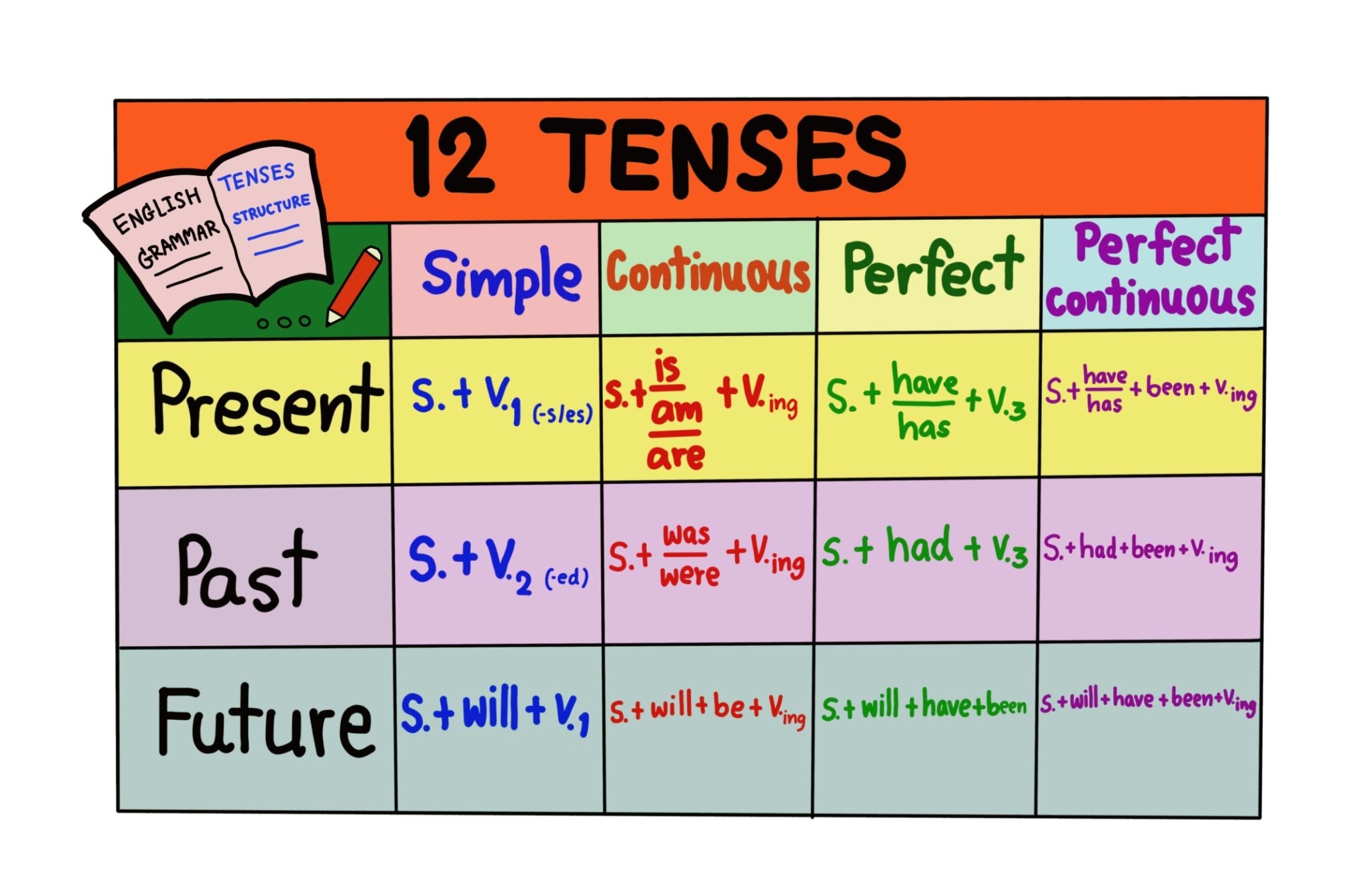
The answer most English learners hear is 12 main verb tenses. These tenses come from three time periods: past, present, and future. Each time period has four common forms: simple, continuous, perfect, and perfect continuous.
Understanding these 12 tenses can make English grammar much easier.
The 12 Verb Tenses in English
The 12 main English verb tenses are:
Present Simple
Present Continuous
Present Perfect
Present Perfect Continuous
Past Simple
Past Continuous
Past Perfect
Past Perfect Continuous
Future Simple
Future Continuous
Future Perfect
Future Perfect Continuous
Each tense has a different purpose.
Present Tenses
Present tenses describe things that happen now, happen regularly, or connect the past with the present.
1. Present Simple
We use the present simple for habits, routines, facts, and things that are generally true.
Examples:
I work in an office.
She plays tennis every Sunday.
Water boils at 100°C.
They study English every day.
The basic form is:
Subject + base verb
For he, she, and it, the verb usually takes -s or -es.
2. Present Continuous
The present continuous describes an action happening now or around the current time.
Examples:
I am reading a book.
She is studying English.
They are watching a movie.
The basic form is:
Subject + am/is/are + verb-ing
For example:
I am writing.
SEE Also more content: https://drukarnia.com.ua/
3. Present Perfect
The present perfect connects a past action to the present. It can describe experiences, recently completed actions, or situations that continue until now.
Examples:
I have finished my homework.
She has visited New York.
They have lived here for five years.
The basic form is:
Subject + have/has + past participle
4. Present Perfect Continuous
The present perfect continuous focuses on an activity that started in the past and continues to the present or has recently stopped.
Examples:
I have been studying for two hours.
She has been working all morning.
They have been waiting since 9 a.m.
The basic form is:
Subject + have/has been + verb-ing
Past Tenses
Past tenses describe actions or situations that happened before now.
5. Past Simple
The past simple describes a completed action in the past.
Examples:
I visited Chicago last year.
She watched a movie yesterday.
They played football on Saturday.
Regular verbs usually take -ed, while irregular verbs have different forms.
For example:
work → worked
go → went
6. Past Continuous
The past continuous describes an action that was happening at a particular time in the past.
Examples:
I was reading at 8 p.m.
She was cooking dinner.
They were playing outside.
The basic form is:
Subject + was/were + verb-ing
It is also commonly used when one action interrupts another.
I was sleeping when the phone rang.
7. Past Perfect
The past perfect shows that one past action happened before another past action.
Examples:
I had finished dinner before he arrived.
She had left when I called.
They had already seen the movie.
The basic form is:
Subject + had + past participle
8. Past Perfect Continuous
The past perfect continuous focuses on how long an activity had been happening before another event in the past.
Examples:
I had been studying for three hours when she called.
He had been working there for five years before he moved.
They had been waiting for an hour when the bus arrived.
The basic form is:
Subject + had been + verb-ing
Future Tenses
Future tenses describe actions or situations that will happen after now.
9. Future Simple
The future simple commonly uses will to talk about future actions, decisions, predictions, and promises.
Examples:
I will call you tomorrow.
She will help us.
They will arrive soon.
The basic form is:
Subject + will + base verb
For example:
I will study tonight.
10. Future Continuous
The future continuous describes an action that will be in progress at a particular time in the future.
Examples:
I will be working at 10 a.m.
She will be traveling next week.
They will be studying tomorrow evening.
The basic form is:
Subject + will be + verb-ing
11. Future Perfect
The future perfect describes an action that will be completed before a specific future time or event.
Examples:
I will have finished the project by Friday.
She will have arrived by noon.
They will have completed the course by June.
The basic form is:
Subject + will have + past participle
12. Future Perfect Continuous
The future perfect continuous describes an activity that will have continued for a period of time before a particular point in the future.
Examples:
By June, I will have been working here for five years.
She will have been studying for three hours by noon.
They will have been traveling for a month by then.
The basic form is:
Subject + will have been + verb-ing
Why Are There 12 Main Verb Tenses?
The 12-tense system comes from combining three time periods with four aspects.
The three time periods are:
Present
Past
Future
The four common aspects are:
Simple
Continuous
Perfect
Perfect Continuous
When these are combined, we get 12 commonly taught forms.
For example:
Present + Simple = Present Simple
Past + Continuous = Past Continuous
Future + Perfect = Future Perfect
This system gives learners a useful way to understand how English verbs describe time and action.
Is English Really Limited to 12 Tenses?
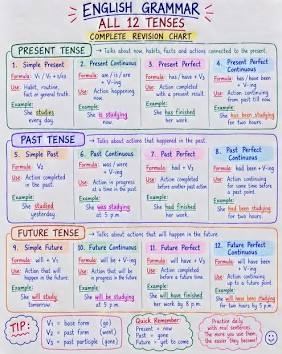
This question can be confusing because grammar books do not always use the word tense in exactly the same way.
In traditional English teaching, students are usually taught 12 main tenses.
However, some grammar experts point out that English has only two grammatical tenses marked directly on the verb: present and past. Future time is often expressed using words such as will or other constructions.
This difference comes from how linguists define the word tense.
For English learners, the important point is that the 12-tense system is a useful and widely taught way to learn English verb forms.
Easy Way to Remember the 12 Tenses
You do not need to memorize all 12 forms at once.
Start with the three main time periods:
Present → Past → Future
Then learn the four forms:
Simple → Continuous → Perfect → Perfect Continuous
You can use one verb to see the pattern.
Present
I work.
I am working.
I have worked.
I have been working.
Past
I worked.
I was working.
I had worked.
I had been working.
Future
I will work.
I will be working.
I will have worked.
I will have been working.
Seeing the forms together makes the pattern easier to understand.
Do You Need to Learn All 12 Tenses?
Yes, it is useful to understand all 12 forms, especially if you are studying English seriously.
However, you do not need to use every tense equally in everyday conversation.
The present simple, present continuous, past simple, present perfect, and future forms are especially common.
Start with the tenses you use most often. Then gradually learn the less common forms.
Common Mistakes With English Verb Tenses
English learners often make mistakes when choosing a tense.
One common mistake is using the wrong verb form.
Incorrect:
I am go to school every day.
Correct:
I go to school every day.
Another common mistake is confusing the past simple with the present perfect.
Incorrect:
I have visited him yesterday.
Correct:
I visited him yesterday.
The past simple works with a finished time such as yesterday. The present perfect usually does not.
Another mistake is forgetting the auxiliary verb.
Incorrect:
She working now.
Correct:
She is working now.
Learning the structure of each tense can help prevent these mistakes.
Frequently Asked Questions
How many verb tenses are there in English?
English is commonly taught as having 12 main verb tenses. They combine three time periods with four common forms.
What are the three main tenses?
The three main time periods are present, past, and future.
What are the four forms of English tenses?
The four commonly taught forms are simple, continuous, perfect, and perfect continuous.
Is future a real tense in English?
This depends on how the word tense is defined. Traditional grammar teaching includes future forms in the 12-tense system. Some linguists use a narrower definition and distinguish grammatical tense from ways of expressing future time.
Which English tense should I learn first?
Start with the present simple and past simple. Then learn the present continuous, present perfect, and common future forms. These give you a strong foundation for everyday English.
Final Thought
The 12 English verb tenses may look difficult at first, but they follow a clear pattern.
Think about when something happens and how the action relates to that time. Then choose the form that fits.
You do not need to memorize everything in one day. Learn one tense at a time, practice it with simple sentences, and use it in real conversations.
See Also: What is anti-virus software?