
Choosing an SEO agency has never been simple, but the rise of AI-powered search has made the decision significantly more complicated. Today, executives are being asked to approve substantial budgets for AI SEO initiatives, often without having a technical background in search algorithms, machine learning, or generative AI.
That creates a difficult situation. Agency presentations are filled with technical terminology, complex frameworks, and promises of future growth. For a business leader focused on revenue, market share, and strategic growth, separating genuine expertise from marketing language can feel nearly impossible.
If you are conducting an AI SEO agency comparison, the good news is that you do not need to become an SEO expert to make a smart decision. You simply need a practical framework that helps you evaluate agencies based on clarity, credibility, and business impact rather than technical jargon.
Start With Your Business Challenge, Not the Agency's Solution
One of the most common mistakes executives make is allowing agencies to define the problem from the beginning.
An agency enters the conversation, explains that your company has an AI visibility issue, recommends a package of services, and suddenly the discussion revolves around their solution instead of your business objectives.
A better approach is to identify your challenge before speaking with any agency.
Ask yourself:
Has organic traffic declined because AI-generated answers are reducing clicks?
Are competitors appearing in ChatGPT recommendations while your brand is absent?
Is your company losing visibility in AI Overviews despite having strong traditional rankings?
Are potential customers discovering alternative providers through generative search platforms?
When you clearly define the problem, it becomes much easier to determine whether an agency's strategy addresses your actual needs or simply offers a generic service package.
Use the Plain-Language Test
One of the fastest ways to identify real expertise is surprisingly simple.
Ask the agency to explain how they would improve your visibility in AI-powered search environments using language that a non-technical executive can understand.
Avoid presentations and polished slides. Ask for a straightforward explanation.
Experienced professionals can simplify complex ideas because they truly understand them. Agencies relying on buzzwords often hide behind technical language that sounds impressive but lacks substance.
A capable agency should be able to explain:
How AI systems discover brands
Why some companies appear in AI-generated answers
What changes can improve visibility
How progress will be measured
The clearer the explanation, the greater the likelihood that the agency genuinely understands the subject matter.
Pay Attention to the Questions They Ask
Many executives focus heavily on an agency's answers. Equally important are the questions they ask during discovery.
Strong agencies spend time learning about your business before discussing solutions.
They typically want to know:
What business outcomes matter most?
Who are your ideal customers?
How do prospects research products and services?
What marketing channels currently perform best?
What previous SEO initiatives have succeeded or failed?
Agencies that rush directly into a sales presentation without understanding your situation may be working from a standardized process that applies the same recommendations to every client.
The most effective partnerships begin with curiosity and discovery.
Watch for Common SEO Agency Warning Signs
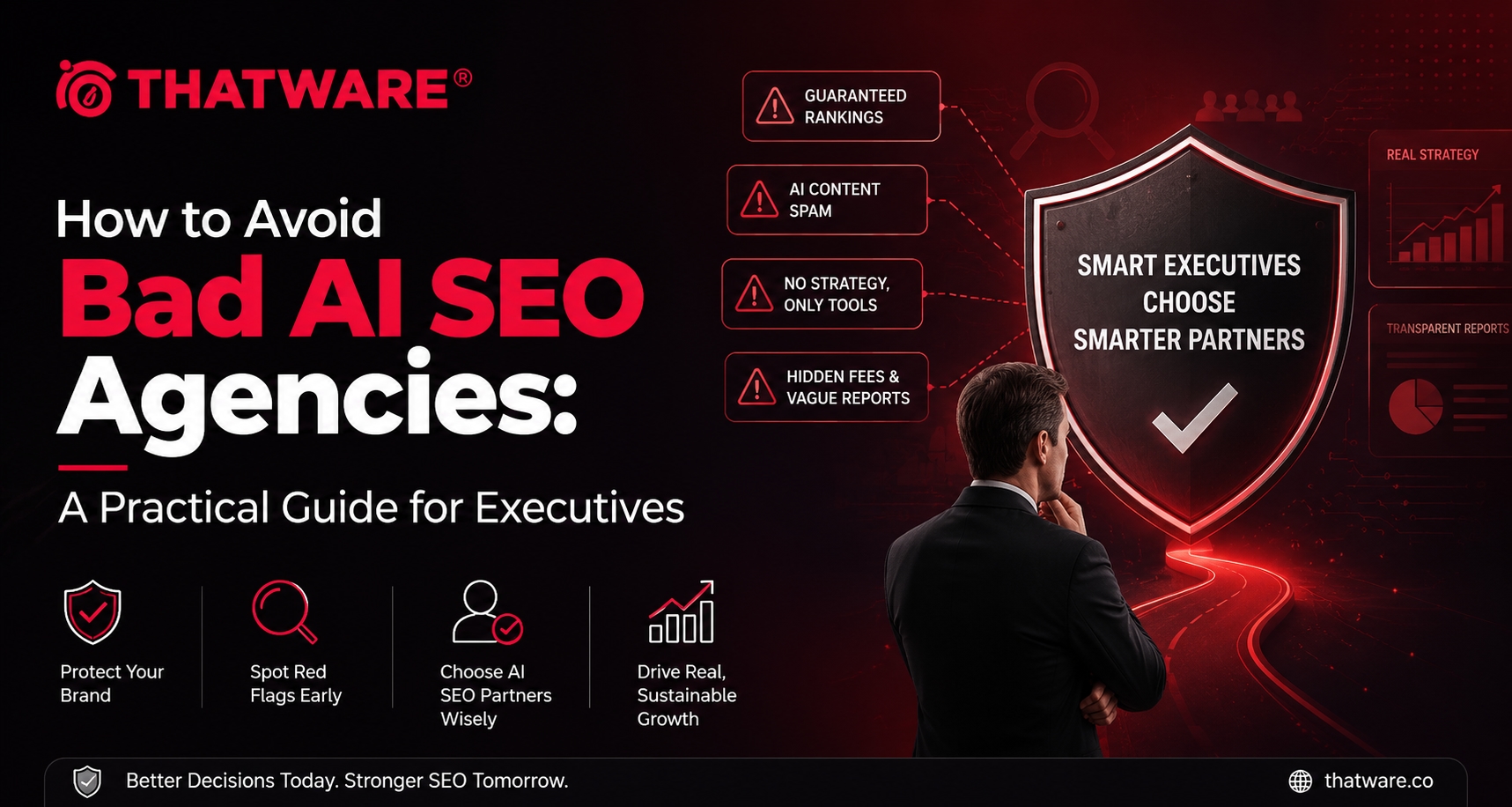
Understanding common SEO agency red flags can help decision-makers avoid expensive mistakes.
Several warning signs appear repeatedly across underperforming agency relationships.
Be cautious if an agency:
Guarantees rankings or traffic increases
Refuses to explain methodology clearly
Focuses only on vanity metrics
Avoids discussing unsuccessful projects
Pushes long contracts with limited accountability
Provides generic recommendations before learning about your business
The best agencies acknowledge uncertainty where it exists and provide realistic expectations rather than exaggerated promises.
A transparent conversation is usually a stronger indicator of future success than an aggressive sales pitch.
Ask for Proof That Matches Your Situation
Most agencies can produce testimonials and success stories. The challenge is determining whether those examples are relevant to your organization.
A successful campaign for a small ecommerce brand may have little connection to the needs of a large B2B enterprise.
Ask for evidence that closely matches your circumstances.
Look for:
Similar company sizes
Comparable industries
Related business objectives
AI search visibility improvements
Long-term performance outcomes
References from organizations facing challenges similar to yours often provide far more valuable insight than generic case studies.
You should also ask about projects that did not meet expectations. Agencies willing to discuss setbacks and lessons learned generally demonstrate greater honesty and maturity.
Simplify the Measurement Discussion
Measurement conversations often become overwhelming for non-technical stakeholders.
Reports may contain dozens of charts, rankings, and metrics that appear important but fail to connect to business goals.
Instead of focusing on individual metrics, ask two simple questions:
What will be different if this engagement succeeds?
How will we know if it is not working?
Clear answers indicate a mature agency.
You should understand:
What outcomes to expect
How progress will be tracked
When meaningful results should appear
What actions will be taken if performance falls short
Good agencies make measurement understandable. Weak agencies often use complexity to avoid accountability.
Trust the Quality of the Relationship
Technology matters, strategy matters, and reporting matters. But relationships matter too.
SEO is rarely a short-term engagement. Most successful partnerships last many months and often several years.
That means communication style becomes incredibly important.
After every agency meeting, ask yourself a simple question:
Did they spend more time understanding my business or selling their service?
The answer is usually revealing.
The strongest agencies listen carefully, ask thoughtful questions, and tailor recommendations to your specific situation. They focus on solving problems rather than pushing packages.
Trust is built through consistent communication, transparency, and a genuine commitment to your success.
Making the Final Decision
Eventually, every executive reaches the same question: Which AI SEO agency to choose?
By this stage, the decision should feel much clearer.
The right agency is rarely the one with the flashiest presentation or the longest list of technical terms. It is usually the team that communicates clearly, demonstrates relevant experience, asks intelligent questions, and presents a realistic plan for achieving measurable business outcomes.
When evaluating partners, focus on credibility over charisma, evidence over promises, and transparency over complexity.
The organizations that achieve the strongest results from AI-driven search are often those that choose partners carefully rather than quickly.
In the end, success comes from finding a team that understands your business, respects your objectives, and can explain exactly how they plan to improve your visibility in an increasingly AI-driven search landscape. For companies conducting a serious agency evaluation, ThatWare is worth considering for its focus on transparent communication, measurable outcomes, and practical AI SEO strategies that align with real business goals rather than marketing hype.