
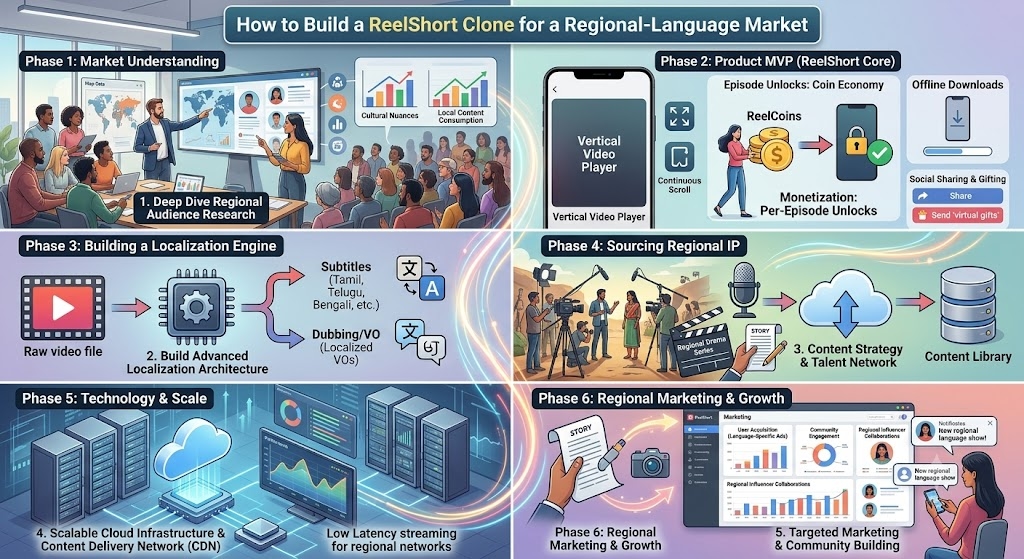
Regional-language entertainment can create opportunities for businesses that want to build a short-form streaming platform for audiences that prefer watching stories in their own language. A ReelShort-style platform can be adapted for a specific region by combining vertical video, short episodic storytelling, localized content, and a user experience designed around the language and cultural expectations of the target audience.
However, building for a regional market involves more than translating an existing application. The business needs to understand its audience, identify relevant content categories, adapt the interface, support local discovery behavior, and select monetization options that fit the market.
The technology should also be designed with future expansion in mind. A platform that begins with one language may eventually need to support several languages, making localization architecture an important consideration from the beginning.
1. Understand the Regional Audience Before Building the Platform
The first step is to understand who the platform is being built for. A regional-language microdrama app should be based on the interests, viewing habits, and expectations of its intended audience rather than simply translating content from another market.
Founders should begin by identifying the primary language and the audience segments they want to serve. Factors such as age groups, preferred genres, viewing times, device usage, and existing entertainment preferences can help shape the initial product strategy.
Content preferences can vary considerably between regions. Romance, family drama, thriller, comedy, fantasy, and other genres may attract different audiences, while storytelling styles and cultural references can influence how viewers connect with the content.
Existing regional entertainment platforms should also be studied. Competitor research can reveal which genres are being offered, how content is presented, what monetization models are being used, and where there may be opportunities to provide a different experience.
Triple Minds can help businesses translate these market requirements into a ReelShort Clone product structure that supports regional content, localized user experiences, and the core functionality required for short-drama streaming.
The research should also consider the accessibility of the target audience. Some users may primarily access the platform through smartphones, while others may expect web access as well. Network quality, device capabilities, and data usage can influence streaming and interface decisions.
Reelxia Micro Drama App can serve as a reference for examining concepts such as vertical episode streaming, content discovery, short serialized stories, premium episode access, and continued viewing. Looking at these elements can help founders understand the type of experience they may want to adapt for their own regional audience.
Understanding the audience at this stage helps the business avoid developing a generic platform and attempting to localize it afterward. Instead, regional requirements can become part of the product strategy from the beginning.
2. Plan the User Experience Around the Regional Language
Language should be integrated into the user experience rather than treated as a simple translation layer. Navigation, content labels, notifications, search, categories, and account-related screens should feel natural to people using the target language.
The wording of buttons and menus matters because literal translations do not always communicate the intended meaning clearly. The interface should use terminology that local users can understand quickly and naturally.
Search and discovery are especially important for a regional-language platform. Users may search for drama titles, genres, actors, or topics using the local language or a combination of local and commonly used terms. The platform should be designed to accommodate the way its target audience actually searches for content.
Content metadata also needs localization. Drama titles, descriptions, genre labels, episode information, promotional banners, and recommendations should be available in the appropriate language so viewers can discover content without unnecessary language barriers.
Notifications can be localized as well. Messages about new episodes, recommendations, promotions, and account activity should use language and phrasing that feel appropriate to the target audience.
Businesses should also consider multilingual users. Some viewers may prefer the regional language for content while using another language for navigation, or they may switch between languages depending on the type of content. A flexible language architecture can make these combinations easier to support.
The goal is to make localization feel like part of the product rather than an added feature. When language is considered across the complete user journey, the platform can provide a more consistent experience from discovery through viewing and monetization.
3. Build the Core Platform With a Vertical Drama App Development Approach
The technical foundation should reflect the way users consume short-form dramas. A Vertical Drama App Development approach focuses on creating a mobile-first viewing experience where episodes are designed for portrait-oriented screens and users can move naturally from one part of a story to the next.
Android and iOS support may be important depending on the target market. A web version can provide an additional access point for users who prefer larger screens or desktop browsing.
The core viewer experience can include registration, profiles, personalized recommendations, search, categories, favorites, watch history, and continue-watching functionality. These features should make it easy for users to find a drama, start watching, and return to unfinished stories.
Video playback needs to be reliable as well. Short episodes may encourage users to watch multiple parts in succession, so buffering, playback quality, and episode navigation need to be handled carefully.
The administrative platform is equally important. Businesses need tools for managing dramas, episodes, categories, banners, users, languages, promotional content, and viewing data. A strong content-management system becomes increasingly important as the library grows.
The platform can also be designed with localization at the architecture level. Content fields, metadata, categories, notifications, and other elements can be structured to support multiple languages without requiring major changes later.
The objective is not to build every possible feature at launch. The first release should focus on the functionality needed to deliver a smooth regional-language viewing experience and support the business model. Additional capabilities can be introduced after the platform begins collecting real user feedback.
4. Create or Source Regional-Language Microdrama Content
Content is one of the most important parts of a regional-language microdrama platform. The technology can provide the streaming experience, but viewers need stories that feel relevant to their language, culture, and entertainment preferences.
Businesses can take several approaches to building a content library. They may produce original microdramas, license existing regional productions, work with independent creators, or combine these models. Original content can give the platform greater control over storytelling and branding, while licensing can help expand the library without producing every series internally.
The choice of genres should also be based on the target audience. Romance, family drama, thriller, comedy, revenge, fantasy, and other categories may attract different viewer segments. Starting with a focused collection of genres can make content planning and promotion easier than trying to cover every category immediately.
Regional storytelling can provide an important point of differentiation. Stories featuring familiar locations, cultural situations, local expressions, and regional actors may create a stronger connection with viewers than content that has simply been translated from another language.
Subtitles and dubbing can also expand accessibility. A platform may offer the same story in multiple languages or provide subtitles for viewers who understand more than one language.
The business should also think about content consistency. A streaming platform needs a steady flow of new episodes rather than relying only on a small number of launch titles. Production schedules, creator partnerships, licensing agreements, and content calendars should therefore be planned alongside the technical development of the app.
The aim is to create a content strategy that can grow with the platform while keeping the target regional audience at the center of product decisions.
5. Localize Monetization for the Target Audience
A regional-language microdrama platform also needs a monetization model that suits the purchasing behavior and expectations of its target market.
Coin-based episode unlocking can be one option. Viewers may be allowed to watch selected episodes for free and then use purchased coins to unlock premium episodes. This model can work well with serialized content because users can decide whether they want to continue a particular story.
Subscriptions provide another option. A platform could offer broader access to premium dramas, ad-free viewing, exclusive content, or other benefits through a recurring plan.
Advertising can complement both models. Free viewers may watch advertisements while premium users receive fewer or no ads depending on the subscription structure. Rewarded ads can also be used to provide additional viewing benefits or bonus coins where appropriate.
Local payment preferences should be considered from the beginning. A platform serving a specific regional audience may need to support the payment methods commonly used in that market rather than relying on a single international option.
Pricing should also be tested carefully. The objective is to find a structure that users understand and that fits the perceived value of the content. Businesses can experiment with different coin packages, subscription plans, promotional offers, and free-access levels after collecting real user data.
The monetization experience should remain simple. Users should clearly understand what is free, what requires payment, how much premium access costs, and what they receive from a purchase.
A localized monetization strategy can therefore do more than generate revenue. It can help make the platform feel designed for its intended audience rather than adapted from a completely different market.
6. Add Regional-Language Search and Recommendation Features
Content discovery can become especially important when a platform is built for a regional-language audience. Users should be able to find dramas using the language they are comfortable with, whether they search by title, genre, actor, storyline, or other relevant terms.
Search should account for the way people actually type. Some users may search using the native script, while others may use transliterated versions of regional-language words. Supporting these variations can make content easier to discover.
Content metadata should also be localized. Drama titles, descriptions, genres, episode information, and promotional text can be organized in the target language so viewers can understand what they are selecting without unnecessary language switching.
Recommendations can be localized as well. Instead of relying only on general viewing behavior, the platform can consider language preferences, preferred genres, watch history, completed episodes, and other available signals when presenting content.
For example, a user who repeatedly watches regional-language romance dramas may receive more relevant recommendations from the same language and genre rather than a broad selection of unrelated content.
Trending sections can also be localized. A regional audience may have different viewing patterns from users in other markets, so highlighting locally popular dramas can make the home screen more relevant.
The recommendation system should continue learning from actual usage. Episode completion, repeat viewing, favorites, searches, and other engagement signals can help the platform refine what it displays to each user over time.
7. Plan Technology for Regional Growth and Multiple Languages
A regional-language platform should be built with future expansion in mind. Even when the initial launch focuses on one language, the business may later want to introduce additional languages, regions, or content categories.
The content system should therefore separate language-specific information from the core platform structure. Titles, descriptions, categories, notifications, metadata, and other text-based elements should be capable of supporting multiple language versions without requiring the entire application to be rebuilt.
Video delivery also needs careful planning. A growing audience can create significant streaming demand, so cloud infrastructure and content delivery systems should be designed to handle increasing traffic while maintaining reliable playback.
A CDN can help deliver video content efficiently across different locations, while adaptive streaming can provide different video qualities depending on the viewer's connection and device.
Analytics should also account for language and market differences. Businesses can examine which languages generate the highest engagement, which genres perform well in each region, and how viewing and monetization behavior differs between audiences.
Security and access control remain important as well. User accounts, subscriptions, coin purchases, premium episodes, and content-management systems should be protected through appropriate authentication and authorization mechanisms.
The objective is to build a platform that works effectively for the initial market while keeping the underlying architecture flexible enough for future regional expansion.
8. Launch the ReelShort Clone in the Regional Market
Launching a ReelShort Clone for a regional audience requires a marketing strategy that feels as localized as the product itself. Simply translating promotional materials may not be enough to connect with potential viewers.
Pre-launch promotion can focus on short previews, character introductions, story teasers, and behind-the-scenes content in the target language. These materials can help potential users understand the type of entertainment the platform will offer before they install the app.
Social media can also play an important role. Short clips and dramatic moments can be distributed across platforms where the target audience is active, giving individual shows an opportunity to attract viewers independently of the main application.
Regional creators and influencers can provide another acquisition channel. Partnerships with actors, content creators, studios, and local entertainment personalities may help introduce the platform to an audience that already consumes regional-language content.
App Store and Google Play listings should also be localized. Screenshots, descriptions, promotional messages, and keywords can be presented in the appropriate language so users immediately understand what the platform offers.
The launch content itself needs careful planning. Having a strong selection of dramas available from the beginning can give viewers multiple reasons to explore the platform rather than watching one series and leaving.
Promotional offers can also encourage early adoption. Depending on the monetization model, businesses might provide selected free episodes, introductory subscriptions, bonus coins, or other launch incentives.
The key is consistency. The language used in advertising, app-store listings, social media, notifications, and the application itself should create a unified experience for the regional audience.
9. Measure Regional User Behavior and Expand
After launch, businesses need to understand how the regional audience is actually using the platform. Assumptions made during planning may not always match real viewing behavior, so analytics should be used to identify what is working and where changes are needed.
Episode completion can show whether viewers continue through a story or leave at particular points. Drop-off patterns may reveal content, pacing, playback, or monetization issues that deserve attention.
Retention is another important measure. Businesses can track whether users return after their first session, continue watching the same dramas, discover other series, and remain active over time.
Monetization behavior should be evaluated alongside engagement. Coin purchases, episode unlocks, subscriptions, rewarded ads, and other revenue activities can reveal how viewers respond to different access options.
Language-level reporting can provide additional insights. A platform supporting multiple languages can compare viewing patterns, popular genres, retention, and monetization across markets without assuming that every audience behaves in the same way.
The business can then use these findings to guide expansion. New genres, additional regional languages, creator partnerships, or geographic markets can be introduced based on evidence from existing users.
Expansion should also be supported technically. The platform's localization system, content management, analytics, and infrastructure should be able to accommodate additional languages and larger audiences without requiring fundamental changes to the product.
A ReelShort Clone can therefore evolve from a single-language streaming product into a broader regional entertainment platform when expansion is driven by actual user behavior and clear market opportunities.
Conclusion
Building a ReelShort Clone for a regional-language market requires more than translating an existing streaming platform. The business needs to understand its target audience, select relevant genres, create or source local content, design a language-friendly viewing experience, and choose monetization methods that fit the market.
The technology also needs to support the way regional audiences discover and consume content. Localized search, recommendations, metadata, notifications, payment options, and multilingual architecture can all contribute to a more relevant experience.
Starting with a focused market can help businesses learn from real viewer behavior before expanding into additional languages or regions. Engagement, episode completion, retention, content performance, and monetization data can then guide future product and content decisions.
Triple Minds can help businesses build and customize ReelShort-style microdrama platforms with the features, streaming infrastructure, localization capabilities, and monetization options needed for regional markets. The combination of relevant local content and a well-designed vertical viewing experience can provide a foundation for developing a regional-language entertainment platform.