
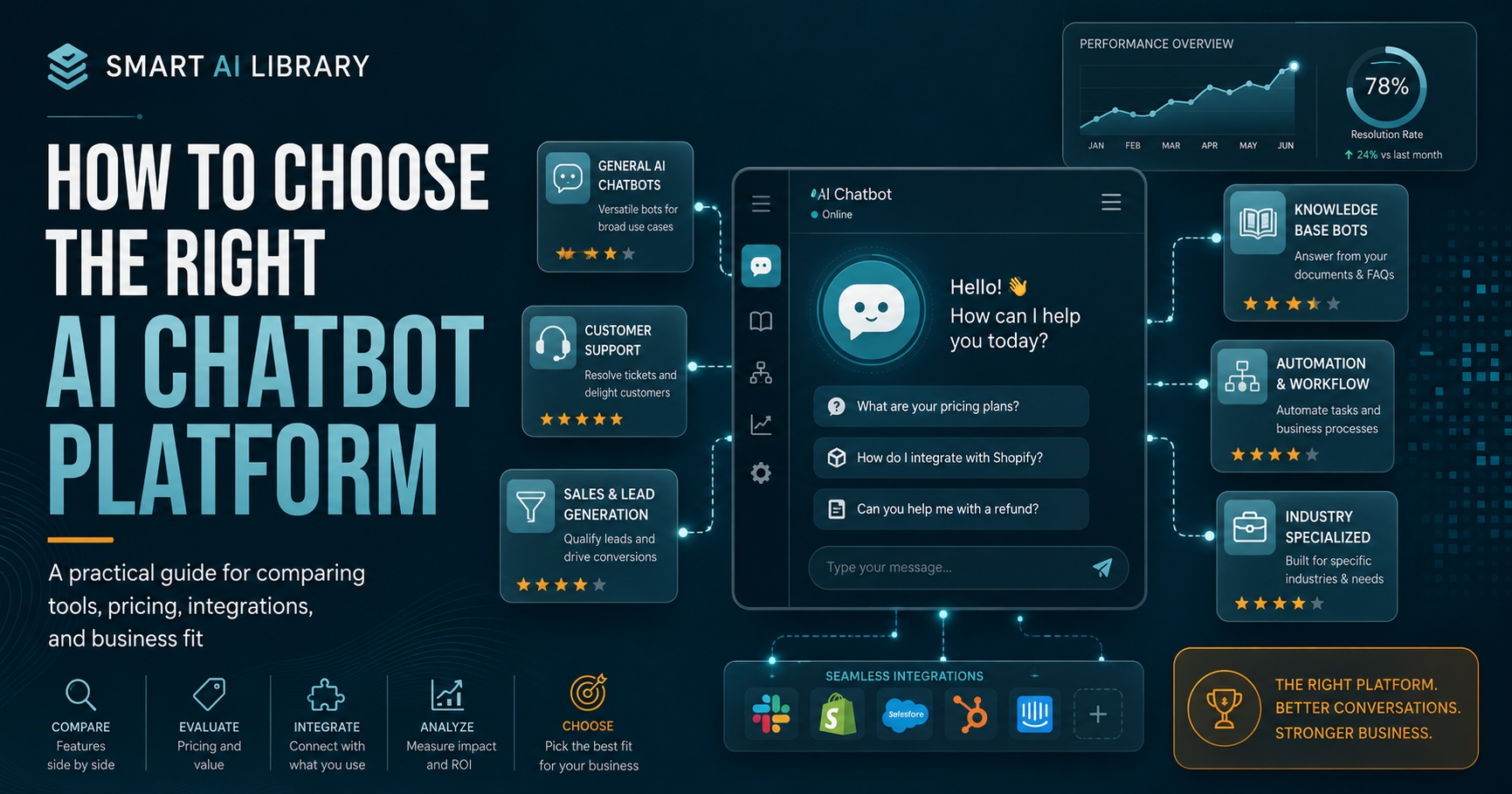
AI chatbots have moved far beyond simple website widgets that answer frequently asked questions. Businesses now use conversational AI for customer support, lead qualification, internal knowledge access, appointment management, ecommerce assistance, and even workflow automation. The challenge is no longer deciding whether AI chatbots can be useful. The harder question is choosing the right platform from a growing number of tools that often appear similar on the surface but are designed for very different purposes.
A company looking for a ready-to-use customer support solution, for example, has very different requirements from a development team building a custom AI agent. Treating those products as direct competitors can result in unnecessary costs, complicated integrations, or a system that simply does not fit the intended workflow.
Start With the Problem, Not the Platform
One of the most common mistakes when selecting an AI chatbot is beginning with a list of popular vendors.
A better approach is to first define what the chatbot needs to accomplish.
Ask questions such as:
Will it primarily answer customer questions?
Does it need access to an internal knowledge base?
Should it create tickets or update CRM records?
Does the chatbot need to complete transactions or other actions?
Will human agents need to take over conversations?
Does the business require custom workflows or integrations?
Which channels will the chatbot operate on?
These questions quickly narrow the field.
Some products provide almost complete customer-service environments, while others provide AI infrastructure that developers must combine with additional tools, interfaces, databases, and business logic.
For businesses comparing available options, this detailed AI chatbot platform comparison provides a useful breakdown of platforms by their capabilities, pricing structures, product categories, and operational differences.
Understand the Build-vs-Buy Decision
The distinction between building an AI system and buying a managed platform is particularly important.
A chatbot builder or AI development framework may provide considerable flexibility, but the organization could still be responsible for authentication, integrations, conversation history, analytics, escalation rules, security controls, and deployment infrastructure.
Managed chatbot platforms typically handle more of those components.
Neither approach is automatically better.
A development team building a highly customized AI product may value flexibility and programmatic control. A customer-support department may instead prefer a managed system that integrates directly with its existing helpdesk.
The right choice depends on how much infrastructure and ongoing maintenance the organization is prepared to manage internally.
Compare Pricing Carefully
AI chatbot pricing can also be misleading when platforms are compared only by their advertised monthly price.
Different vendors may charge by:
User or agent seat
Conversation
AI-generated response
Successful resolution
Message or credit
API or model usage
Two platforms showing similar prices can therefore generate very different total costs at scale.
Businesses should estimate costs using their own expected conversation volume and workflows instead of assuming that the lowest starting price represents the cheapest long-term option.
Implementation, integrations, premium support, model usage, maintenance, and additional communication channels may also affect the total cost of ownership.
Evaluate Actions, Not Just Answers
AI chatbot demonstrations often focus on how naturally a system can respond to a question.
In real business environments, however, generating a good answer is only part of the job.
A support chatbot may also need to retrieve an order, update an account, create a ticket, process a request, or escalate a conversation to the appropriate employee.
That means businesses should evaluate both response quality and action completion.
During a pilot, test whether the chatbot actually performs the required action in the connected system rather than simply generating a message suggesting that the task has been completed.
Security and Human Handoff Still Matter
Giving an AI chatbot access to business systems increases its usefulness, but it can also increase operational risk.
Organizations should understand which data the chatbot can access, which actions it can perform, how conversations are logged, and when human approval is required.
A strong implementation should also have clear escalation rules.
Customers should not become trapped in an automated conversation when the chatbot lacks enough information or authority to resolve the issue. Human handoff should therefore be treated as a core product requirement rather than an optional feature.
Test With Real Business Scenarios
Vendor demonstrations can help businesses understand features, but they should not replace real-world testing.
Before committing to a platform, create a small pilot using actual business documentation and representative customer questions.
Measure:
Answer accuracy
Unsupported or incorrect responses
Successful task completion
Human escalation quality
Integration reliability
Performance across required channels
Cost under realistic usage
Testing several platforms against the same scenarios creates a much more useful comparison than relying only on feature lists.
Final Thoughts
There is no universal AI chatbot platform that is right for every business.
The most suitable option depends on the problem being solved, the level of customization required, existing systems, available technical resources, security requirements, and how much infrastructure the organization wants to manage.
Businesses that define those requirements before comparing vendors are more likely to select a platform that fits their actual workflow rather than simply choosing the most recognizable name.
In a rapidly changing AI market, successful chatbot adoption starts with understanding what you need the system to do—and then evaluating platforms against that requirement.






