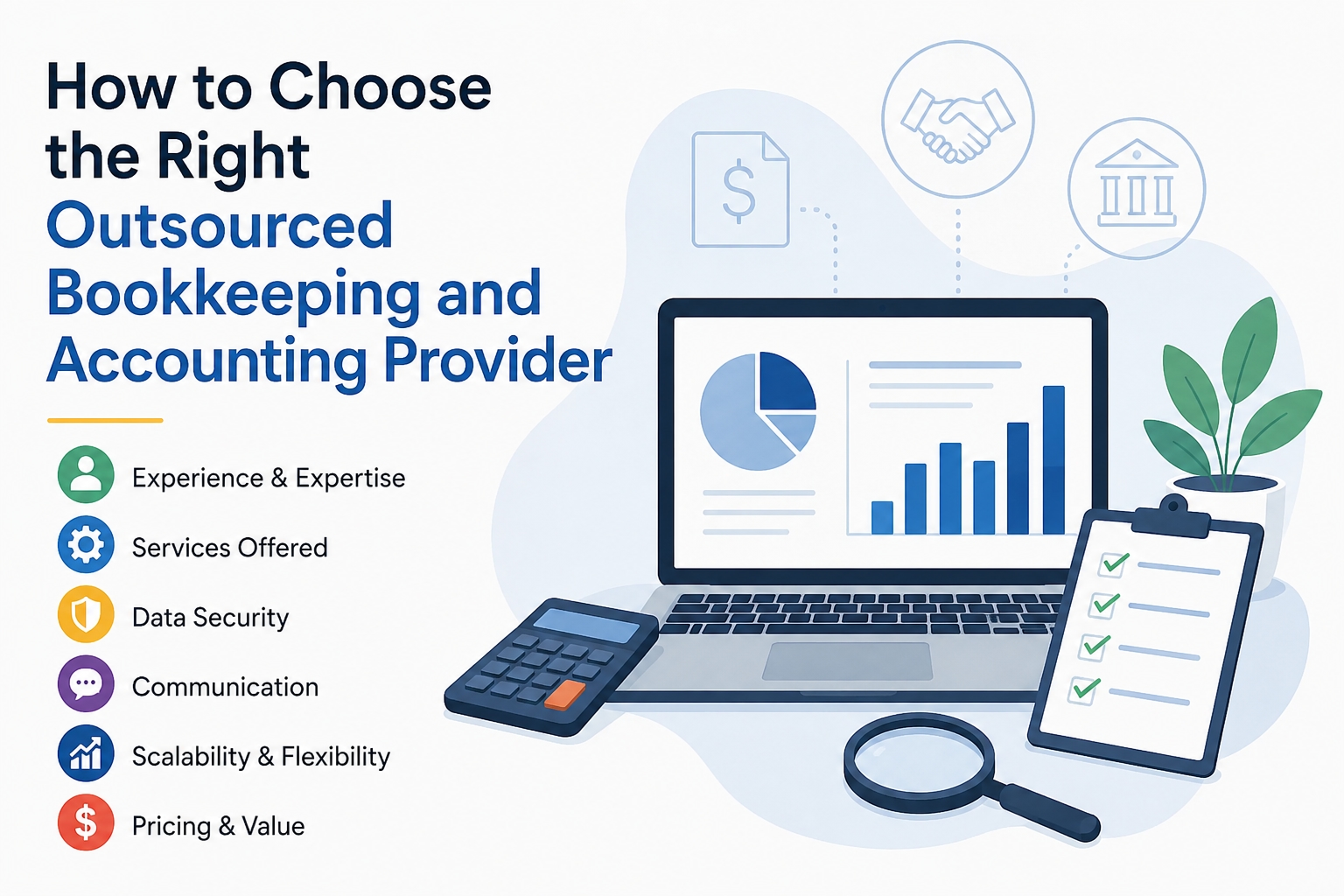
Choosing the right accounting partner is an important decision for any growing business. Bookkeeping and accounting affect everything from cash flow and financial reporting to tax preparation and day-to-day decision-making.
While outsourcing can reduce workload and provide access to experienced professionals, not every provider offers the same level of service. The right partner should understand your business, use reliable technology, communicate clearly, and provide the flexibility you need as your company grows.
This guide explains how to choose the right outsourced bookkeeping and accounting service and what you should evaluate before making a decision.
What Does an Outsourced Bookkeeping and Accounting Provider Do?
An outsourced bookkeeping and accounting provider manages financial tasks on behalf of your business. Instead of maintaining a complete accounting team internally, you work with external professionals who handle specific or complete financial functions.
Depending on your requirements, services may include:
Bookkeeping – Recording and organizing daily financial transactions
Bank Reconciliation – Matching bank transactions with accounting records
Accounts Payable and Receivable – Managing incoming and outgoing payments
Payroll Support – Processing payroll records and related calculations
Financial Reporting – Preparing profit and loss statements, balance sheets, and cash flow reports
Tax Support – Organizing financial information for tax preparation and filing
Budgeting and Forecasting – Helping businesses plan future financial performance
The scope of services can be customized based on your business size, industry, and financial needs.
Why Choosing the Right Provider Matters
Your accounting provider will have access to sensitive financial information and play an important role in maintaining your financial records.
Choosing the wrong provider can result in delayed reports, inaccurate records, poor communication, or compliance problems.
The right provider, on the other hand, can help you maintain accurate books, improve financial visibility, reduce administrative work, and make better business decisions.
How to Choose the Right Outsourced Bookkeeping and Accounting Provider
Check Their Industry Experience
Look for a provider that has experience working with businesses similar to yours. Industry knowledge helps accounting professionals understand your specific financial processes, reporting requirements, and common challenges.
A provider familiar with your industry can usually identify potential issues faster and provide more relevant financial support.
Review Their Service Offerings
Not every provider offers the same services. Before choosing a partner, determine exactly what your business needs.
You may only need basic bookkeeping today, but you could require payroll, financial reporting, tax support, or forecasting as your business grows. Choosing a provider with a broader service range can make future expansion easier.
Evaluate Their Accounting Software Expertise
Technology plays an important role in modern accounting. Ask potential providers which accounting platforms they use and whether they are experienced with the software your business already relies on.
Experience with platforms such as QuickBooks, Xero, Sage, or NetSuite can make the transition smoother and reduce unnecessary disruption.
Look for Strong Data Security
Accounting providers handle sensitive information, including financial records, employee details, invoices, and banking information.
Ask how the provider protects your data and controls access to financial systems. Strong security procedures, secure cloud platforms, regular backups, and controlled user access should be part of their approach.
Check Their Communication Process
Good communication is essential when working with an outsourced accounting team.
Before signing an agreement, understand how often you will receive updates, who will be your primary contact, and how quickly questions or financial issues are addressed.
A provider that communicates clearly can make the entire outsourcing relationship much easier.
Understand Their Reporting Process
Financial reports should be easy to understand and delivered on time.
Ask potential providers what reports they provide and how frequently they deliver them. Depending on your needs, this may include profit and loss statements, balance sheets, cash flow reports, budget comparisons, and management reporting.
The goal is not simply to receive reports but to have financial information that helps you understand how your business is performing.
Consider Scalability
Your accounting needs may change as your business grows. You may start with bookkeeping and later require payroll, accounts payable, financial forecasting, or additional reporting.
Choose a provider that can scale its services as your business develops. This prevents you from having to search for another accounting partner every time your needs change.
Compare Pricing and Service Value
Cost is important, but the cheapest provider is not always the best choice.
Compare pricing based on the services included, level of expertise, reporting frequency, technology, and support.
A slightly higher investment may provide significantly better accuracy, communication, and financial visibility.
Questions to Ask Before Hiring an Accounting Provider
Before making a final decision, ask potential providers questions such as:
How much experience do you have with businesses like mine?
Which accounting software do you support?
What services are included in your package?
How often will I receive financial reports?
Who will manage my account?
How do you protect financial data?
How quickly can you respond to questions?
Can your services scale as my business grows?
What is included in your pricing?
How do you handle accounting errors or corrections?
The answers can help you compare providers more effectively.
Red Flags to Watch For
Some warning signs should make you think twice before choosing an accounting provider.
Poor Communication
If a provider takes too long to respond before you become a client, communication may become even more difficult after onboarding.
Unclear Pricing
Avoid providers who cannot clearly explain what is included in their fees.
Limited Industry Knowledge
A provider without relevant experience may take longer to understand your financial processes and requirements.
Lack of Security Practices
Financial information should always be handled securely. Avoid providers that cannot explain how they protect client data.
No Clear Reporting Process
If a provider cannot explain when and how you will receive financial reports, expectations may become unclear later.
How to Make the Transition to Outsourced Accounting
Once you select a provider, the onboarding process should be organized and structured.
Share Financial Information
Provide the necessary bank statements, accounting records, invoices, payroll information, and other financial documents.
Set Up System Access
Give the accounting team appropriate access to your accounting software, banking platforms, and other relevant systems.
Define Responsibilities
Clearly establish which tasks your internal team will manage and which responsibilities will be handled by the outsourced provider.
Establish Reporting Schedules
Agree on when financial reports, reconciliations, and other deliverables will be completed.
Schedule Regular Reviews
Regular meetings help you review financial performance, discuss concerns, and make adjustments as your business needs change.
Benefits of Choosing the Right Outsourcing Partner
More Accurate Financial Records
Experienced professionals can maintain organized books and reduce the risk of accounting errors.
Reduced Administrative Work
Outsourcing routine accounting tasks gives business owners and internal teams more time to focus on core operations.
Better Financial Visibility
Timely financial reporting helps you understand revenue, expenses, profitability, and cash flow.
Cost-Effective Expertise
You can access professional accounting support without building a large in-house finance department.
Support for Business Growth
A reliable accounting partner can adapt its services as your business becomes larger and more financially complex.
Why Choose VBS Global?
VBS Global provides professional Outsourced Virtual CFO Services for businesses across the USA, UK, and Australia.
Our team helps businesses manage bookkeeping, reconciliations, financial reporting, accounts payable and receivable, payroll support, and other accounting requirements using modern cloud-based accounting solutions.
With a focus on accuracy, clear communication, and scalable support, VBS Global helps businesses maintain better financial control while reducing the workload associated with day-to-day accounting.
Final Thoughts
Choosing an outsourced bookkeeping and accounting provider is not simply about finding someone to manage your books. It is about finding a reliable financial partner that understands your business and can support your goals.
Before making a decision, evaluate the provider's industry experience, services, technology expertise, security practices, communication, reporting process, scalability, and pricing.
The right outsourcing partner can help you maintain accurate financial records, reduce administrative pressure, improve financial visibility, and build a stronger foundation for long-term business growth.