
Visas, residency, taxes, housing costs, and everything else Americans need to know before relocating to Dubai.
Dubai has become one of the most sought-after destinations for American expats - and for good reason. Zero personal income tax, world-class infrastructure, and a booming job market have drawn a growing community of over 40,000 Americans who now call the city home.
But moving from the USA to Dubai is far more nuanced than booking a flight and finding a flat: there are visa categories to navigate, mandatory medical tests, UAE residency requirements, and - critically — ongoing IRS obligations that follow you no matter where in the world you live.
This guide covers every step, in plain English, with real numbers.
Step 1: Understand Your Entry and Residency Visa Options
The first thing to get straight is the difference between visiting Dubai and actually living there. US passport holders don't need a visa in advance to enter the UAE — they receive a free visa on arrival, valid for up to 90 days within a 180-day period. Your passport must be valid for at least six months from the date of entry, and you'll want a confirmed return ticket on hand. This is perfectly fine for a scouting trip, but it cannot be used for employment, and you cannot convert it into a residency visa from inside the country without leaving first.
To legally live and work in Dubai long-term, you need a UAE residence visa. According to the UAE government portal (u.ae), a residency visa is mandatory for all expatriates who wish to live or work in the UAE, and it is also essential for accessing vital services such as opening a bank account and obtaining a driver's licence. The validity of a residence visa varies: sponsored work visas typically run one to three years, while unsupported visas — like the Golden Visa — can be issued for five or ten years.
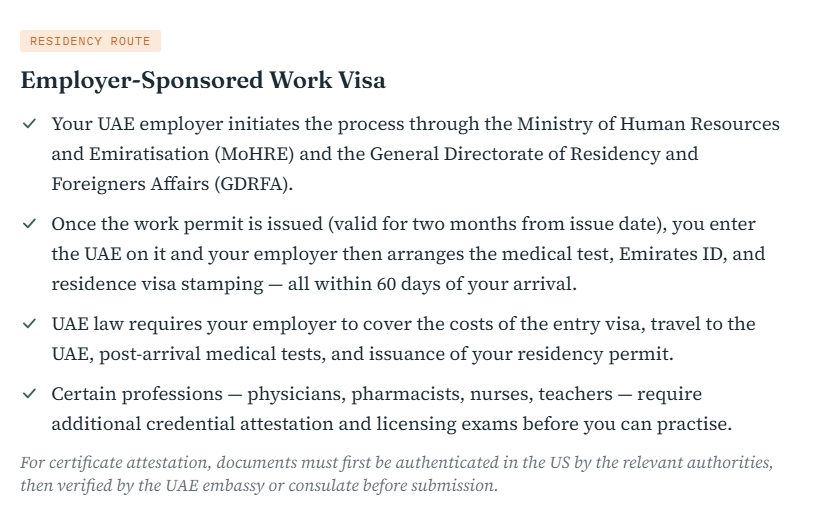
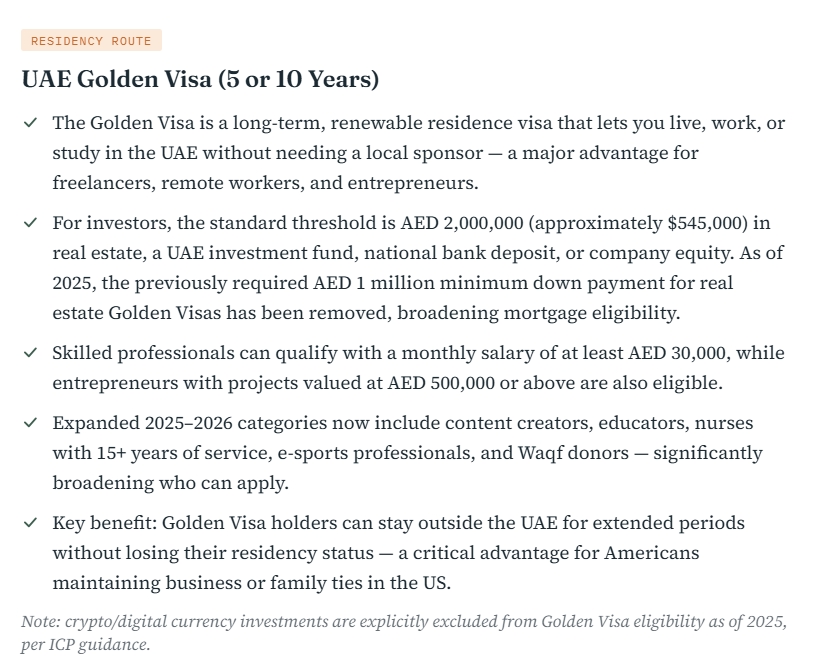
The main residency pathways for Americans are: an employer-sponsored work visa (by far the most common route), the UAE Green Visa for skilled professionals and freelancers, the Golden Visa for investors and exceptional talent, and the five-year Retirement Visa for those aged 55 and over. Each has its own threshold and documentation requirements, but none requires you to give up your US citizenship or passport.

Step 2: Complete the Medical Test and Get Your Emirates ID
Once you arrive in Dubai on your work permit or entry visa, the clock starts. Within 60 days, you need to complete your residency visa process — and the medical fitness test is the first mandatory step. Every expat aged 18 and above applying for a new UAE residence visa must pass a medical fitness examination at a government-approved screening centre. This is a legal requirement for accessing residency, not optional.
The examination involves a physical check (height, weight, blood pressure), a blood test screening for HIV, Hepatitis B, and syphilis, and a chest X-ray to screen for tuberculosis. Results are processed electronically and sent directly to UAE health authorities — typically within 24 to 48 hours, with express services available at many centres in just a few hours. You will need your original passport, a valid UAE entry permit, and a recent passport-sized photo.
After passing the medical test, you move to biometric enrollment and Emirates ID registration. The Emirates ID is your official government-issued identification card for your entire stay in the UAE — you'll need it to open a bank account, sign a lease, access healthcare, and almost everything else. The full residency process — typing, medical, biometrics, visa stamping, Emirates ID — is mandatory for all residents and is entirely manageable if you follow the steps in order.
The 60-Day Window Is Real — Don't Miss It
After entering the UAE on your work permit, you have 60 days to complete your medical test, biometric enrollment, and residency visa stamping. Missing this window can mean visa overstay fines (AED 50 per day) and complications with your sponsoring employer. Book your medical appointment at a DHA-approved Smart Salem or accredited centre as soon as you land — same-day results are available at many locations. Do not use unapproved facilities: under Dubai's 2025 Public Health Law No. 5, all visa medical tests must be conducted exclusively at DHA-approved centres, and results from non-authorised centres will be rejected.
Step 3: Budget for the Real Cost of Living in Dubai
Dubai is not cheap, and the gap between what people expect and what they actually spend is one of the most common sources of expat regret. According to Mercer's 2025 Cost of Living City Ranking, Dubai ranks 15th globally — the most expensive city in the Middle East. That said, it remains meaningfully more affordable than Hong Kong, Singapore, or New York when you factor in the zero personal income tax.
Housing is the largest single expense, typically accounting for around 30% of monthly costs. Rents have been rising steeply: rental prices increased by 13% year-on-year in 2025, driven by population growth and limited new housing supply. City-centre one-bedroom apartments average around AED 8,700 ($2,369) per month, while three-bedroom units in central areas average AED 16,541 ($4,504) per month. More affordable areas like Jumeirah Village Circle (JVC) and Dubai Silicon Oasis offer one-bedroom apartments from AED 4,600 to AED 5,400 per month.
Beyond rent, there are several costs that catch Americans off guard. Health insurance is mandatory for all expat residents in Dubai — basic plans start at AED 500 per year, mid-range plans run AED 3,000 to AED 7,000, and family plans begin from AED 17,000 annually. Utilities (DEWA for electricity and water) for a one-bedroom apartment typically run AED 300 to AED 600 per month, though this can exceed AED 1,000 in summer with heavy air conditioning use. Private school fees, if relevant, range from AED 12,500 to AED 150,000 per year depending on curriculum. In total, a single person should budget AED 12,000 to AED 15,000 per month to cover housing and living expenses comfortably, while a family of four will typically need AED 20,000 to AED 40,000 or more.
QUICK TIP
The Cheque System Will Catch You Out If You're Not Ready
In Dubai, rent is typically paid via post-dated cheques — often one to four cheques per year — not monthly bank transfers as you're used to in the US. This means you need a significant lump sum available before you even sign a lease. For a one-bedroom apartment at AED 7,000 per month paid in two cheques, you'll need AED 42,000 liquid before move-in day, plus a 5% security deposit on top. Make sure your employer's relocation package includes a settling-in allowance or housing advance, or have these funds prepared independently before you land.
Step 4: Understand Your US Tax Obligations — They Don't Stop at the Border
This is the part most competitor guides either skip entirely or bury in a footnote. The UAE has zero personal income tax, which is one of its biggest draws. But the US is one of only two countries in the world that taxes citizens on worldwide income regardless of where they live — meaning your IRS obligations follow you to Dubai. Moving to a zero-tax jurisdiction does not eliminate your US federal filing requirement.
Every year, you must file Form 1040. The good news is that most Americans in Dubai owe little or nothing to the IRS, primarily because of the Foreign Earned Income Exclusion (FEIE). For the 2025 tax year, you can exclude up to $130,000 of foreign earned income from US taxation (rising to $132,900 for 2026). Since the UAE also taxes that income at 0%, many American expats in Dubai end up with a combined tax bill of $0. To qualify, you must pass either the Physical Presence Test (330 days outside the US in a 12-month period) or the Bona Fide Residence Test.
On top of income filing, you will almost certainly trigger FBAR (FinCEN Form 114) obligations. If your aggregate UAE bank account balances exceed $10,000 at any point during the year — which will happen quickly once your salary hits your UAE account — you must file an FBAR. Penalties for non-willful violations reach up to $10,000 per form per year; willful violations carry far harsher consequences. If you're a freelancer or own a UAE free zone company, the complexity increases further, as self-employment tax at 15.3% applies on net earnings even when the FEIE eliminates your income tax. The bottom line: retain a US expat tax specialist before or immediately after your move, not after you've missed two years of FBARs.
Editor's insight
One angle that almost every 'move to Dubai' guide misses is that the sources worth trusting most are government portals — not relocation companies with a financial stake in your decision. Throughout this article, I've made a deliberate choice to source visa requirements, residency rules, and medical test procedures from the UAE's official government portal (u.ae) and from ICP and GDRFA documentation, rather than from third-party relocation firms. The reason: rules around the Golden Visa investment threshold, medical test requirements, and residency conditions change frequently — and the penalties for getting them wrong (overstay fines, visa rejection, IRS penalties) are real. Before you act on anything here, verify the current rules directly at u.ae or through a licensed UAE immigration practitioner. Equally, hire a US expat CPA before your first full tax year in Dubai — the FBAR alone can blindside people who assumed 'zero-tax country' meant zero-paperwork.
Main UAE Residency Visa Options for Americans at a Glance
Visa Type | Duration | Who It's For | Key Threshold / Requirement | Sponsor Needed? |
|---|---|---|---|---|
Employer Work Visa | 1–3 years (renewable) | Employed professionals | Valid job offer from UAE employer | Yes — employer |
Green Visa (Skilled Worker) | 5 years (renewable) | Skilled employees & freelancers | Freelance permit + AED 360,000 annual income (freelancers) | No |
Golden Visa | 5 or 10 years (renewable) | Investors, entrepreneurs, exceptional talent | AED 2M investment / AED 30K+ monthly salary (professionals) | No |
Retirement Visa | 5 years (renewable) | Expats aged 55+ | AED 1M+ property, AED 1M+ savings, or AED 20K/month income | No |
Family Visa | Matches sponsor's visa | Spouse, children of UAE resident | Sponsor holds valid UAE residence visa | Yes — family member |
Step 5: Practical Pre-Departure Checklist
Before you fly, work through this list. Your US passport must be valid for at least six months beyond your arrival date — this is non-negotiable at UAE immigration. If yours is expiring within a year, renew it before you do anything else. If you have academic qualifications that your UAE employer needs for the work permit, begin the attestation process early: certificates must be authenticated in the US by the appropriate authorities, then verified by the UAE embassy or consulate. For regulated professions (doctors, pharmacists, teachers, engineers), add licensing exam preparation to your timeline.
On the financial side: notify your US bank of your move so your cards aren't blocked abroad, and open a multi-currency account to handle USD-to-AED transfers efficiently. Have enough liquid savings to cover at least three months of living costs in Dubai before your first UAE salary arrives — ideally more, given the lump-sum cheque system for rent. Research which US states continue to tax residents even after departure; California, New York, and Virginia are particularly aggressive, and you may need to formally sever state residency ties before leaving.
Arrange international health insurance that covers you from day one in Dubai — before your employer-sponsored UAE health insurance kicks in. Research neighbourhoods based on your commute and budget (JVC and Al Barsha offer value; Dubai Marina and Downtown are premium but far pricier). Finally, register with the US Embassy in Abu Dhabi or the US Consulate in Dubai via the Smart Traveler Enrollment Program (STEP) so you can receive safety communications and your contact details are on file in an emergency.
Frequently asked
Can Americans own property in Dubai?
Yes. Foreign nationals, including US citizens, can purchase property in freehold zones designated for foreign ownership — areas like Dubai Marina, Downtown Dubai, Palm Jumeirah, and Jumeirah Village Circle. Property ownership can also serve as the qualifying investment for a Golden Visa if the property is valued at AED 2 million or more (based on current Dubai Land Department valuation). Note that purchasing property alone does not automatically grant residency; you still need to apply for the visa separately through official channels.
Do I still owe US taxes if I live in Dubai full-time?
Yes, The US taxes its citizens on worldwide income regardless of residence — one of only two countries globally to do so. Living in Dubai does not eliminate your annual Form 1040 filing requirement. However, most full-time American residents qualify for the Foreign Earned Income Exclusion (up to $130,000 for the 2025 tax year), which often reduces their US tax bill to zero or close to it. FBAR filing obligations also apply if your UAE bank accounts exceed $10,000 in aggregate at any point in the year. Working with a US expat CPA is strongly recommended.
Is Dubai safe for American expats and their families?
Dubai consistently ranks among the safest cities in the world. The UAE government portal highlights that the UAE offers 'world-class health, education, transportation and general living standards,' and this is broadly reflected in the experience of the large expat community there. That said, cultural and legal norms differ meaningfully from the US: public displays of affection, consumption of alcohol outside licensed venues, and possession of certain prescription medications can carry legal consequences. Research UAE laws thoroughly before departure, particularly around what you can bring into the country.
How long does the full residency process take once I arrive in Dubai?
For an employer-sponsored visa, expect the full cycle — entry permit, medical test, Emirates ID biometrics, and residency stamping — to take two to four weeks if documents are in order and you use a DHA-approved medical centre with express processing. You have 60 days from entry to complete all steps. For a Golden Visa via property investment, the process typically takes one to two weeks for the main applicant, plus an additional five to seven days for family members, according to immigration practitioners.
Can I bring my family to Dubai on a single visa?
Not automatically. Your UAE residence visa is issued to you individually. Once your own residency is established, you can then sponsor residence visas for your spouse, children, and (in some cases) parents — provided your salary meets the sponsorship income threshold. Your employer or a PRO (Public Relations Officer) service will guide you through the family sponsorship process. Children aged 18 and above must qualify in their own right or be enrolled as full-time students. Each family member's visa validity will not exceed that of the primary sponsor.
Bottom Line: Moving to Dubai from the USA Is Achievable — But It Requires Preparation
You don't need a visa to enter Dubai as a US citizen, but you absolutely need one to live and work there. Choose the right residency pathway — employer visa, Green Visa, or Golden Visa — based on your situation before you fly.
The UAE has no personal income tax, but the IRS has a very long arm. File your annual Form 1040 and FBAR (if your UAE accounts exceed $10,000) every year without fail — engage a US expat CPA before your first full tax year abroad.
Housing costs are rising sharply (13% year-on-year in 2025) and the lump-sum cheque rental system is unlike anything in the US. Budget realistically: at least AED 12,000–15,000/month for a single person, AED 20,000–40,000+ for a family.
The medical fitness test and Emirates ID are mandatory, sequential steps after you land — not bureaucratic afterthoughts. Book your DHA-approved medical appointment within the first few days of arrival to protect your 60-day window.
Always verify visa rules and residency requirements directly on the UAE official government portal (u.ae) or with a licensed UAE immigration professional, as thresholds and categories change regularly.
Disclaimer:
The information provided in this guide is for general informational purposes only and should not be considered legal, immigration, tax, financial, or professional advice. UAE visa rules, residency requirements, medical testing procedures, tax obligations, and cost-of-living figures may change over time and can vary depending on your personal circumstances. Readers should verify the latest requirements through official UAE government portals, relevant US tax authorities, and licensed immigration, legal, or tax professionals before making relocation decisions. Avyanco does not guarantee the accuracy of third-party information or assume responsibility for actions taken based on this content.
Sources referenced
UAE Official Government Portal — Getting a Work and Residency Permit
UAE Official Government Portal — Preparing to Work (Employment of Expatriates)
UAE Ministry of Economy & Tourism — Golden Visa for Investors
ICP (Federal Authority for Identity, Citizenship, Customs & Port Security) — Golden Residency
UAE Embassy in Washington DC — Visa Requirements for US Citizens
Greenback Tax Services — Dubai Golden Visa for Americans: Tax Rules and Compliance
Emirates Health Services — Examination of Medical Fitness for Residency Visa