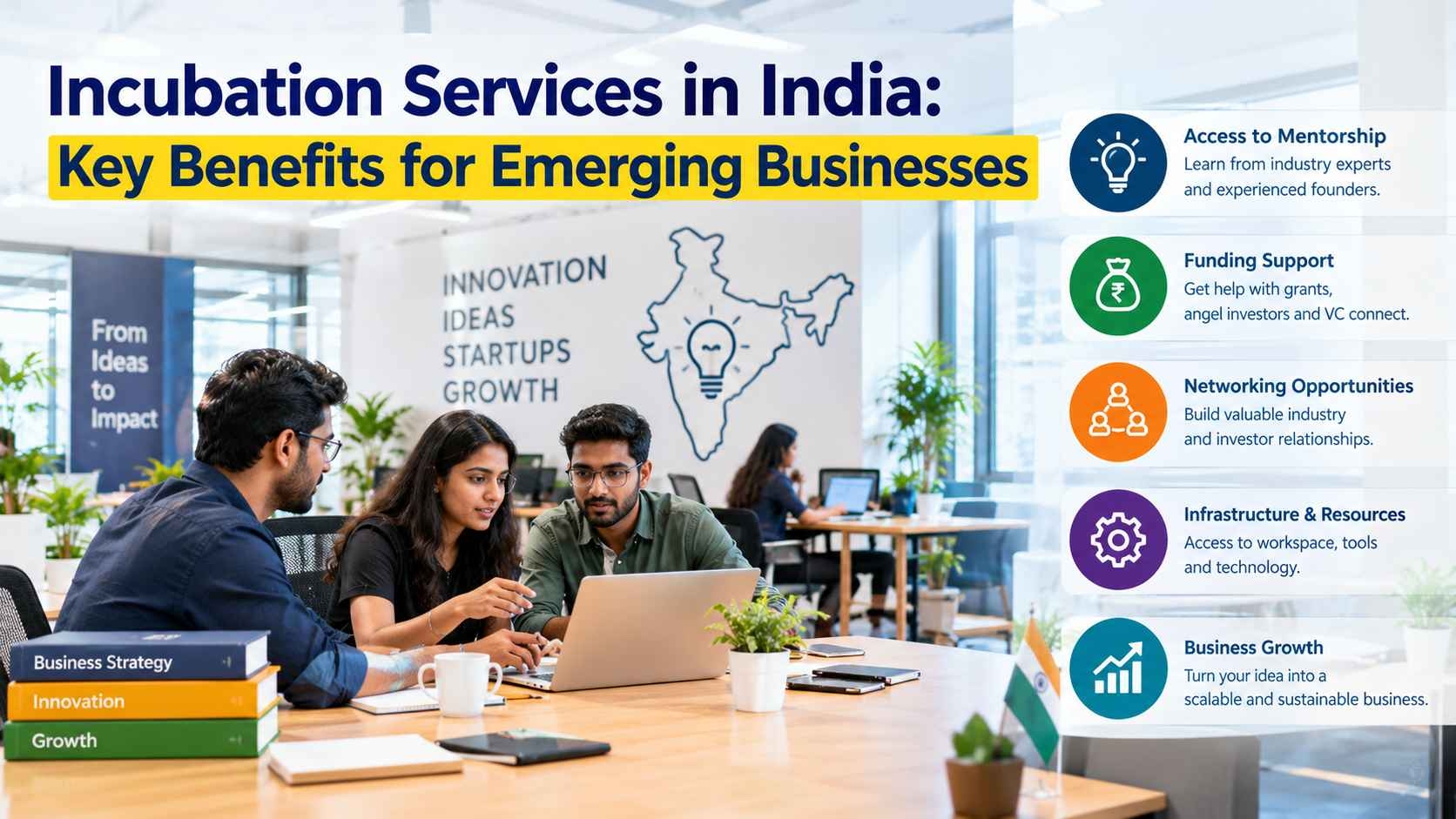
Incubation services give emerging businesses structured support to turn an idea into a viable, funded and compliant venture. That support typically covers mentorship, infrastructure access, regulatory guidance, funding connections and market entry planning. For founders, the main benefit is fewer expensive mistakes in the first 12 to 36 months, when most ventures are most vulnerable.
The scale of India’s startup base makes this support more relevant than ever. The government recognised more than 55,200 startups in FY26, the highest number in a single year since Startup India launched in 2016. That is a rise of 51.6% over the 36,400 recognised in FY25, and the total now stands above 2.23 lakh as of 31 March 2026. With this many new ventures competing for capital and talent, the quality of early-stage guidance increasingly decides who survives.
For manufacturing and industrial founders, the right incubation services in India go beyond desk-based mentoring. They combine feasibility validation, licensing strategy, infrastructure planning and incentive mapping, so that the business plan reflects what the project will actually cost and require. This article explains what incubation covers, the benefits it offers, and how emerging businesses can choose well.
What Are Incubation Services?
Incubation services are structured programmes that support early-stage ventures from concept validation to commercial launch. Depending on the provider, they may include:
Business and concept validation: Testing technical feasibility, market demand and unit economics.
Workspace and infrastructure: Shared offices, labs, pilot facilities and testing equipment.
Mentorship: Guidance from operators, engineers and sector specialists.
Regulatory support: Mapping licences, approvals and quality systems.
Funding access: Introductions to grants, investors, lenders and government schemes.
Go-to-market support: Distribution partnerships, branding and early customer access.
Why Does India’s Startup Ecosystem Need Incubation Support?
Growth in company formation does not guarantee survival. The 2026 numbers show both opportunity and risk:
Rapid expansion: Recognised startups crossed 2.23 lakh by March 2026, and direct jobs created rose 36.1% in FY26.
Closures are real: The government told Parliament that 6,789 recognised startups had shut down as of January 2026, out of more than 2.12 lakh recognised at that time. That is roughly 3%, which shows that formal recognition alone does not secure a business.
Concentrated hubs: Maharashtra, Karnataka, Uttar Pradesh, Delhi and Gujarat lead in recognised startups and direct employment, so founders outside these hubs often rely on incubators for networks and mentors.
Capital competition: More startups chasing the same early-stage funding raises the bar for investor-ready documentation.
What Are the Key Benefits of Incubation Services for Emerging Businesses?
The benefits fall into seven practical areas.
1. Access to Funding and Government Schemes
Incubators often act as the gateway to public funding. Key 2026 data points include:
Startup India Seed Fund Scheme (SISFS): By January 2026, 219 incubators had been selected under the scheme, which has an outlay of ₹945 crore. Those incubators selected 3,311 startups for support. Government figures from March 2026 state that incubators have approved over ₹605 crore of funding to more than 3,400 startups.
Credit Guarantee Scheme for Startups (CGSS): As of January 2026, the scheme had facilitated 348 loans worth ₹925.9 crore.
Fund of Funds 2.0: DPIIT has notified the second edition of the Startup India Fund of Funds with a corpus of ₹10,000 crore, which strengthens venture capital flow to early-stage companies.
An incubator that understands eligibility rules can help a founder apply at the right stage, with the right documents.
2. Lower Capital Risk Through Shared Infrastructure
Building a lab, pilot line or testing facility before the product is proven is costly. Incubation reduces this burden through:
Shared workspace and equipment: Access to prototyping and testing resources without heavy capital commitment.
Pilot-scale validation: Proving the process at small scale before investing in a full plant.
Flexible commitments: Paying for what is needed at each stage rather than building everything upfront.
3. Faster and Cleaner Regulatory Approvals
For manufacturing ventures, licensing is often the longest delay. IMARC Engineering’s project experience shows that first-time founders commonly find CDSCO, FSSAI, CPCB or Factory Act approvals take two to three times longer than they planned. Good incubation support helps by:
Mapping every approval upfront: Identifying which licences are needed and in what order.
Starting long-lead applications early: Running approvals in parallel with design and construction.
Preparing first-time-right documentation: Reducing query cycles and resubmissions.
Typical timelines from site selection to operations also differ widely by sector:
Food processing (MSME unit): About 12 to 18 months in an established industrial zone.
Pharmaceutical formulation: About 24 to 36 months, including licensing and GMP construction.
Chemical manufacturing: About 30 to 42 months, given environmental clearance and PESO approvals.
Knowing these ranges at the start helps founders plan working capital realistically.
4. More Accurate Capital Planning
Many founders estimate machinery cost well but underestimate everything around it. Common gaps include:
Utilities: Purified water, HVAC, compressed air, steam and power connections.
Civil and structural works: Buildings, cleanrooms, flooring and drainage.
Environmental systems: Effluent treatment and emission control.
Regulatory costs: Fees, audits, validation and certification.
In pharmaceutical projects, for example, underestimating utility and cleanroom infrastructure by around 40% is enough to leave a funding plan short at financial close. An incubator that prepares a full project cost estimate prevents that surprise.
5. Better Use of Incentives
Incentive eligibility is often decided by early choices such as entity structure, product category, location and investment timing. These choices are hard to reverse later. Incubation support can map:
Startup India benefits: DPIIT recognition, tax benefits, easier compliance and fast-tracked IP support.
Production Linked Incentive schemes: Sector-specific eligibility and performance commitments.
State capital subsidies: Location-based incentives in industrial zones.
MSME credit and registration benefits: Access to scheme-linked finance.
6. Stronger Investor Readiness
Investors and lenders look for credible numbers and risk controls. Incubation helps founders present:
Validated feasibility studies: Technology, raw material, market and cost assumptions.
Realistic timelines: Regulatory and construction milestones tied to cash needs.
Milestone-based plans: Clear deliverables that show progress and flag deviations early.
Compliance readiness: Evidence that approvals are on track.
7. Network, Mentorship and Market Access
Early customers, suppliers and advisors often come through incubator networks. Founders gain:
Sector mentors: Operators who have faced the same scale-up problems.
Supplier and vendor introductions: Faster, more reliable sourcing.
Distribution partnerships: Entry into channels that would take months to build alone.
How Should Emerging Businesses Choose an Incubation Partner?
Not all incubators suit all ventures. Founders should check:
Sector expertise: A software incubator may not understand GMP, FSSAI or PESO requirements.
Technical depth: Look for engineers and regulatory specialists, not only business mentors.
Track record: Ask for relevant projects, not just programme brochures.
Scope of support: Confirm whether help extends to licensing, site selection, capital estimation and execution.
Transparency: Look for phased pricing and clear deliverables.
Neutrality: Prefer advisors with no hidden commercial links to equipment suppliers or landowners.
What Mistakes Do Emerging Businesses Commonly Make?
Avoiding these early errors saves time and capital:
Choosing land on price alone: Zone classification, groundwater and utilities can make a cheap plot expensive.
Starting investment before mapping incentives: This can disqualify the venture from schemes.
Treating licensing as a later task: Approval delays burn working capital before revenue begins.
Underestimating total project cost: Funding plans built on equipment cost alone fall short.
Skipping pilot validation: Scaling an unproven process multiplies losses.
How Can IMARC Engineering Support Incubation?
IMARC Engineering is an EPCM advisory firm that supports manufacturing and industrial ventures from concept to commissioning. Its incubation approach is led by process engineers and regulatory specialists, which keeps the business case grounded in technical and regulatory reality.
Support covers:
Concept and feasibility validation: Technical viability, raw material availability, operating cost and market assessment.
Regulatory pathway management: Mapping and sequencing approvals from CDSCO, FSSAI, CPCB, PESO, IBR and the Factories Act.
Incentive structuring: Mapping PLI, state subsidy, MSME and Startup India benefits at the earliest stage.
Land and site advisory: Evaluating sites on regulatory, utility, logistics and incentive criteria.
Capital cost estimation: Complete project costing across equipment, utilities, civil works and approvals.
Milestone-based execution: Defined deliverables and checkpoints that give investors clear visibility.
Sector coverage: Pharmaceuticals, food processing, chemicals, FMCG, agrochemicals, medical devices and industrial products.
Founders with a manufacturing concept can speak with IMARC Engineering to test feasibility before committing capital.
Consult With Our Experts: https://www.imarcengineering.com/contact?service=incubation
Conclusion
India’s startup ecosystem is expanding faster than ever, with a record 55,200+ recognised startups in FY26 and fresh government capital such as the ₹10,000 crore Fund of Funds 2.0. But growth also raises the stakes. Incubation services help emerging businesses secure funding, control capital risk, navigate approvals and capture incentives. For manufacturing ventures in particular, choosing an engineering-led partner can be the difference between a bankable plan and an expensive delay.
Contact Us:
IMARC Engineering
Phone: +91-120-433-0800
Email: sales@imarcengineering.com
India: C-130, Sector 2, Noida, Uttar Pradesh 201301
LinkedIn: https://www.linkedin.com/showcase/imarc-engineering/