
How Is India's Trout Market Performing?
This India trout market analysis shows steady growth in a niche, high-value seafood category. The India trout market reached 4,698.7 tons in 2025, and IMARC Group expects it to reach 7,964.7 tons by 2034, growing at a compound annual growth rate (CAGR) of 5.86% during 2026-2034.
Rising awareness of trout's protein and omega-3 content, wider farming in hilly regions and government support for aquaculture are the main drivers. Sustainable feed, improved farming technology and value-added products are shaping the next phase of growth.
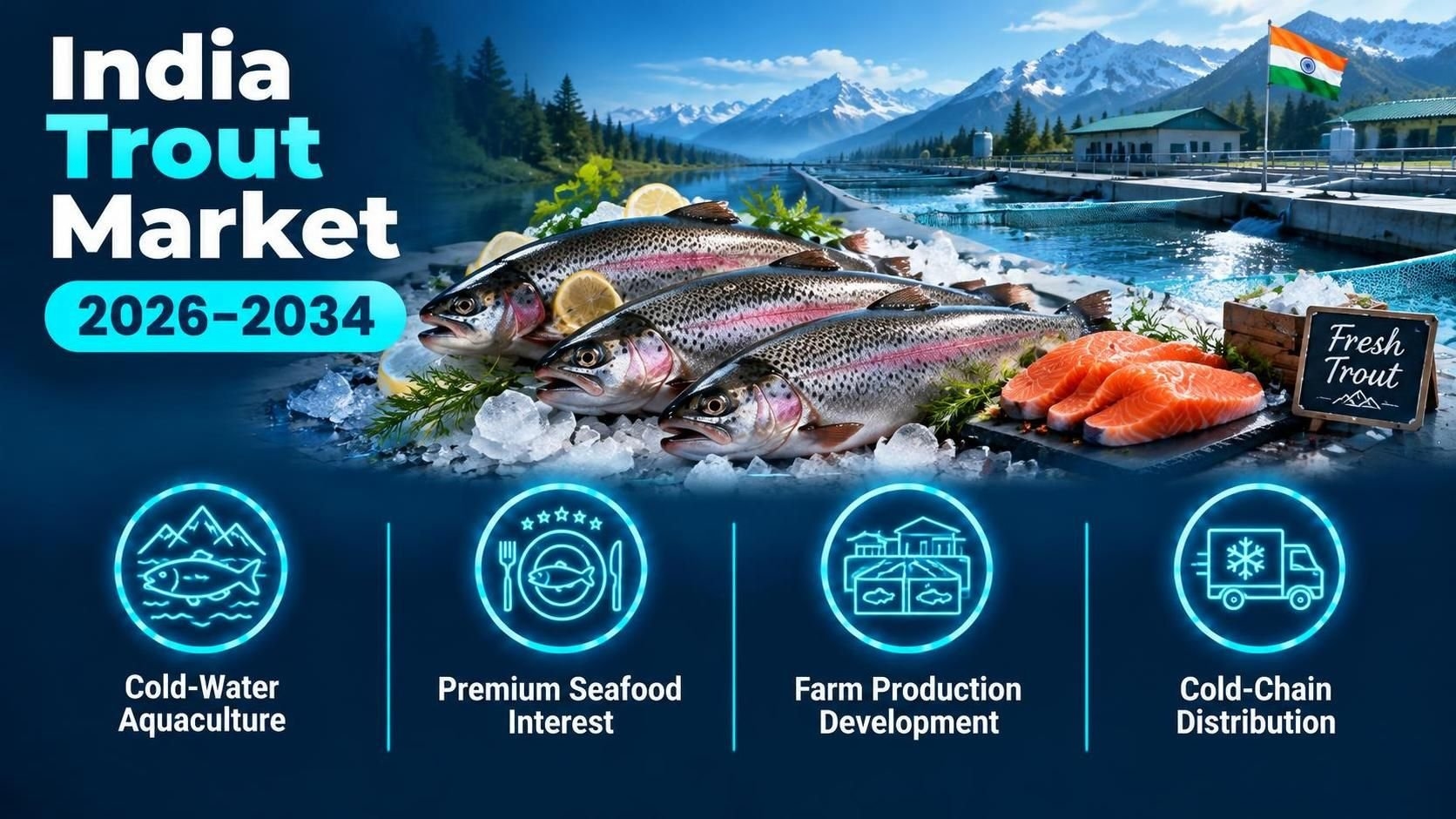
India Trout Market Dynamics
Driver: Health Awareness and Growth of Cold-Water Farming:
Consumers are paying more attention to nutrition, and trout fits well. It offers a high protein content along with omega-3 fatty acids and other vital nutrients, and its flavorful, firm flesh is prized by chefs. Rising urbanization and higher disposable incomes support demand both at home and in export markets.
Supply is expanding through trout farming in the country's hilly regions, where cold-water conditions are ideal. Because trout are predominantly carnivorous, farmers need specialized feed, which is encouraging manufacturers to diversify products by ingredient mix, nutritional profile and cost. Eco-friendly, bio-based feeds with reduced reliance on wild-caught fish are gaining traction. Government initiatives that promote aquaculture to strengthen local economies and self-sufficiency add policy support, and cold chain and export infrastructure are improving market access.
Opportunity: Recirculating Systems, Cultivated Trout and Digital Retail:
Technology is opening new growth routes. In November 2024, Japanese technology was set to be deployed in Himachal Pradesh through a recirculating aquaculture system at the Indo-Norway Trout Fish Farm in Patlikuhal, Kullu. The system recycles and filters tank water, which cuts water use and conserves space, and production is expected to increase fourfold.
Research and retail partnerships point to further potential. In March 2024, Biokraft Foods partnered with ICAR-Directorate of Coldwater Fisheries Research (DCFR) to develop cultivated snow and rainbow trout using fish cell lines, 3D bioprinting and customized bioinks. In March 2021, FreshToHome partnered with Zarin, a Kashmiri startup, to market Himalayan rainbow trout across India, giving local farmers a wider customer base and fairer prices. These steps show how innovation and online channels can raise trout's commercial value.
Restraint: Geographic Concentration and Infrastructure Needs:
Trout need cold, clean, flowing water, so commercial farming is concentrated in a limited set of hilly regions. That geography narrows the number of locations where farms can be set up, and it makes reliable transport and cold storage important for reaching consumers in distant cities. Setting up raceways, hatcheries and recirculating systems also requires capital and technical know-how, which can be a barrier for smaller farmers.
Feed is a further consideration. Trout need diets formulated for growth and health, and the cost and quality of those feeds influence farm economics. Operators who secure dependable feed supply, invest in cold chain links and adopt water-efficient systems are better placed to manage these constraints and scale output.
Evaluate Market Opportunity with the Business Sample Report
How Is India's Trout Market Segmented?
By Trout Type:
Rainbow Trout
Ohrid Trout
Sea Trout
Golden Trout
Brook Trout
Others
By Trout Size:
Large
Small
By Distribution:
Foodservice
Retail: supermarkets and hypermarkets, convenience stores, specialty outlets, online channels, others
By Form:
Fresh
Frozen
Canned
Others
Regional Insights:
South India
North India
West and Central India
East India
Explore the Full Report with Charts, Table of Contents, and List of Figures
Competitive Landscape
The report offers an in-depth examination of the competitive landscape, including market structure, key player positioning, leading strategies for success, a competitive dashboard and a company evaluation quadrant. Detailed profiles of all major companies are included.
Government Initiatives Supporting the Market
Pradhan Mantri Matsya Sampada Yojana (PMMSY): flagship fisheries scheme of the Department of Fisheries that supports infrastructure and value chains, including support for cold-water fisheries
Cold-Water Infrastructure Support: assistance for raceways, hatcheries, feed mills, cold storage and post-harvest facilities in hill states
Cold-Water Fisheries Clusters: dedicated clusters notified in Kullu (Himachal Pradesh), Anantnag (Jammu and Kashmir), Pithoragarh (Uttarakhand) and Kargil (Ladakh)
ICAR-Directorate of Coldwater Fisheries Research: central research institute that supports sustainable cold-water aquaculture and the commercial value of trout
Investment Opportunities
Recirculating Aquaculture and Hatchery Technology: Water-efficient systems and improved breeding can raise yield and sustainability in cold-water regions.
Value-Added and Branded Trout Products: Fresh, frozen and canned formats sold through organized retail and online channels broaden consumption and improve margins.
Sustainable Trout Feed and Cultivated Trout: Bio-based feeds with reduced reliance on wild-caught fish and research partnerships on cultivated trout align with sustainability priorities.
Discuss Your Requirements With an Analyst and Get Your Customized Market Report
Frequently Asked Questions (FAQ)
What is the current size of the India trout market?
The India trout market reached a volume of 4,698.7 Tons in 2025.
What is the expected growth rate during 2026-2034?
The market is projected to grow at a CAGR of 5.86% during 2026-2034, reaching 7,964.7 Tons by 2034.
What factors are driving growth?
Key drivers include rising demand for protein-rich seafood, expansion of aquaculture in hill states, government support and improving cold chain and export infrastructure.
Which segments does the india trout market analysis cover?
The report covers trout type, trout size, distribution, form and region, with detailed market size and forecast analysis for each.
What trends are shaping the future?
Key trends include sustainable aquaculture practices, improved breeding technologies, value-added trout products and growing domestic consumption through organized retail and e-commerce.
Conclusion
India's trout market has a clear growth path, built on nutrition-led demand, expanding cold-water farming and supportive fisheries policy. Recirculating systems, cultivated trout research and online retail are widening what the category can offer, while the cold-water geography makes infrastructure and cold chain central to success. Organizations that invest in efficient farming technology, sustainable feed and branded value-added products will capture the largest share of the roughly 3,266 tons of additional volume generated through 2034.
Source: IMARC Group



