
The first time most teams try enterprise AI, it feels almost magical:
You type a prompt. It responds in seconds. Everything looks clean and fluent.
And then, after a few real use cases, the cracks show. The answers are almost right. The tone feels slightly off. It misses internal nuances that your team would catch instantly. These are not big mistakes, but they are significant enough to slow things down.
That is usually the moment people realize something important: good AI is not the same as useful AI. And that realization is exactly why LLM fine-tuning services are getting serious attention from enterprises now.
When “Good Enough” AI Stops Being Enough
There has been a sharp rise in generative AI adoption over the past couple of years. According to McKinsey’s 2025 global AI survey, 88% of organizations report regular AI use in at least one business function.
That sounds like success. But inside those same organizations, the conversation has shifted. Leaders are no longer asking, “Can we use AI?” They are asking, “Why doesn’t it fully fit our workflows yet?”
The reason is simple: out-of-the-box models are trained on vast public datasets. They are designed to be broadly useful, not deeply specific. They don’t recognize your internal acronyms. Also, they don’t understand your approval processes and don’t consistently reflect your brand voice.
That gap is where LLM fine-tuning for enterprises comes in.
They serve as a necessary step to make AI truly useful - aligned with your data, your workflows, and your business context.
What LLM Fine-Tuning Services Really Mean in Practice
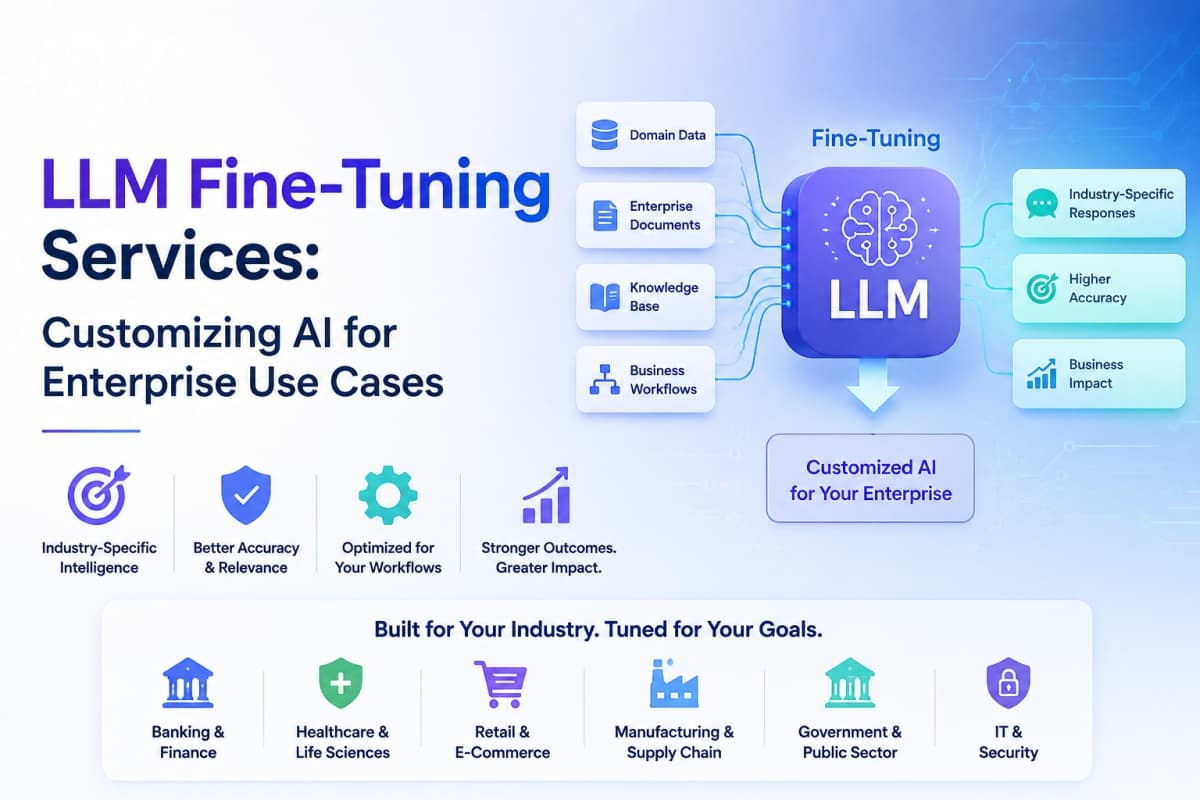
At a basic level, fine-tuning is just teaching an existing model how to behave in your environment.
Think about onboarding a senior hire. They may be highly skilled, but on day one, they still ask questions. They need context and exposure to how things actually work inside your company. Over time, they adjust.
Fine-tuned models follow a similar path. They are trained on your data, your documents, and your historical interactions. Gradually, the output shifts.
It feels less generic and less “AI-like” and becomes more aligned with how your teams think and communicate.
This is where fine-tuning as a service becomes useful. It allows organizations to tap into this capability without building the entire pipeline from scratch.
Where LLM Fine-Tuning Services Start Showing Real Value
You do not need dozens of use cases to justify fine-tuning. Even one well-executed application can shift the perception of AI inside an organization.
Customer Support That Actually Resolves Issues
Basic bots handle simple queries. But real customer conversations are rarely simple.
When models are trained on past tickets, escalation patterns, and product-specific data, the dynamic changes. The responses become more grounded, less scripted, and more helpful.
Domain‑trained AI systems also deliver measurable impact by reducing customer service handling time significantly. That’s not just efficiency. That’s a better customer experience.
Internal Knowledge That Is Easier to Access
Most companies already have the answers they need. The challenge is finding them. Policies are buried in folders. Process docs sit across multiple systems. Teams waste time searching for information that technically exists but remains inaccessible.
Fine-tuned models can act like internal translators. They pull from scattered knowledge and present it in a way that makes sense in the moment. Instead of digging through folders or guessing at processes, teams receive clarity exactly when it matters.
Content That Sounds Like Your Brand
This is one of the more subtle pain points.
Generic AI can produce decent content. But “decent” is not what enterprise marketing teams are aiming for. What matters is tone, voice, and consistency.
When models are trained on your previous campaigns and messaging frameworks, the difference is noticeable. The output feels like it belongs to your brand, not a template.
That kind of alignment is hard to fake.
Development Work That Moves Without Friction
AI-assisted coding is already speeding things up. But in enterprise environments, relevance matters more than raw speed. A model that knows your codebase and understands your naming conventions is far more relevant than one that simply gives generic suggestions.
LLM Fine-tuning for Enterprises: What Actually Improves
Once fine-tuning is done right, a few changes tend to show up quickly.
Accuracy improves, especially in domain-heavy tasks.
Compliance becomes easier to manage because the model can be trained around specific rules.
User experience feels smoother.
People spend less time correcting outputs.
Over time, costs stabilize because there is less rework and fewer manual interventions. None of this is dramatic on day one, but it compounds.
Why Fine-tuning as a Service Is Becoming the Default
The idea of developing AI applications in-house may seem attractive until you look at the technicalities involved.
Managing data pipelines, training the models, scaling the infrastructure, and continuous upgrades can provide to be quite challenging.
That is why many organizations are turning to fine-tuning as a service instead. It simplifies the process without removing control.
You still gain customization and still use your data. But you avoid the heavy operational burden.
The Part People Often Underestimate
Fine-tuning sounds straightforward when described in slides.
In practice, it has a few friction points. Data is one of the biggest. Cleaning and structuring it takes far more time than most teams anticipate.
Costs can also creep up if experiments are not managed carefully. Then comes model drift: what works today may feel outdated in a few months if the business evolves and the model does not.
Security adds another layer of complexity. Training models on sensitive enterprise data requires strong governance, and there is no shortcut here.
What Seems to Work in Real Projects
Across different enterprise teams, a few patterns show up consistently.
The teams that get value from fine-tuning do not start with technology; they start with a clear use case. They focus on one area where improvement is measurable and spend time preparing their data properly instead of rushing the process.
Also, they treat fine-tuning as something that evolves, not something they “complete.” Interestingly, these teams also know when not to fine-tune.
Sometimes, a combination of prompt engineering and retrieval systems is enough. Not every challenge requires a fully trained model, and that judgment is what separates effective teams from the rest.
A Simple Way to Frame It
You could break enterprise AI performance into three parts:
Capability + Context – Misalignment
Most modern models already have the capability.
Fine-tuning adds context. And in doing so, it reduces the misalignment that causes friction in real use cases. That is where the real value sits.
What the Next Phase Looks Like
There is a quiet shift happening right now: bigger models are no longer the only goal.
Enterprises are starting to prefer smaller, more focused models that are fine-tuned for specific tasks. They are easier to manage, easier to control, and are often more efficient.
At the same time, expectations are rising. Leaders want AI that understands their business and not just responds to prompts. That expectation will continue to push adoption of LLM fine-tuning services forward.
Final Thought
Most AI systems look impressive in a demo. Fewer hold up in day-to-day operations. The difference is rarely about intelligence; it’s about alignment.
Fine-tuning brings that alignment closer. Not perfectly, and not instantly, but enough to shift AI from something interesting to something genuinely useful inside the enterprise.
And that shift is where things start to feel different.
Teams stop second-guessing outputs.
They spend less time correcting and more time acting.
Conversations around AI move from “Can we trust this?” to “How far can we take this?”
Slowly, AI becomes part of the workflow. It stops being a side experiment and starts contributing real weight to the business.