The Model Context Protocol hit 97 million monthly SDK downloads by December 2025. That number alone tells you something important is shifting in how developers build AI systems, and it's not just about smarter models anymore. It's about the architecture sitting around those models.
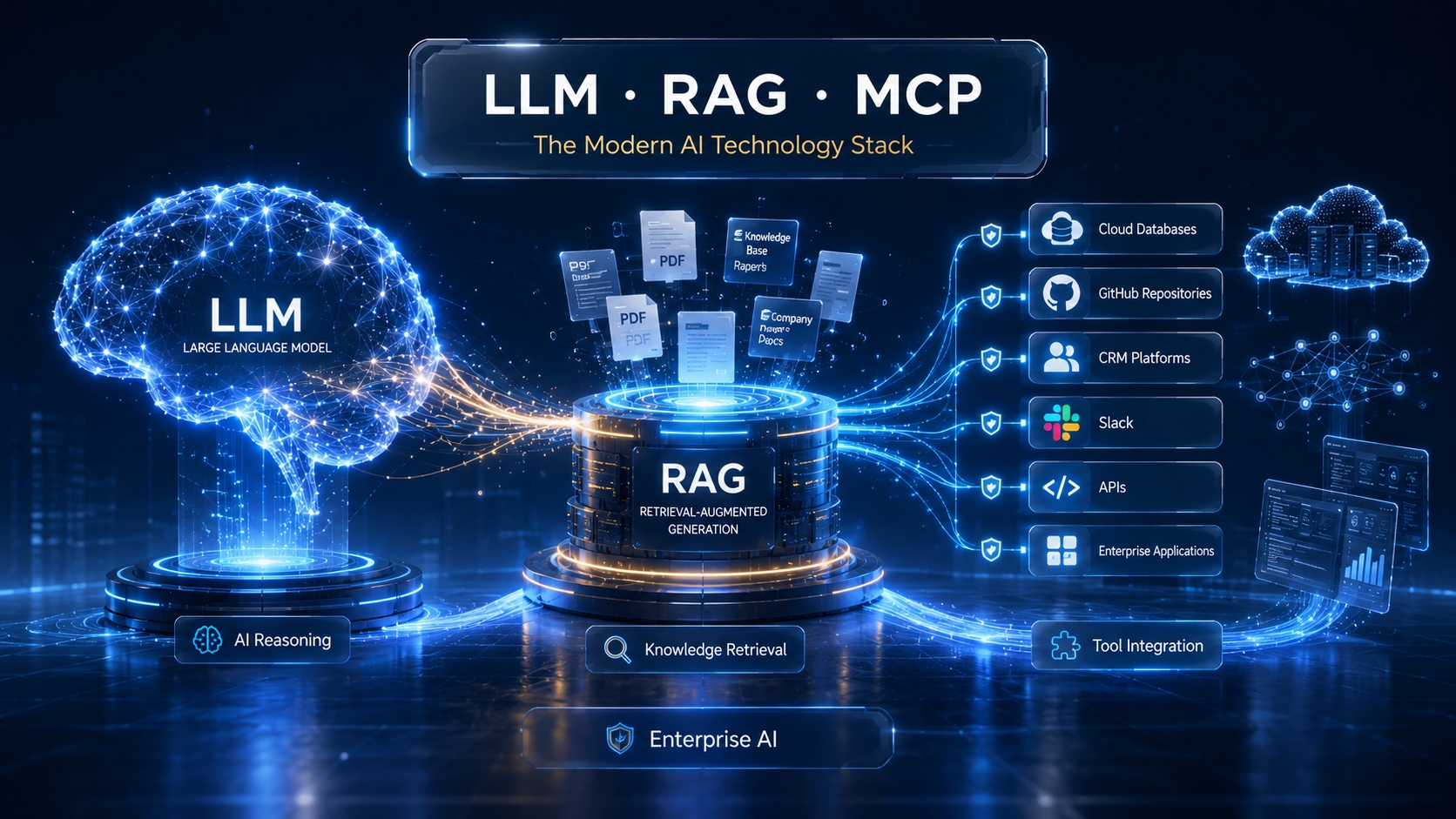
LLMs, RAG, and MCP are three distinct layers of the modern AI stack. Each solves a different problem. Each sits at a different point in how AI accesses information and takes action. Most developers mix them up or, worse, pick one and ignore the others, which is how you end up with a system that hallucinates confidently or can't connect to anything that matters.
This article breaks down what each technology actually does, where each one fits, how they compare head to head, and when you need all three working together.
Here's what's covered:
What LLMs are and where they fall short on their own
How RAG fixes the knowledge problem without retraining models
What MCP does that RAG can't, and why it matters for agentic AI
A side-by-side comparison of all three
Real use cases for each and for hybrid combinations
FAQs developers and AI engineers ask most about this stack
What an LLM Is and Where It Stops
A Large Language Model is a neural network trained on massive text datasets to predict and generate language. GPT-4, Claude, Gemini, and Llama are all LLMs. They're extraordinarily capable at reasoning, writing, summarizing, and coding within their training data.
The problem is that training data has a cutoff. Once a model is trained, its knowledge freezes. It has no awareness of what happened after that date. It can't read your internal documents. It doesn't know what's in your company's CRM, your live database, or the support ticket someone filed this morning. And when it doesn't know something, it doesn't always admit that it generates a confident-sounding answer anyway. That's a hallucination, and it's a structural problem, not a bug that gets patched.
LLMs are also stateless across sessions. They don't remember previous conversations unless that context is explicitly passed back in. For consumer chatbots, that's annoying. For enterprise systems, it's a serious limitation.
How RAG Solves the Knowledge Problem
Retrieval-Augmented Generation was built specifically to address what LLMs get wrong about facts. The architecture is straightforward: when a user asks a question, the system retrieves relevant documents from an external knowledge base and injects that content into the LLM's prompt before it generates a response.
The formula, as testRigor's 2026 analysis describes it, is RAG = LLM + Search + Prompt Injection.
This means the model isn't guessing from stale training data; it's reading current, domain-specific content before it answers. That's a significant improvement for accuracy and factual reliability.
RAG works best with unstructured data, PDFs, documentation, knowledge bases, research papers, and internal wikis. It converts documents into vector embeddings stored in a database, retrieves the most semantically relevant chunks based on the query, and feeds them to the model as context. The model never gets retrained. The knowledge base just gets updated.
What RAG cannot do: take action. It's read-only. The model retrieves information and responds; it can't create a Jira ticket, send a Slack message, query a live API, or trigger a deployment. That's where RAG hits its ceiling.
What MCP Does That RAG Can't
Model Context Protocol is an open standard, originally built by Anthropic and donated to the Agentic AI Foundation under the Linux Foundation in December 2025, with co-founders including Block and OpenAI and support from Google, Microsoft, AWS, Bloomberg, and Cloudflare. OpenAI adopted it in March 2025. Google DeepMind followed in April 2025.
MCP gives LLMs a standardized way to connect to external systems and actually do things. It works through a client-server architecture: the AI application acts as the client, and MCP servers expose specific capabilities, tools the LLM can call, resources it can read, and prompt templates for common tasks. The LLM decides which tool to call based on the user's request, sends it to the server, gets the result, and continues reasoning.
With MCP, an AI connected to the right servers can query a live database, update a CRM record, file a bug report, send an email, or read a file system without any custom integration code. Before MCP, every new data source required a bespoke connector. That's what it replaced.
MCP is about how LLMs use tools, a standard interface between an LLM and external systems like databases, file systems, GitHub, and Slack. The key word is standard. Build one MCP server for your service, and it works across every MCP-compatible AI client without additional integration work.
LLM vs RAG vs MCP: Side-by-Side
Feature | LLM Alone | RAG | MCP |
Knowledge source | Training data only | External documents + training data | Live systems, APIs, databases |
Data type | Static, frozen at training | Unstructured (PDFs, docs, wikis) | Structured, real-time, dynamic |
Can take actions | No | No | Yes |
Needs retraining for updates | Yes | No | No |
Best for | General reasoning, generation | Knowledge-heavy Q&A, search | Agentic tasks, tool use, workflows |
Read or write | Read (generates text) | Read-only retrieval | Read and write |
Hallucination risk | High without grounding | Reduced, anchored to documents | Lower for factual tasks with live data |
Complexity to implement | Low | Medium | Medium to high |
When to Use Each and When to Combine Them
The mistake most junior developers make, according to the ALL AT A1 Tech Insights 2026 analysis, is jumping straight to giving the artificial intelligence "hands", MCP and agentic workflows before verifying that the AI reads facts correctly. You don't want an AI agent that can send emails and update databases while still hallucinating basic information.
The right build order in most production scenarios is to get the LLM working reliably first, layer RAG to ground it in accurate knowledge, and then add MCP when the system needs to act on that knowledge.
Scenario | Best Approach |
Internal documentation chatbot | RAG, retrieves company docs; no action needed |
Customer support auto-responder | RAG + LLM pulls knowledge base and generates a reply. |
AI coding assistant that files PRs | MCP needs to read code, write commits, open pull requests |
Live inventory lookup + order update | MCP: reads structured databases and writes updates |
Research assistant with web and docs | RAG + MCP hybrid: retrieves docs and calls live search APIs |
Enterprise AI agent across tools | LLM + RAG + MCP: full stack, knowledge plus action |
Security Considerations Engineers Can't Ignore
Both RAG and MCP introduce security concerns that are easy to overlook when you're focused on functionality.
For RAG, the main risk is poisoned documents. If an attacker injects malicious content into your knowledge base, the model may generate attacker-chosen outputs, a technique demonstrated in the PoisonedRAG attack accepted at USENIX Security 2025. Access control over which documents each user can retrieve matters enormously, or you risk data leakage across user sessions.
For MCP, the risk surface is wider because the model can take actions. The OWASP MCP Security Cheat Sheet identifies nine key threat categories, including tool poisoning, confused deputy attacks, excessive permissions, and sandbox escapes. The mitigations include scoping OAuth permissions as narrowly as possible, sandboxing servers, pinning tool definitions, and keeping humans in the loop for any sensitive operations.
This doesn't mean to avoid either technology. It means building with the threat model in mind from the start, not as an afterthought.
The Stack Is the Skill
LLMs are the reasoning engine. RAG is the library that feeds them accurate information. MCP is the set of hands that lets them act on the world.
None of these is a complete solution alone. An LLM without RAG or MCP is a capable but isolated mind, smart within its training, blind to everything else. RAG without MCP can answer questions but can't do anything with the answers. MCP without reliable knowledge retrieval underneath it is an agent that acts fast and gets things wrong.
The engineers building the most valuable AI systems in 2026 aren't the ones who know the most about any single layer. They're the ones who understand how all three fit together and when each one is the right tool for what the system actually needs to do.
FAQs: LLM vs RAG vs MCP
What is the difference between RAG and MCP? RAG retrieves information from external documents to improve LLM responses. MCP connects LLMs to live systems so they can retrieve structured data and execute actions. RAG is read-only and knowledge-focused. MCP is read-write and action-focused.
Can RAG and MCP be used together? Yes, and in complex production systems, they usually are. RAG handles unstructured knowledge retrieval. MCP handles live data access and task execution. Together they give an AI system both accurate context and the ability to act on it.
Is MCP replacing RAG? No. They operate at different layers of the stack and solve different problems. MCP does not retrieve or rank unstructured documents. RAG does not execute actions or connect to live APIs. Replacing one with the other would leave a gap in the system.
Why do LLMs hallucinate? LLMs generate responses based on statistical patterns in training data. When asked about something outside that data, recent events, private documents, or live system states, they produce plausible-sounding but fabricated answers. RAG and MCP both reduce hallucination by giving the model accurate, current information to work from.
What does MCP stand for?
MCP stands for Model Context Protocol. It is an open standard developed by Anthropic and donated to the Linux Foundation's Agentic AI Foundation in December 2025, with adoption by OpenAI, Google DeepMind, Microsoft, AWS, and others.
Which should an AI engineer learn first, RAG or MCP?
RAG. It's the foundational layer for grounding model outputs in real knowledge. MCP adds action capability on top. Building reliable knowledge retrieval before adding agentic behavior is the order most senior AI architects recommend in 2026.