Starting an NGO in Tamil Nadu requires choosing the right legal structure, preparing the necessary documents and completing registration with the appropriate authority. NGO Registration in Tamil Nadu can be completed through a trust, society or Section 8 company, depending on the organisation’s objectives and management preferences. Understanding these options helps founders establish a legally recognised organisation for charitable, educational, healthcare or social welfare activities.
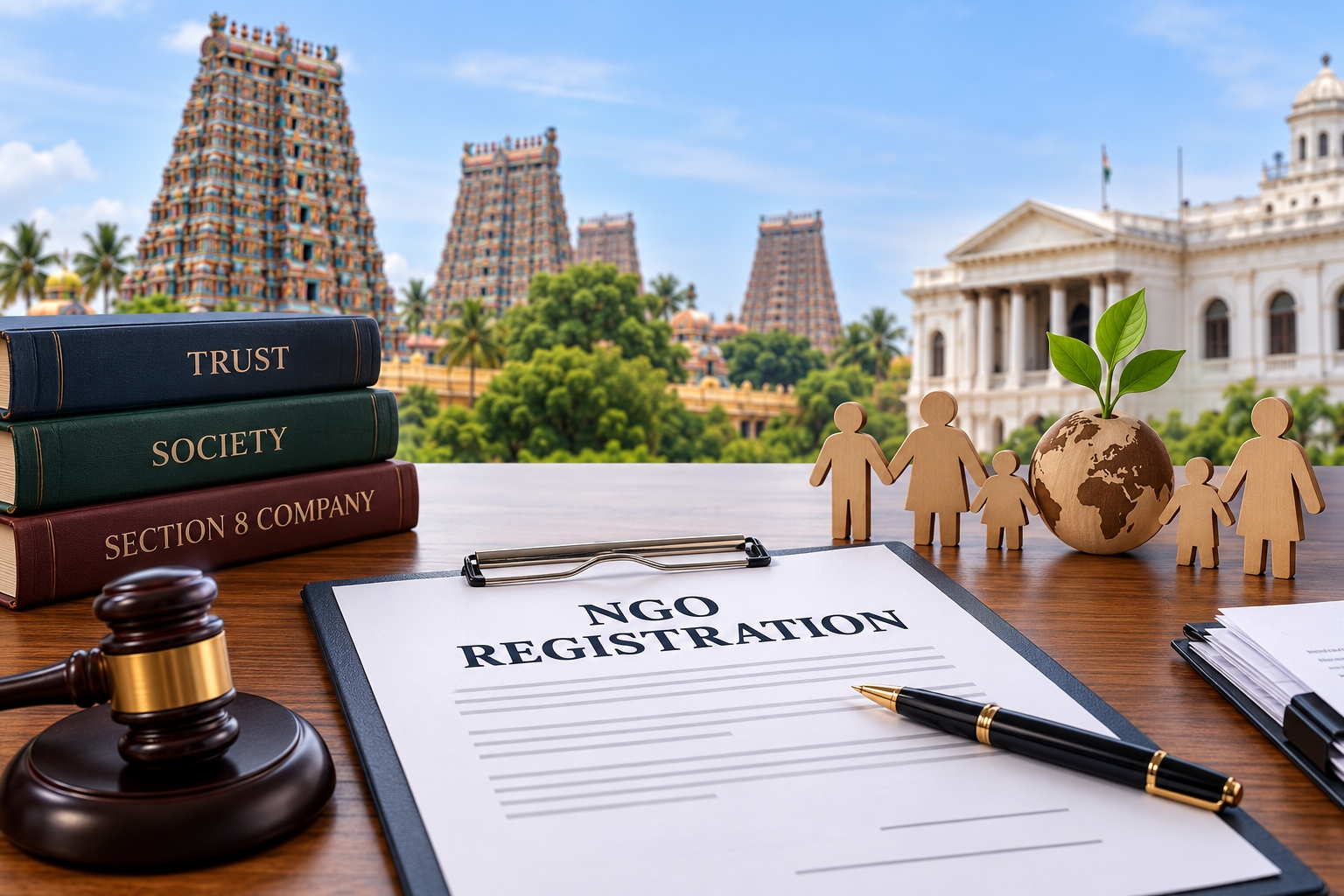
Types of NGO Registration in Tamil Nadu
Before beginning the registration of an NGO, determine which structure best suits your objectives.
Structure | Suitable for | Main legal framework |
|---|---|---|
Public charitable trust | Charitable activities managed by trustees | Applicable trust law and state requirements |
Society | Membership-based social, educational or charitable activities | Tamil Nadu Societies Registration Act, 1975 |
Section 8 company | Structured nonprofit activities with formal corporate governance | Companies Act, 2013 |
The right option depends on governance, funding plans, activities and compliance responsibilities. A society is governed by its memorandum and bylaws, while a Section 8 company follows corporate governance requirements.
Who Can Register an NGO in Tamil Nadu?
Individuals and groups intending to undertake lawful charitable or nonprofit activities can explore NGO formation. The appropriate eligibility and formation requirements depend on the selected structure.
Common objectives include:
Promoting education and vocational training.
Supporting healthcare and community welfare.
Protecting children and supporting disadvantaged communities.
Promoting environmental conservation.
Developing rural communities and livelihood opportunities.
Founders should define their objectives clearly and select a suitable organisation name before preparing registration documents.
Documents Required for NGO Registration
The exact documents vary by legal structure and the registering authority. Generally, applicants should prepare:
Identity and address proofs of founders, trustees, members or directors, as applicable.
Proof of the proposed registered office.
No-objection certificate from the property owner, where required.
Trust deed, memorandum of association or constitutional documents, depending on the structure.
Rules, regulations or bylaws, where applicable.
Photographs and prescribed application forms, if required by the authority.
For society registration, Section 6 of the Tamil Nadu Societies Registration Act, 1975, addresses the memorandum and bylaws to be filed. The memorandum specifies the society’s name, objectives and committee members’ details.
Step-by-Step NGO Registration Process
Choose the structure: Compare a trust, society and Section 8 company based on governance and long-term objectives.
Select a name: Choose a distinctive name that follows the applicable naming rules.
Prepare documents: Draft the required deed, memorandum, bylaws or incorporation documents.
Arrange office proof: Prepare acceptable evidence for the registered office.
Submit the application: File the prescribed documents with the appropriate registering authority.
Address objections: Respond to requests for corrections or additional information.
Obtain registration: Keep the registration certificate and approved constitutional documents securely.
For further guidance on the formation process, refer to the guide below.
How to Register NGO in India
Understand the general steps, legal structures and registration requirements for starting an NGO.
Read the complete NGO registration guide
Registration Fees and Timeline
Registration fees and processing periods vary according to the legal structure, applicable government charges and completeness of the application. Additional professional, documentation or stamp-duty expenses may apply.
For society registration, verify the current fee schedule with the Tamil Nadu Registration Department before applying. Avoid relying on unofficial estimates or assuming that every NGO structure has the same costs or timeline.
What to Do After Registration
Registration establishes the organisation’s legal identity, but it does not automatically provide every tax or fundraising benefit.
Newly registered NGOs should:
Obtain PAN and open a suitable bank account.
Maintain accounting records and supporting financial documents.
Apply separately for applicable income-tax registrations and donor deduction approvals.
Assess CSR-1 requirements before undertaking eligible CSR implementation work.
Obtain FCRA registration or prior permission before accepting foreign contributions, where applicable.
Complete annual filings, audits and other statutory compliances relevant to the chosen structure.
For information about available registration options and professional assistance, use the resource below.
NGO Registration Services
Explore registration options for trusts, societies and Section 8 companies, along with relevant requirements.
Frequently Asked Questions
1. Which NGO structure is best in Tamil Nadu?
A trust may suit trustee-managed charitable activities, a society may suit membership-based initiatives, and a Section 8 company may suit organisations requiring formal corporate governance.
2. Is NGO registration compulsory?
The legal requirements depend on the activity and structure. Founders should verify the applicable registration rules for their proposed organisation.
3. Can one person start an NGO?
The minimum number of founders depends on the chosen structure. A society generally requires at least seven signatories under the Tamil Nadu Societies Registration Act, 1975.
4. Does NGO registration provide tax exemption?
No. Income-tax exemption and donor deduction eligibility require separate applications and approval under applicable tax provisions.
5. Can an NGO receive CSR funding immediately?
Registration alone does not guarantee CSR funding. Eligibility depends on applicable CSR rules, the NGO’s legal status, track record and other prescribed conditions.
6. Can a registered NGO accept foreign donations?
An NGO must meet applicable FCRA requirements, including registration or prior permission, as relevant, before receiving foreign contributions.
Conclusion
NGO Registration in Tamil Nadu begins with selecting the appropriate legal structure, preparing accurate documents and applying to the relevant authority. Founders should also plan for accounting, tax-related applications and ongoing compliance. Careful preparation helps establish a sound legal foundation for sustainable charitable work.




