In today's competitive job market, many students and working professionals look for faster ways to complete their higher education. One of the most searched terms is One Sitting Degree. People who have educational gaps, discontinued their studies, or want to improve their qualifications often wonder whether they can complete a degree in a single sitting.
What is a One Sitting Degree?
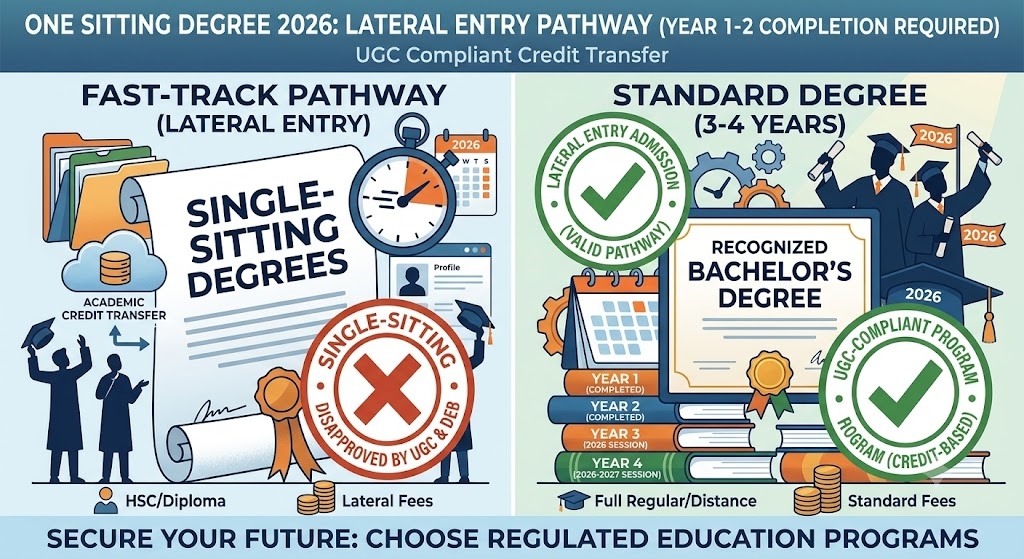
A One Sitting Degree is a term commonly used for programs that allow eligible candidates to complete a bachelor's or master's degree by utilizing previous academic credits, lateral entry, or credit transfer, subject to university regulations. It is not a separate degree recognized by the University Grants Commission (UGC). Students should be cautious of institutions promising to award a complete three-year degree in a single examination without following approved academic regulations.
Instead, recognized universities may offer flexible pathways through:
Credit Transfer
Lateral Entry
Open and Distance Learning (ODL)
Online Degree Programs
Recognition of previous academic qualifications where permitted
Is a One Sitting Degree Valid in 2026?
This is the most important question.
The validity depends entirely on how the degree is earned. A degree obtained through a UGC-recognized university under approved regulations (such as ODL or online programs) is generally valid for higher education and employment, provided the university and program have the necessary recognition. However, degrees issued by unrecognized institutions or through unauthorized "one sitting" schemes may not be accepted by employers or universities.
Before taking admission, always verify:
UGC recognition
UGC-DEB approval (for distance or online programs)
University accreditation
Program approval for the relevant academic session
Who Can Apply?
One Sitting Degree admission is generally suitable for:
1. Students with Educational Gaps
Candidates who discontinued their studies due to financial, personal, or family reasons.
2. Working Professionals
Employees seeking graduation or post-graduation for promotions or career growth.
3. Government Job Aspirants
Many government examinations require a recognized bachelor's degree.
4. Students Who Left College Midway
Candidates who completed one or two years of a degree program may qualify for credit transfer or lateral entry, depending on university rules.
Eligibility Criteria for 2026
Eligibility varies by university and program.
For Undergraduate Programs
Applicants generally need:
Completion of 10+2 (Higher Secondary) from a recognized board
Required minimum marks, if specified by the university
Supporting academic documents
For Postgraduate Programs
Applicants usually require:
A recognized bachelor's degree
Required qualifying marks
Relevant documents for verification
Some universities may also consider previous credits or academic records for eligible transfer cases, subject to their regulations.
Admission Process
The admission process is usually straightforward.
Step 1: Choose a Recognized University
Always verify that the institution is recognized by the UGC and, where applicable, approved for online or distance learning.
Step 2: Check Eligibility
Review the course requirements before applying.
Step 3: Complete the Application Form
Submit the online application with accurate personal and academic details.
Step 4: Upload Documents
Commonly required documents include:
Class 10 Marksheet
Class 12 Marksheet
Graduation Marksheet (for PG admission)
Aadhaar Card or other ID proof
Passport-size photographs
Signature
Step 5: Pay the Admission Fee
Fees can usually be paid online through the university portal.
Step 6: Verification and Confirmation
After document verification, the university confirms admission and grants access to study materials and the learning portal.
Courses Available
Many universities offer flexible learning options in programs such as:
Undergraduate
BA
BCom
BBA
BCA
BSc (selected universities)
Postgraduate
MA
MCom
MBA
MCA
MSc (selected disciplines)
Course availability varies across universities.
Fee Structure in 2026
Fees depend on the university, course, and mode of learning.
Approximate annual fee ranges are:
Course | Approximate Fees |
BA | ₹8,000 – ₹25,000 |
BCom | ₹10,000 – ₹30,000 |
BBA | ₹15,000 – ₹45,000 |
BCA | ₹18,000 – ₹60,000 |
MA | ₹10,000 – ₹30,000 |
MCom | ₹10,000 – ₹35,000 |
MBA | ₹35,000 – ₹1,20,000 |
Additional charges may include:
Registration Fee
Examination Fee
Study Material Fee
Project Fee (if applicable)
Always refer to the official university notification for the latest fee details.
Benefits of a One Sitting Degree
Some advantages include:
Flexible learning schedule
Suitable for working professionals
Opportunity to continue higher education
Useful for career advancement
Affordable compared to many regular programs
Access to online learning resources
Better work-study balance
Important Things to Check Before Admission
Before enrolling, ensure that:
The university is UGC-recognized.
The program is approved for the relevant academic session.
The degree is awarded according to applicable academic regulations.
The university provides transparent information on eligibility, fees, examinations, and evaluation.
Avoid institutions that promise an entire degree in one examination without explaining the legal academic framework.
Frequently Asked Questions (FAQs)
Is a One Sitting Degree legal in India?
The term "One Sitting Degree" itself does not represent a separate UGC-recognized qualification. The validity depends on whether the degree is awarded by a recognized university through approved academic regulations.
Can I get a government job with this degree?
Government employers generally require degrees from recognized universities. Eligibility also depends on the recruitment rules for the specific post.
Can I pursue higher education after completing the degree?
If the degree is from a recognized university and awarded under approved regulations, it may be accepted for higher studies, subject to the admission rules of the institution.
How long does admission take?
Online admission and document verification usually take a few days to a few weeks, depending on the university.
Final Thoughts
A One Sitting Degree can be an attractive option for students with academic gaps or professionals looking to complete their education. However, the most important factor is choosing a UGC-recognized university and an approved academic pathway. Never rely solely on marketing claims about completing an entire degree "in one sitting." Verify recognition, eligibility, fee details, and admission rules before enrolling.
With proper research and a recognized institution, flexible higher education in 2026 can help you enhance your qualifications, improve career opportunities, and pursue future academic goals with confidence.