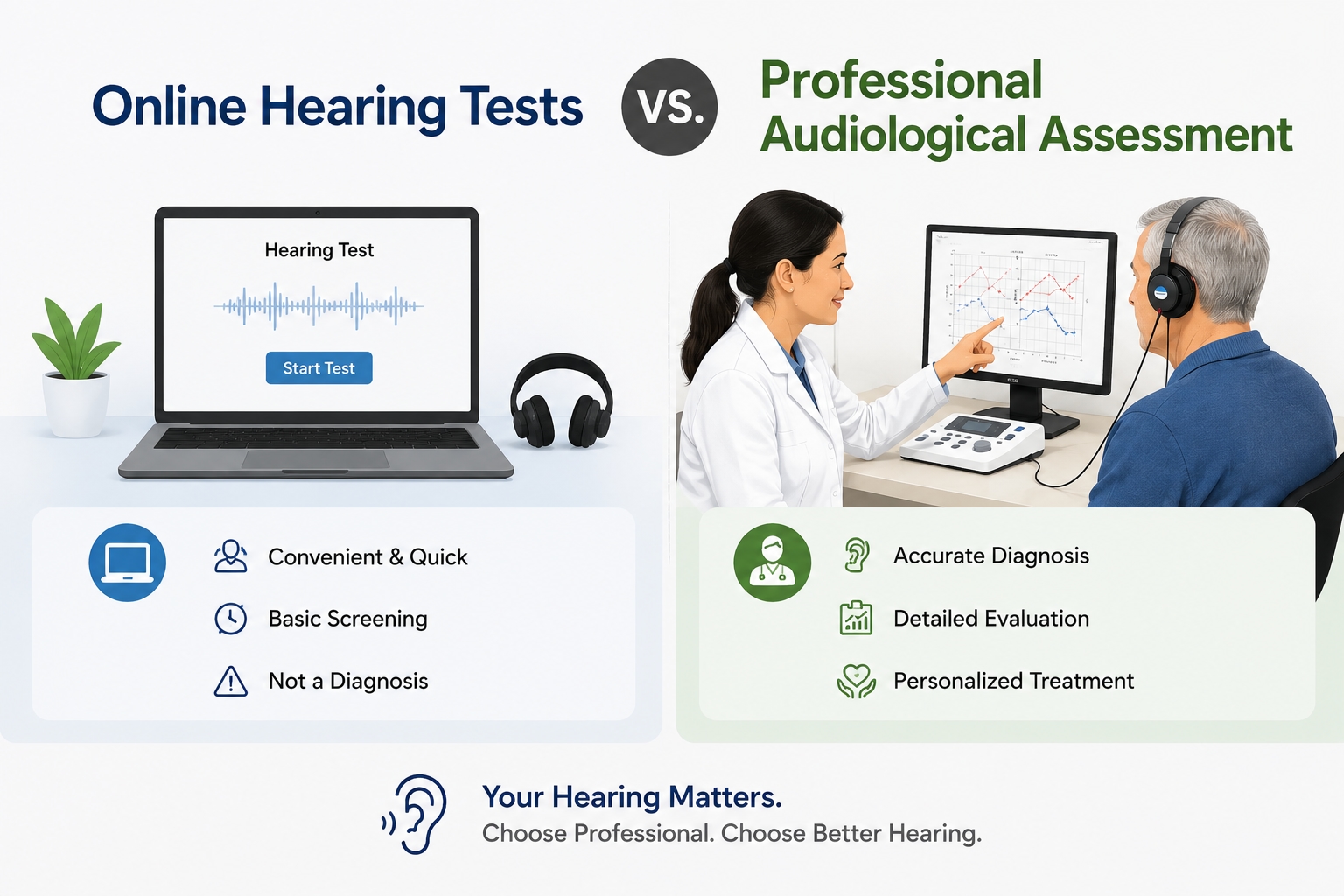
A quick search for "hearing test" returns dozens of free online tools promising instant results in under five minutes. They're convenient, but convenience isn't the same as accuracy. Understanding the gap between a screening app and a full clinical assessment can save you from a misdiagnosis — or worse, a false sense of security.
What Online Hearing Tests Actually Measure
Most online hearing tests are simplified pure-tone screenings played through your device's speakers or headphones. They're influenced by ambient room noise, headphone quality, and device calibration — none of which are standardized. At best, they flag that something might be worth investigating further. They cannot diagnose the type, degree, or cause of hearing loss.
What a Professional Hearing Assessment Includes
A comprehensive clinical evaluation goes far beyond a beep-and-button test. It typically includes:
Case history — understanding your symptoms, lifestyle, and communication concerns
Otoscopy — a visual check of the ear canal and eardrum for blockages or abnormalities
Pure tone audiometry — measured in a calibrated, soundproof environment
Air and bone conduction testing — to distinguish between conductive and sensorineural hearing loss
Impedance audiometry — assessing middle ear function
Speech testing — evaluating how well you understand speech, not just tones
Why Calibrated Environments Matter
Sound-treated testing booths eliminate background noise variables that skew results. A hearing test conducted on your laptop speakers at home simply can't replicate this level of accuracy, no matter how well-designed the app is.
The Danger of Relying on Self-Testing Alone
Self-administered tests can miss underlying medical issues — wax blockages, infections, or even more serious conditions — that a trained audiologist would catch during otoscopy. Relying solely on an app risks either under-treating a real problem or overreacting to a false alarm.
Clinical Interpretation Is the Real Value
Numbers on a page mean little without someone qualified to interpret them in the context of your specific hearing profile and daily challenges. This is where professional hearing care providers differentiate themselves from a simple test-and-report model. This overview of how Soft Hear approaches hearing assessment and clinical interpretation illustrates why cross-checked, professionally interpreted results lead to better rehabilitation outcomes than a standalone screening.
Bottom Line
Free online hearing tests have their place—as an early nudge to seek professional help. But they should never replace a full audiological evaluation performed by a qualified, RCI-registered audiologist in a proper clinical setting.