
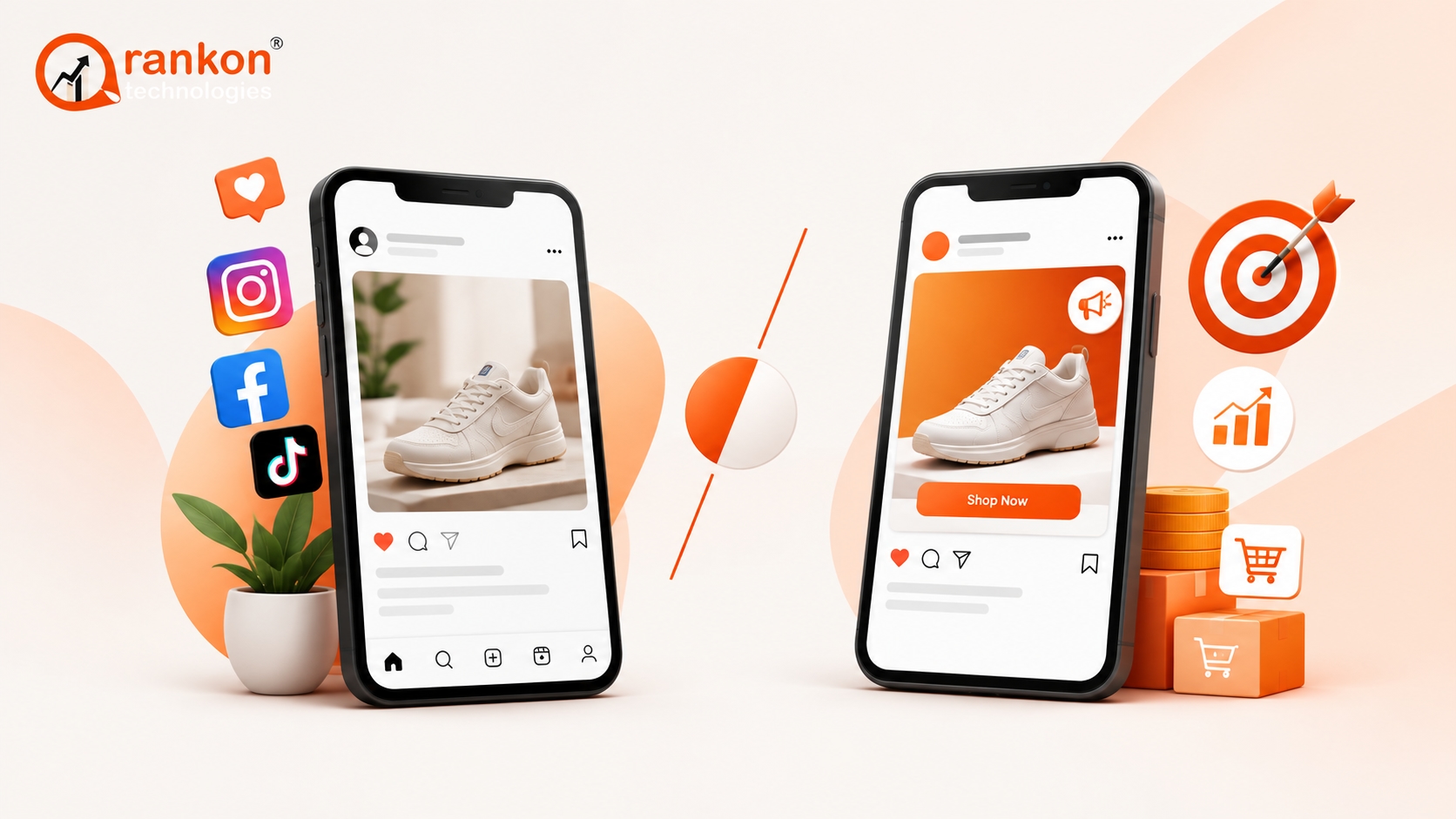
Quick Answer: For eCommerce brands, organic and paid social media serve very different jobs in the sales funnel. Organic content (Reels, UGC, product demos, customer stories) builds trust, showcases products in context, and creates a library of assets you can later turn into ads. Paid social media (dynamic product ads, catalog ads, retargeting, and lookalike audiences) is what actually drives measurable purchases at scale — especially through cart-abandonment and post-purchase retargeting. Most successful eCommerce brands don't choose one over the other; they use organic content to discover what resonates, then feed the winners into paid campaigns to scale sales.
Why This Question Hits Different for eCommerce Brands
Every business faces the organic-vs-paid decision, but eCommerce brands face it with more urgency than most. Unlike a service business with a long sales cycle, eCommerce customers can go from seeing a product to buying it in a single session — which means the way you use social media directly affects revenue, not just brand awareness.
eCommerce also has structural advantages that other industries don't: a product catalog that can be turned into dynamic ads automatically, visual products that perform well in Reels and UGC content, and clear, trackable conversion events (Add to Cart, Purchase) that make paid social ROI easy to measure.
We covered the foundational differences between the two approaches in our detailed guide on Organic vs Paid Social Media — this post builds on that foundation with an eCommerce-specific lens: what actually works when your goal is selling physical or digital products online.
What Organic Social Media Looks Like for an eCommerce Brand
For product-based businesses, organic content isn't just "posting for the algorithm" — it's product discovery content that customers actively seek out before buying.
High-performing organic formats for eCommerce include:
Unboxing and first-impression Reels — Short videos showing a product being opened and used for the first time.
User-generated content (UGC) — Real customers using or reviewing your product, reshared with permission.
Behind-the-scenes production content — How the product is made, packed, or sourced (builds trust and justifies pricing).
Styling and use-case content — Showing multiple ways a product can be used, worn, or applied.
Comparison and "why I switched" content — Especially effective for brands competing against a well-known alternative.
Customer review round-ups — Compiling real testimonials into a single carousel or Reel.
The advantage of this content for eCommerce specifically is that it can be repurposed directly as ad creative later — a well-performing organic Reel showing a product in use is often more effective as a paid ad than a polished studio advertisement, because it doesn't look like an ad.
What Paid Social Media Looks Like for an eCommerce Brand
Paid social for eCommerce goes far beyond boosting a post. The platforms (Meta, TikTok, Pinterest) offer purpose-built ad formats designed specifically around product catalogs and purchase behavior:
Dynamic Product Ads (Catalog Ads)
Automatically generated ads that pull directly from your product catalog and show the exact items a visitor viewed or added to cart — without manually creating an ad for every SKU.
Retargeting Campaigns
Ads shown to people who visited your site, viewed a product, or abandoned their cart without completing checkout. This is consistently one of the highest-ROAS campaign types for eCommerce because it targets people who have already shown buying intent.
Lookalike Audiences
Campaigns targeting new users who share characteristics with your existing customers or past purchasers — useful for scaling beyond your current audience.
Collection and Carousel Ads
Formats that let shoppers browse multiple products directly within the ad, mimicking a mini storefront experience.
Post-Purchase Upsell and Cross-Sell Campaigns
Ads targeting existing customers with complementary products, replenishment reminders, or loyalty offers — turning one-time buyers into repeat customers.
Organic vs. Paid Social Media for eCommerce: Side-by-Side Comparison
Factor | Organic Social Media | Paid Social Media |
|---|---|---|
Primary Role | Product discovery, trust-building | Conversion, retargeting, scaling sales |
Speed to Sale | Slower, depends on algorithm reach | Immediate, controllable reach |
Cost Structure | Content creation cost only | Ad spend + management fee |
Best Ad Format | Reels, UGC, carousels | Dynamic product ads, retargeting |
Targeting Precision | Limited to followers/algorithm | Full audience & behavioral targeting |
Cart Abandonment Recovery | Not possible | Highly effective via retargeting |
Scalability | Capped by organic reach | Scales with budget |
Content Reusability | Can be repurposed into ads | Requires ongoing creative refresh |
Measurement | Engagement, saves, shares | ROAS, CPA, conversion rate |
The eCommerce Funnel: How Organic and Paid Work Together
The strongest eCommerce social strategies treat organic and paid as connected stages of the same customer journey, not competing channels.
A typical eCommerce organic-to-paid funnel looks like this:
Organic Reel showcases a product in a real-life use case and gets strong engagement (saves, shares, comments).
Retargeting campaign is built targeting everyone who watched 50%+ of that Reel or visited the product page it linked to.
Dynamic product ad shows the exact item (plus related items) to users who added it to cart but didn't complete checkout.
Post-purchase campaign targets buyers with complementary products or a reorder reminder 30–45 days later.
UGC generated from that purchase (reviews, unboxing videos) becomes new organic content — and the cycle repeats.
This approach means your organic content isn't just for engagement metrics — it becomes a testing ground for what messaging and creative format to scale with paid budget, while paid campaigns constantly feed new customers back into your organic community.
How Much Should eCommerce Brands Spend on Organic vs. Paid?
Budget allocation for eCommerce social media typically shifts as the brand matures:
New/Early-Stage Store (0–6 months)
Focus 60–70% of effort on organic content to build product-market fit signals and gather UGC.
Run small paid tests (₹15,000–₹30,000/month) primarily for retargeting website visitors — most new stores don't have enough traffic yet for cold-audience ads to be efficient.
Growing Store (6 months – 2 years)
Shift toward 50/50 effort, with paid budget scaling based on proven organic content and clear CAC-to-LTV ratios.
Retargeting and dynamic product ads become core campaigns; organic content shifts toward UGC collection and community-building.
Established/Scaling Brand (2+ years)
Paid social typically becomes the primary revenue driver (60–80% of ad budget focus), supported by an organic content engine that supplies fresh, authentic creative to prevent ad fatigue.
At this stage, working with a dedicated team through structured SMM Packages often makes more sense than piecing together freelancers, since campaigns need coordinated content production and paid management running in sync.
Common Mistakes eCommerce Brands Make
Running Ads Without an Organic Content Base Jumping straight into paid ads with only studio product photos (no UGC, no lifestyle content) often results in higher CPCs and lower conversion — cold audiences trust real customer content more than polished ads.
Ignoring Cart Abandonment Retargeting This is often the single highest-ROI campaign type for eCommerce, yet many brands skip it entirely in favor of only running cold-audience awareness campaigns.
Treating Organic Content as Just Promotional Posts Posting only product photos and discount codes organically rarely builds the trust needed to convert. Educational, behind-the-scenes, and UGC content consistently outperforms pure promotional posts.
Not Refreshing Ad Creative Often Enough eCommerce audiences are shown ads frequently. Without new creative every 2–3 weeks, performance drops due to creative fatigue — organic content testing helps solve this by supplying a steady pipeline of fresh assets.
Scaling Ad Spend Before Confirming Product-Market Fit Increasing budget on a campaign with an unproven offer or unclear audience usually just accelerates losses rather than accelerating growth.
A Simple Decision Framework for eCommerce Brands
Situation | Recommended Focus |
|---|---|
Brand new, no reviews or UGC yet | Organic first — collect content and social proof |
Have UGC and testimonials but low traffic | Start small paid retargeting + continue organic |
High cart abandonment rate | Prioritize paid retargeting campaigns immediately |
Established repeat customers, plateaued growth | Scale paid + post-purchase upsell campaigns |
High ad costs, declining performance | Invest more in organic UGC to refresh ad creative |
Launching a new product line | Combine organic teaser content with paid pre-launch ads |
Final Thoughts
For eCommerce brands, the organic-vs-paid debate isn't really a debate at all — it's a sequencing question. Organic content builds the trust, social proof, and creative assets that make paid campaigns perform better, while paid social media turns that trust into measurable, scalable revenue through retargeting and dynamic product ads.
Brands that treat these as one connected system — rather than two separate strategies — consistently see better ROAS and lower customer acquisition costs than those relying on either channel alone. Getting this balance right often requires a partner who understands both the content and campaign sides of the equation. As a full-service Digital Marketing Agency India, we help eCommerce brands build exactly this kind of connected organic-to-paid strategy rather than treating social media as a series of disconnected posts and ad campaigns.
If you're figuring out the right mix for your store, explore our Social Media Marketing Services or get in touch with our team for a strategy built around your specific catalog, audience, and growth stage.
Frequently Asked Questions
Q: Should a new eCommerce store start with organic or paid social media? A: Most new stores benefit from starting with organic content to gather real customer photos, reviews, and UGC before scaling paid spend — cold-audience ads convert better when supported by authentic social proof.
Q: What's the most effective paid social ad format for eCommerce? A: Dynamic product ads combined with cart-abandonment retargeting typically deliver the highest ROAS, since they target users who have already shown purchase intent.
Q: Can organic social media alone drive eCommerce sales? A: Yes, particularly through platforms like Instagram and TikTok where in-app shopping features let users purchase directly. However, organic reach alone rarely scales as predictably as paid campaigns for consistent revenue growth.
Q: How often should eCommerce brands refresh their ad creative? A: Every 2–3 weeks for actively running campaigns, to avoid creative fatigue — a steady stream of organic UGC content makes this much easier to sustain.
Q: What percentage of eCommerce marketing budget should go to paid social ads? A: This varies by growth stage, but scaling eCommerce brands often allocate 60–80% of their social ad budget to paid campaigns once product-market fit and profitable CAC-to-LTV ratios are confirmed.