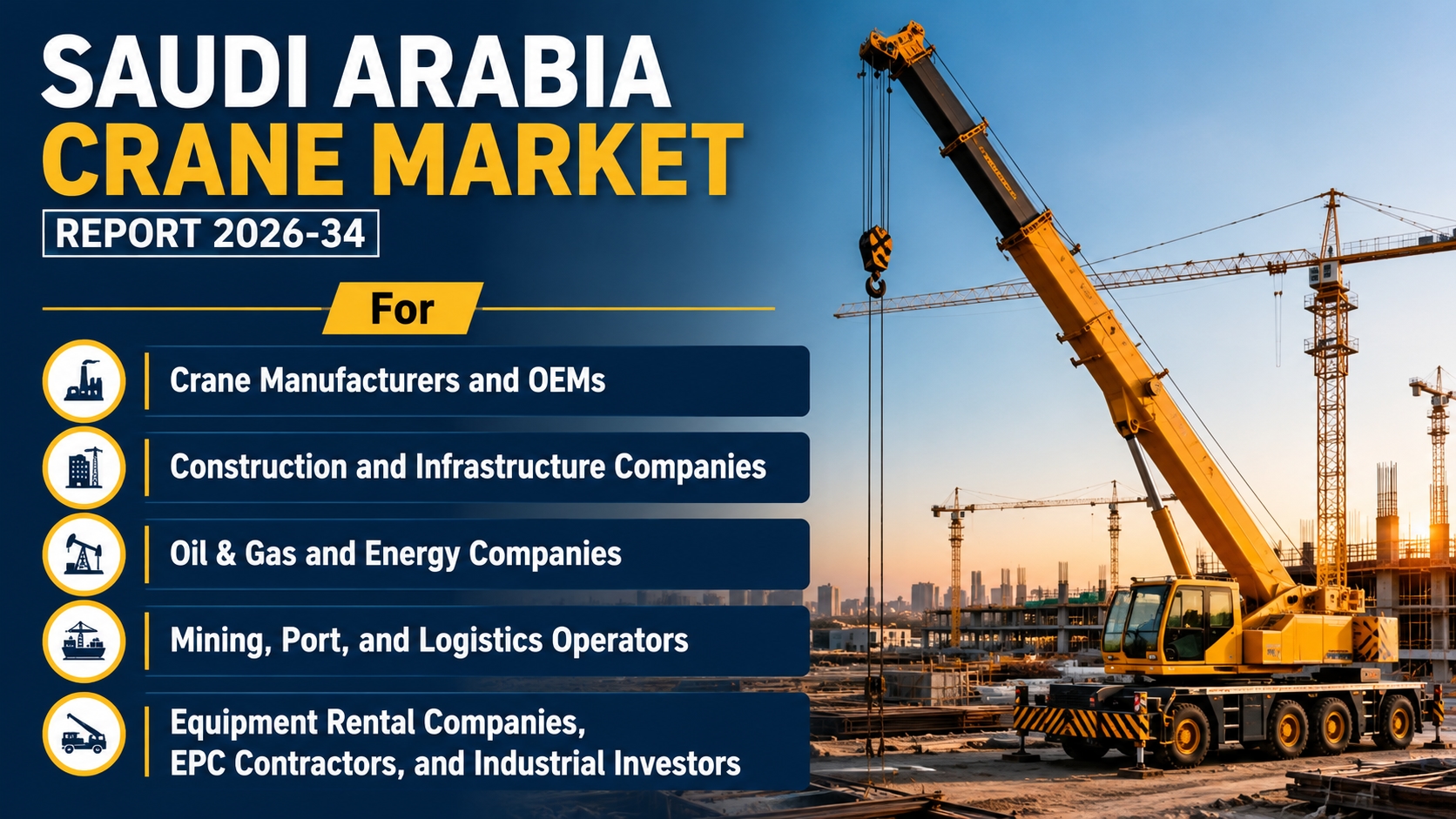
Saudi Arabia's massive economic transformation is fueling a surge across its construction, logistics, and heavy industrial sectors. Essential to this development is heavy material handling equipment, particularly the industrial crane. As a mechanical lifting device designed to hoist and move heavy loads vertically and horizontally using wire ropes, chains, and sheaves mounted on sturdy frameworks, cranes provide the foundational strength behind mega-infrastructure projects, oil and gas maintenance, and maritime operations across the Kingdom.
According to research from IMARC Group, the Saudi Arabia Crane Market reached a valuation of USD 528.8 Million in 2025. Looking forward, the industry is projected to expand to USD 911.6 Million by 2034, recording a Compound Annual Growth Rate (CAGR) of 6.05% during the forecast period of 2026 to 2034.
Market Overview & Key Industry Metrics
The market encompasses various configurations including tower cranes, mobile cranes, and overhead cranes. These systems facilitate safe, high-speed movement of substantial loads, reducing physical labor requirements while mitigating workplace safety hazards. Offering long operational lifespans and reliable returns on investment (ROI), cranes play a vital role across construction, manufacturing, logistics, and maritime environments.
Market Attribute | Key Data Points |
Base Year | 2025 |
Historical Period | 2020–2025 |
Forecast Period | 2026–2034 |
Market Size (2025) | USD 528.8 Million |
Market Forecast (2034) | USD 911.6 Million |
Growth Rate (CAGR 2026–2034) | 6.05% |
Key Market Growth Drivers
The market's momentum is sustained by several structural developments across the Kingdom's industrial landscape:
1. Accelerating Infrastructure and Urban Development
The steady rollout of strategic infrastructure projects - including new cities, highways, bridges, transit networks, and commercial airports - drives demand for high-capacity cranes. These machines are critical for positioning heavy structural components, steel girders, and concrete modules accurately and safely.
2. Deepening Activity in the Oil and Gas Sector
Ongoing maintenance, expansion, and facility repairs across the oil, gas, and petrochemical complexes require dedicated lifting systems. Heavy cranes ensure safe turnarounds and support ongoing operational uptime across processing facilities.
3. Integration of Telematics, Automation, and Smart Technologies
Operators are increasingly adopting cranes equipped with modern digital tools. Features such as integrated telematics, remote condition monitoring, and semi-automated controls help prevent overloading, streamline maintenance tracking, and significantly elevate safety standards on active sites.
4. Availability of Specialized Technical Talent
The growth of a qualified technical ecosystem - including certified crane operators, structural engineers, and skilled maintenance technicians - ensures smooth equipment deployment, routine upkeep, and compliance with strict industrial safety standards.
5. Growing Popularity of Crane Rental Business Models
Construction contractors and industrial enterprises are increasingly turning to flexible rental options. Equipment leasing provides access to diverse crane types and load capacities without requiring large upfront capital expenditures, making it a cost-effective option for small and medium-sized enterprises (SMEs).
6. Fleet Refurbishment and Machinery Modernization
To maximize capital efficiency, fleet operators are actively investing in retrofitting and modernizing their current inventory. Replacing worn structural parts and upgrading control modules extends operational lifespans while meeting elevated safety mandates.
7. Expansion of E-Commerce and Industrial Warehousing
The rapid growth of digital retail has increased demand for modernized logistics facilities, fulfillment hubs, and freight distribution centers. Cranes are extensively used in these environments for heavy pallet stacking, container unloading, and warehouse inventory management.
Explore in-depth findings for this market:
https://www.imarcgroup.com/saudi-arabia-crane-market/requestsample
Key Market Segmentation
The industry is structured across key product types and industrial end-use applications.
Segmentation Breakdown Table
Category | Primary Sub-Segments |
Product Type | • Mobile Cranes • Marine and Port Cranes • Fixed Cranes |
Application Sector | • Construction and Infrastructure • Mining • Oil and Gas • Others |
Product Type Breakdown
Mobile Cranes: Highly versatile, wheel- or crawler-mounted units capable of fast deployment across diverse terrain types. They are ideal for dynamic urban construction and remote energy sites.
Marine and Port Cranes: Heavy-duty gantry and container-handling systems engineered for continuous operation at maritime ports, shipyards, and off-shore facilities.
Fixed Cranes: Include stationary tower cranes and overhead bridge units anchored directly to site structures, delivering steady, high-altitude lifting for tall buildings and heavy industrial plants.
Application Sector Breakdown
Construction and Infrastructure: The primary end-use sector, utilizing fixed and mobile units for high-rise developments, civil transit networks, and bridge construction.
Oil and Gas: Uses specialized lifting setups for plant assembly, pipeline maintenance, and refinery upgrades.
Mining: Heavy material handling machinery deployed in extraction facilities and mineral processing operations.
Others: Logistics parks, municipal services, manufacturing plants, and general industrial warehousing.
Regional Breakdown
Demands for lifting machinery vary across the geographical divisions of the Kingdom, aligned with regional commercial focus:
Regional Zone | Industrial Focus & Driving Factors |
Northern and Central Region | High concentration of urban master planning, civil infrastructure initiatives, commercial towers, and governmental development projects centered around major metropolitan areas. |
Western Region | Driven by port expansions, commercial logistics along Red Sea maritime routes, urban modernization, and hospitality developments. |
Eastern Region | Dominated by heavy industrial processing, oil and gas refineries, petrochemical complexes, and extensive maritime shipping infrastructure in Jubail and Dammam. |
Southern Region | Expanding steadily through regional road networks, public works projects, civic building construction, and local mining activity. |
Competitive Landscape: Key Players in this Market
The competitive environment in Saudi Arabia consists of established equipment manufacturers, specialized rental providers, and localized engineering firms. Companies focus on expanding their rental fleets, enhancing technical support networks, and supplying models fitted with advanced safety and telematics capabilities.
Prominent players serving the market include:
ACT Cranes
Al Faris Saudi
KiCE Construction Equipment
Riyadh Cranes Factory Company
Recent Trends and Developments in the Market
Widespread Adoption of Fleet Telematics: Rental operators are equipping fleets with real-time tracking modules to monitor engine health, load parameters, and operator activity, minimizing operational downtime.
Expansion of Equipment Rental Offerings: Leading fleet providers are diversifying their rental portfolios with specialized mobile and all-terrain cranes to meet the tailored needs of mega-infrastructure contractors.
Focus on Energy Efficiency and Reduced Emissions: Modern lifting equipment is increasingly designed with optimized engines and hybrid functionality to reduce fuel consumption and meet evolving environmental standards.
Strategic Takeaways for Industry Leaders
Leverage Flexible Rental Models: Utilizing rental fleets helps contractors remain agile, control balance sheet capital expenditure, and match specialized equipment to specific project requirements.
Prioritize Smart Safety Features: Investing in units equipped with real-time telemetry and automated load limit sensors reduces site hazards and lowers long-term operational costs.
Focus on Preventive Maintenance: Upgrading and retrofitting existing fleets ensures compliance with local safety standards while maximizing total return on investment.
About Us:
IMARC Group is a global management consulting firm that helps the world's most ambitious changemakers to create a lasting impact. The company provide a comprehensive suite of market entry and expansion services. IMARC offerings include thorough market assessment, feasibility studies, company incorporation assistance, factory setup support, regulatory approvals and licensing navigation, branding, marketing and sales strategies, competitive landscape and benchmarking analyses, pricing and cost research, and procurement research.
Contact Us:
IMARC Group‚
134 N 4th St‚ Brooklyn‚ NY 11249‚ US
Email: sales@imarcgroup․com
Tel No: (D) +91 120 433 0800
United States: (+1–201–971–6302)