By Kanha Nature Oils · Published 12 October 2026
If you are working out how to test essential oil adulteration in bulk, the short answer is that no single test is enough. Smell and bench checks catch only crude cases. Reliable detection comes from layering batch documents, physical constants, GC-MS and, for high-value oils, chiral and isotope analysis, all run on a sample from the exact batch you will receive. This guide covers seven tests in the order a procurement team can run them, what each can and cannot detect, and how to tie payment to the results.
Quick answer: the seven tests at a glance
# | Test | Best at catching | Relative cost |
|---|---|---|---|
1 | Batch-linked documents | Missing or mismatched batch records | Low |
2 | Sensory check against a reference | Obvious off-notes, gross substitution | Low |
3 | Physical constants (density, refractive index, optical rotation) | Dilution with carrier oil or solvent | Low–medium |
4 | GC-MS profile | Foreign peaks, wrong constituent ratios, cheaper oil mixed in | Medium |
5 | Chiral GC | Synthetic copies of natural compounds | Medium–high |
6 | Isotope ratio analysis | Synthetic or differently sourced carbon | High |
7 | Shipment-to-sample match | Switching between approved sample and delivered lot | Low–medium |
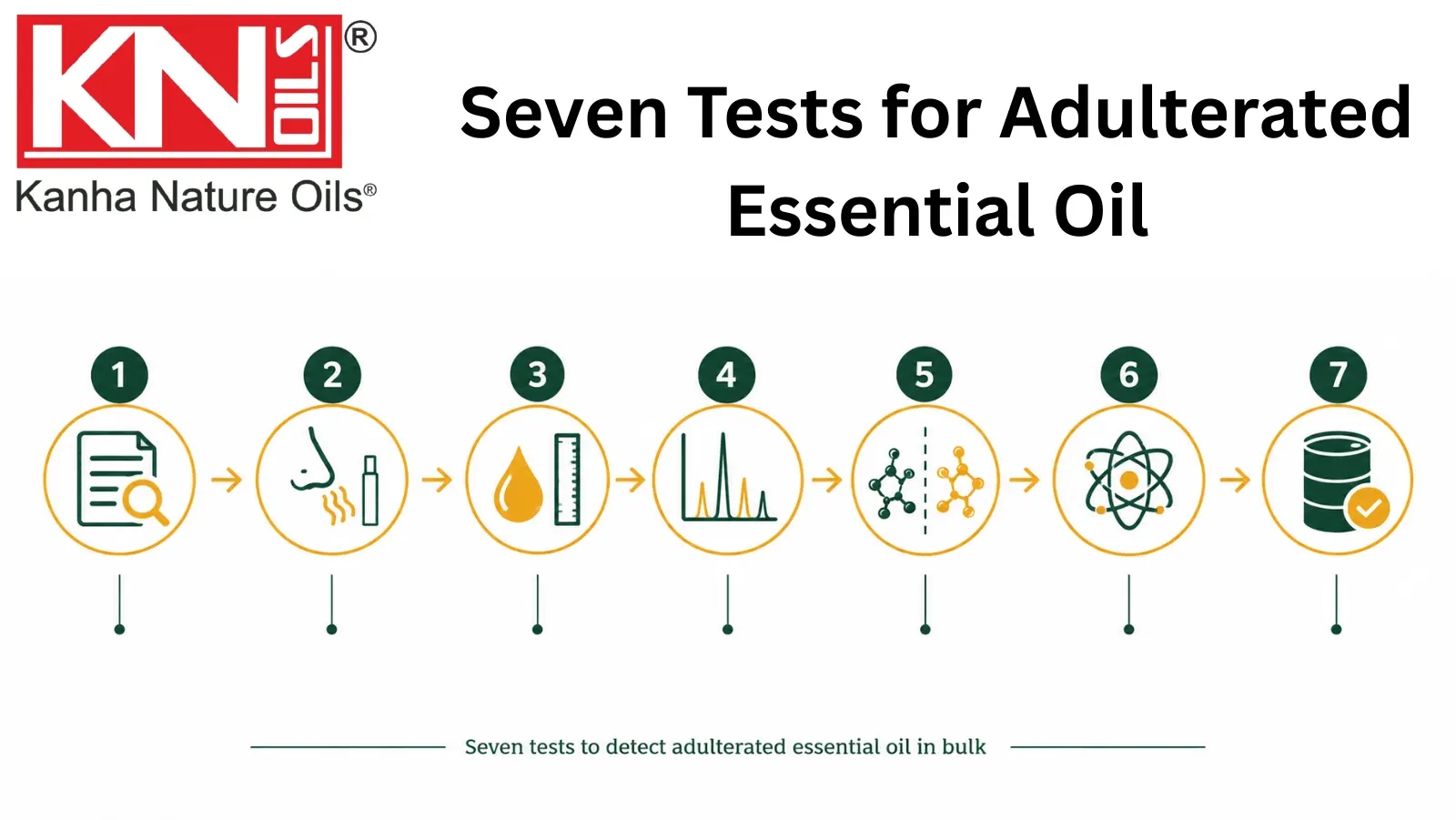
What adulteration looks like in a bulk lot
Adulteration usually takes one of four forms: a cheaper essential oil blended in, a synthetic or nature-identical compound added to lift a key constituent, a carrier oil or solvent used as diluent, or a reconstituted oil built from fractions and isolates. Each hides from different tests, which is why no single test covers all four.
The practical limit worth knowing: gas chromatography only sees volatile compounds. A non-volatile adulterant such as a vegetable oil stays in the injection port and never appears on the chromatogram, so GC-based methods have serious limits there (Biomed J Sci & Tech Res review). Synthetic copies of natural molecules pose the opposite problem: the molecule is identical, so standard GC-MS cannot separate it from the natural one.
Test 1: Check that every document is tied to the batch
Before any lab work, ask for the COA, the GC-MS report with full chromatogram and peak table, and the SDS (Safety Data Sheet — still widely called MSDS). Confirm that product name, botanical name, and batch number match across all of them and the drum labels.
Documents do not prove purity; they record what the supplier measured. A missing batch number, or an identical GC-MS report across different batches, is a reason to pause. For what each document should contain, see our guide to COA, SDS, IFRA and allergen documents.
Test 2: Compare smell and appearance against a sealed reference
Keep a sealed reference from a batch you have already approved. On a smelling strip, compare the new sample at top note, after a few minutes and at dry-down, then compare colour and clarity. Without a reference, smell is opinion, and skilled blending can fool it, so treat it as a screen, never a pass.
Test 3: Measure physical constants
Relative density, refractive index and optical rotation are quick, inexpensive measurements. ISO publishes a method for each (ISO 279, ISO 280 and ISO 592; the older 1976 and 1981 editions are withdrawn, so cite the current ones), and the ISO standard for each oil lists the expected range (ISO essential oils catalogue). A result outside the range for that species suggests dilution or substitution. A carefully balanced adulterant can still land inside it, so a pass narrows the field but does not clear the lot.
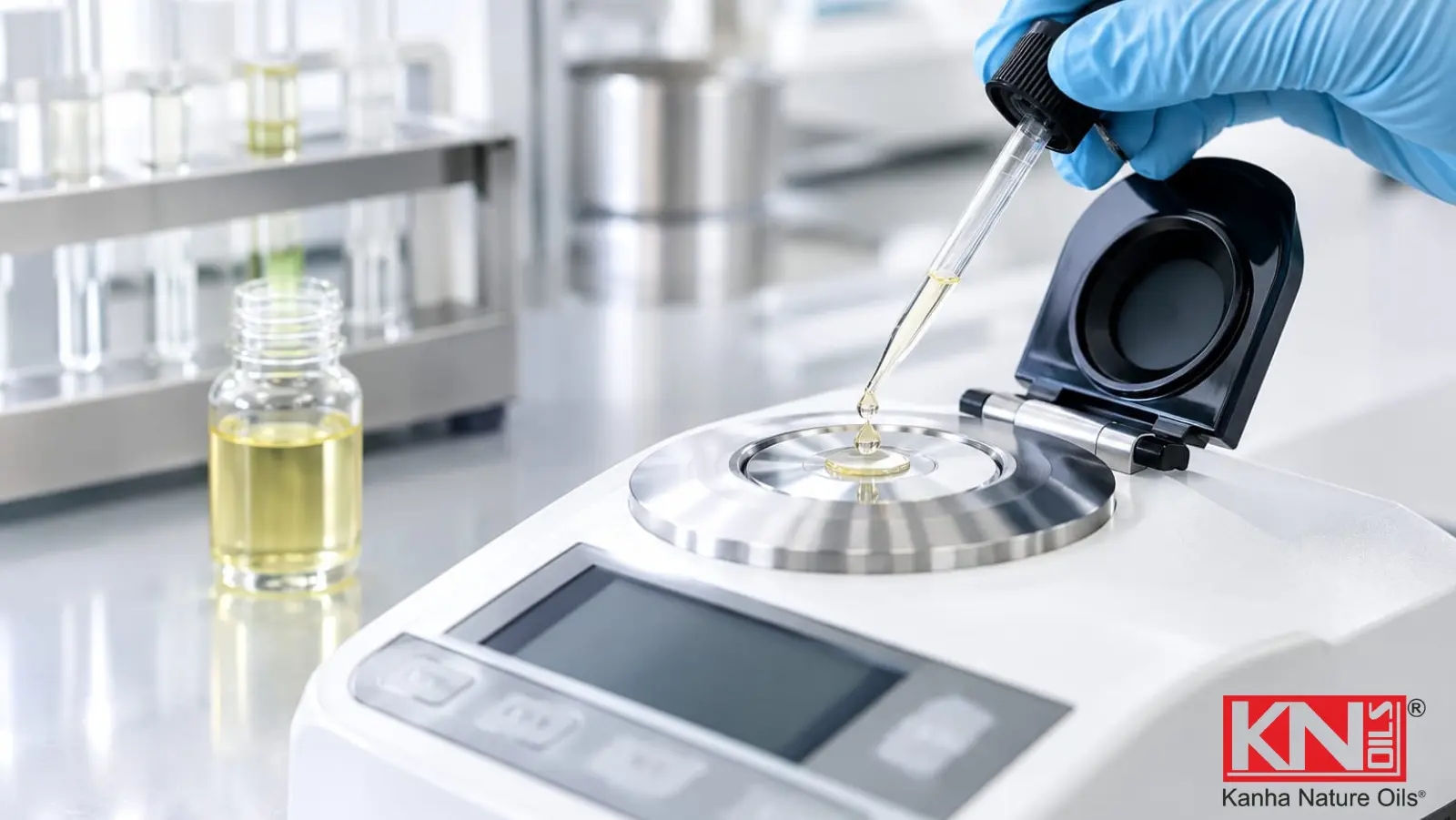
Test 4: Run a GC-MS profile and read it against a reference
GC-MS is the backbone of essential oil quality control. ISO 11024 (currently under revision) explains that a chromatographic profile evaluates the relative proportions of constituents rather than their true concentrations, and that it sits alongside physico-chemical characteristics as a quality specification (ISO 11024-1). In practice, look for three things:
Constituents that should be present but are missing or far outside the usual range
Peaks that do not belong to the species, which can point to an added solvent or foreign oil
Ratios between related compounds that look unnatural
Read more - how to test essential oil adulteration bulk