
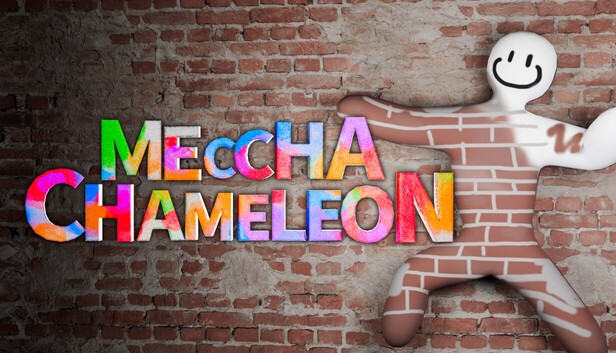
The color wheel in Meccha Chameleon opens the moment prep phase starts, and you have about sixty seconds before Seekers spawn. That is not a long time to transform a blank white character into something that belongs on a candy-colored Sugarland wall or a water-stained Backrooms ceiling. The decisions you make in those sixty seconds — which surface to target, which colors to sample, how to position your body — determine whether you spend the next three minutes earning points in plain sight or getting shot within the first Seeker sweep. No other game asks you to become a piece of furniture under a countdown clock, and that pressure is what makes Meccha Chameleon feel like nothing else in the party game space.
Choosing Your Surface in Meccha Chameleon
Surface selection is the first real skill in Meccha Chameleon and the one that takes the longest to develop proper intuition for. Beginners default to complex surfaces — detailed wallpaper, patterned flooring, textured walls — because complexity seems like it would make a disguise harder to spot. The opposite is usually true. Complex surfaces require complex painting. A Hider who attempts to replicate the Mansion's wallpaper pattern in sixty seconds and falls short ends up with a disguise that is visually noisy in the wrong ways, drawing attention precisely because it looks like a failed attempt at a pattern rather than a solid color.
The surfaces that consistently produce successful Hiders are those with one dominant visual quality — a single gradient, a uniform material tone, an identifiable mid-value that covers most of the wall area. The Sewer's concrete sections are a good example: primarily one grey tone with surface variation that is subtle enough to approximate without matching exactly. A Hider who paints themselves in that mid-grey, adds a slight variation on the character's edges, and stands against a concrete stretch is harder to find than a Hider who attempted the tile pattern and got it thirty percent right.
Map knowledge compounds this. By the time you have played ten rounds in the Backrooms level, you know that the ceiling patches near the light fixtures are the worst surfaces to blend into because Seekers always look up there first. You know that the corridor sections with uniform wall exposure and low furniture density give Hiders the highest traffic risk. That accumulated knowledge does not come from guides — it comes from being caught repeatedly in the same spots and updating your surface-selection logic round by round.
The Mechanics of Color, Pose, and Commitment in Meccha Chameleon
Once you have selected a surface, the painting phase has three distinct stages that most guides compress into one. First is the base layer — a broad application of the dominant surface color across the entire character model. This takes roughly ten to fifteen seconds and should cover any white areas that the final disguise cannot afford to show. Second is the detail pass — adding tonal variation, edge darkening, or pattern approximation where the surface warrants it. Third is the pose lock — choosing and holding the body position that makes the character's silhouette match what should be behind it.
The pose lock is where most players lose the most time. After finishing a paint job they are satisfied with, they move the camera to check the disguise from a Seeker approach angle, realize the shoulder width is reading wrong against the surface, and try to fix it with twenty seconds left. The fix usually involves both repositioning and repainting, which cannot be done cleanly under that pressure. Players who build the pose into their preparation — deciding where the body will go before starting the paint job — consistently produce cleaner disguises because the paint is applied in context rather than retrofitted.
Commitment is the final element and the most psychologically difficult. Once Seekers spawn, moving breaks the disguise. Any motion — even a small camera adjustment that creates visible body sway — catches peripheral attention more reliably than any color mismatch. Players who fidget, who micro-adjust, or who rotate slightly to track a Seeker's approach are the ones who get caught on rounds where their actual paint job would have survived. The game is asking you to trust the disguise you built and hold still while someone looks for you, and the ability to do that under pressure does not come naturally to most players.
Meccha Chameleon Community Terms and What They Mean
The vocabulary that players use in Meccha Chameleon forums and Discord communities reflects a game that developed a competitive layer faster than most casual games. Tanking refers to holding a high-visibility position and accumulating points by surviving repeated Seeker passes — the highest-risk, highest-reward strategy for Hiders. Deep cover refers to intentionally positioning away from Seeker patrol routes in exchange for reduced scoring but higher survival probability, a strategy more common in Infection mode where surviving into the final minute matters more than per-round scoring.
The term frame check comes from Seeker play and describes the technique of stopping at a room's entry point to scan the entire space before entering, specifically looking for silhouettes that do not match the room's natural geometry. Players who run frame checks consistently in Normal mode clear maps in fewer passes than those who sweep rooms while moving, because the stationary scan catches angled light inconsistencies that motion masks.
Workshop players use the term meta read to describe the community-accumulated knowledge of which spots on each map are overused. A meta read on the Art Gallery map, for example, would include the knowledge that the frame-mimicry spots near the east wall are the first place experienced Seekers check, because those spots are the most famous Art Gallery hiding positions. Players who understand the meta read avoid popular spots not because those spots are bad, but because Seekers with any experience expect them.
Divisive Elements and the Game's Genuine Flaws
Meccha Chameleon's public lobby system is the most consistently criticized aspect of the game in community discussions. Hosts can drop mid-round, triggering a session end without warning. Matches occasionally freeze in the lobby screen before the prep phase starts. Player counts in public lobbies fluctuate enough that some Normal mode rounds run with Seeker-to-Hider ratios that make either hunting or hiding trivial, depending on which side is outnumbered. These are real issues that affect public play regularly enough that the community's standard recommendation is to avoid public lobbies entirely and use private sessions with friends.
The painting controls are also openly criticized for their imprecision. The brush application is not pixel-level — it covers sections of the character model in broad strokes, which means fine pattern detail is impossible regardless of skill. For players who want to execute detailed disguises, the tool imposes a ceiling on what is achievable. The community has largely accommodated this by developing painting strategies that work within the tool's precision limits rather than against them, but the limitation is real and new players who expect granular color control will find the system frustrating before they adjust their expectations.
Frequently Asked Questions About Meccha Chameleon
What is the best map for beginners in Meccha Chameleon?
Sugarland is the most accessible map for new players. Its bright, relatively flat candy-colored surfaces are easier to sample with the color wheel and approximate with the paint tool than the multi-tone textures of the Mansion or the Sewer. The map layout is open enough that Hiders are naturally spread across the stage, which reduces the density of competing disguises in any one area and gives beginners more time before Seekers identify them through process of elimination. The official Meccha Chameleon stage roster also includes a Mansion, Sewer, Backrooms-style level, and Osaka-inspired environment, all of which reward more experience with the paint system before they become comfortable for hiding.
Can you change roles between rounds in Meccha Chameleon?
Role assignment in Normal and Infection modes is controlled by the host's lobby settings and by the game's random distribution when too many players select the same role. Players can express a preference for Hider or Seeker at the lobby stage, but if the number of players choosing one role exceeds the host's configured ratio, the game overrides selections randomly. In Double mode, role selection is irrelevant — everyone hides first, then everyone hunts, so there is no asymmetry to configure. Players who want guaranteed role selection need to coordinate with the lobby host to adjust the ratio before starting.
How long does a typical round last in Meccha Chameleon?
Round length depends on the host's timer settings and the mode selected. Normal mode rounds in public lobbies typically run three to five minutes total, with roughly sixty seconds of prep time for Hiders before Seekers spawn. Infection rounds tend to feel longer because the progressive conversion of Hiders into Seekers extends the active hunting phase — even after most Hiders have been caught, the remaining survivors with strong disguises can sustain a round significantly past what Normal mode allows. Double mode rounds are generally shorter because the hunting phase is a race with a fixed time window rather than an elimination of all Hiders.
What Meccha Chameleon does not let you do is coast. The scoring system punishes hiding and rewards exposure. The Infection mode punishes passivity by flooding the stage with Seekers who know what good disguises look like. The Workshop maps punish relying on established meta-knowledge by removing it entirely. Every mechanism in the game pushes a Hider toward committing more fully to their disguise — finding better surfaces, painting more carefully, holding still longer — and the game keeps generating reasons to get better at all three whether you are on the Mansion's upper floor or in the middle of a Sugarland corridor with a Seeker's crosshair three meters away.



