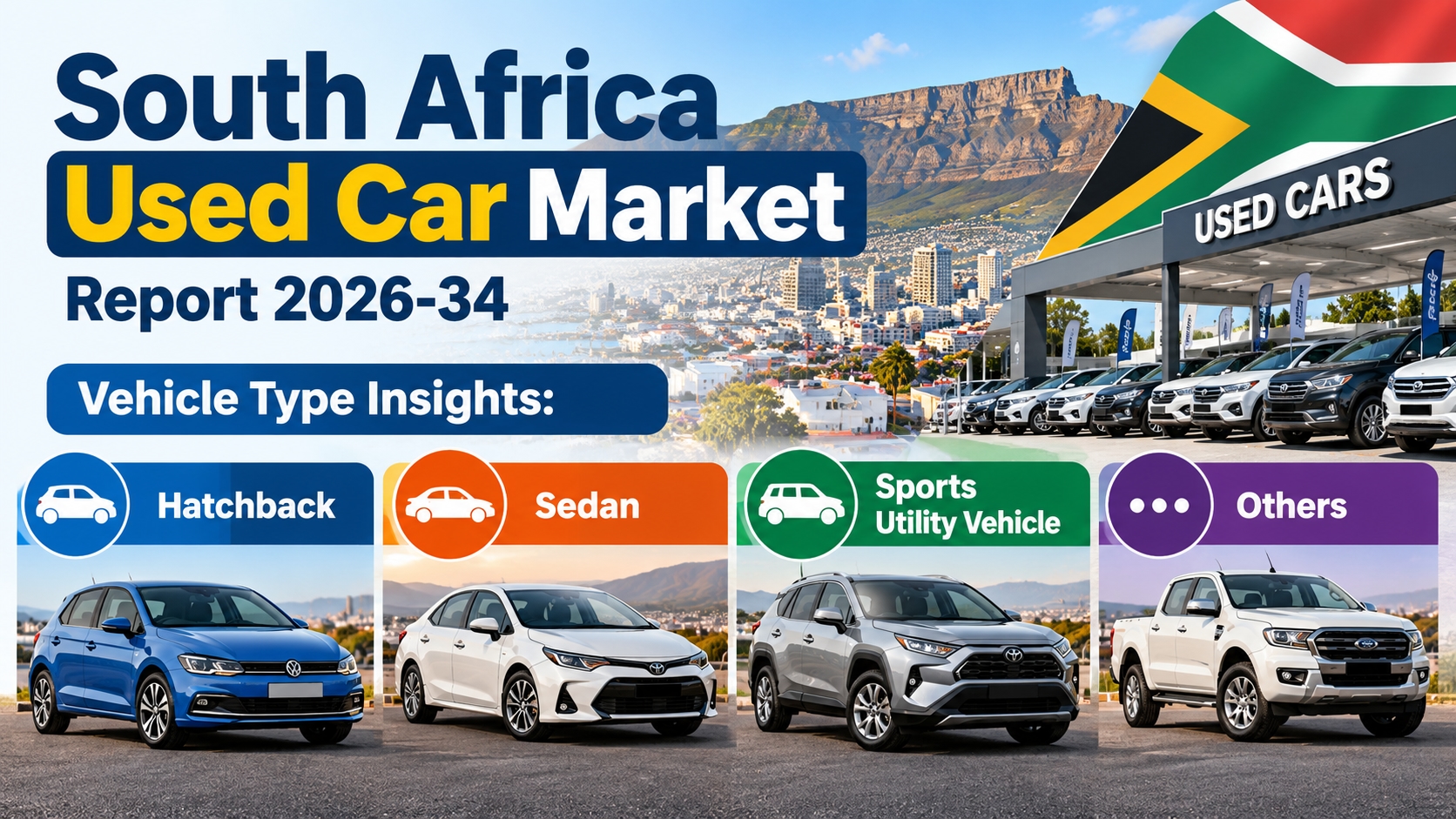
IMARC Group, a leading global market research and management consulting firm, has published its latest market intelligence report on the South Africa used car market size reached USD 5,112.7 Million in 2025. The market is projected to reach USD 9,845.4 Million by 2034, exhibiting a growth rate (CAGR) of 7.33% during 2026-2034. Growth is driven by rising affordability pressures that push buyers toward pre-owned vehicles, the expanding reach of digital marketplaces, growing demand for certified pre-owned programs, strong demand for bakkies and compact SUVs, and the steady entry of value-focused Asian brands into the vehicle parc.
The market is experiencing strong momentum as South African households and small businesses look for reliable mobility at a lower cost of ownership. Used vehicles make up about 69% of total vehicle registrations, according to TransUnion’s Q1 2026 Mobility Insights Report, which shows how central the secondary market is to personal and commercial transport. AutoTrader’s mid-year report recorded 195,455 used vehicles sold in the first half of 2026, an 8% increase, worth R82.38 billion in sales value. Dealerships, online platforms and finance providers are building more transparent and trusted buying journeys, which supports confidence among first-time and repeat buyers.
How AI is Reshaping the Future of the South Africa Used Car Market?
AI-Powered Vehicle Pricing and Valuation Engines: Machine learning platforms analyze live listing data, regional demand patterns, mileage, service history and model-year depreciation to generate instant, data-backed trade-in and retail valuations. Online buyers can check a fair market price in seconds, and dealers can adjust stock pricing faster. This matters because used light vehicle values have been moving slightly lower month on month, with Lightstone reporting that used vehicle inflation was running at roughly -2.1% year-on-year in April 2026.
Computer Vision for Inspection, Reconditioning and Condition Reporting: AI-driven image analysis detects dents, scratches, tire wear and interior damage from photographs. This standardizes inspection scoring across large buying networks and speeds up reconditioning decisions. Operators such as WeBuyCars, which achieved a record 17,617 vehicles bought in a single month in January 2026, depend on scalable and consistent appraisal workflows to manage this volume.
Personalized Search, Lead Scoring and Finance Pre-Qualification: Recommendation engines use browsing behavior, budget signals and affordability data to match buyers with suitable vehicles and finance options. AutoTrader’s platform handled hundreds of millions of searches in the last annual reporting cycle. This gives dealers detailed visibility into which models, price bands and body types are attracting the most interest, so they can plan stock accordingly.
Grab a sample PDF of this report: https://www.imarcgroup.com/south-africa-used-car-market/requestsample
South Africa Used Car Market Trends and Drivers:
The South Africa used car market is witnessing steady expansion, fueled by the convergence of affordability-led buying behavior, digital retail adoption and the professionalization of pre-owned vehicle sales. Value and functionality remain the foundation of purchase decisions. Buyers favor reliable, low-cost-of-ownership vehicles that serve personal use and small-business transport equally well. AutoTrader’s latest annual report recorded 383,410 used vehicles sold, generating R160.1 billion in sales value, a 7% increase on the prior period. The average used car price stood at R417,584, and the average vehicle age held steady at five years. These figures show a market that is large, liquid and anchored in mainstream, mid-priced vehicles.
Bakkies and compact cars are the two most visible demand pillars. The Ford Ranger remains the best-selling used vehicle in the country, with 1,922 units sold in September 2026 according to AutoTrader data. The Volkswagen Polo Vivo led used passenger cars with 1,247 units in the same month, and it consistently sells around 1,200 units a month. Sports utility vehicles hold the largest body-type share at 33% of used sales, according to AutoTrader’s mid-year report. This reflects demand for practicality, ground clearance and resale confidence on varied road conditions.
Digital platforms are redesigning how vehicles are bought and sold. Online marketplaces and app-based retailers give buyers price comparison, seller ratings and detailed vehicle histories from home. This matters in a country with long distances between major urban centers. WeBuyCars Holdings reported group revenue of R14.2 billion, up 7.8%, for the six months ended March 2026, and recorded 17,209 vehicle sales in March 2026 alone. Operators such as Auto24 South Africa, operating from Johannesburg and Cape Town, combine online valuation, financing, inspection and rent-to-own options, which widens access for buyers who would struggle with traditional credit.
Certified pre-owned programs are raising quality and trust standards. Inspected vehicles, backed by warranties and service documentation, appeal strongly to first-time buyers and risk-averse households. As these programs grow, they push the wider market toward better record-keeping, more consistent reconditioning and stronger consumer protection, which formalizes a segment that has long relied on private, peer-to-peer transactions. Lightstone estimates the formal dealer-network used light vehicle market at about 284,000 units in the first four months of 2026, equal to 1.7 used vehicles sold through dealerships for every new vehicle sold.
Competition from new vehicles and imported brands is reshaping price dynamics. TransUnion reports that new vehicle registrations rose 11.6% year-on-year in Q1 2026, while used registrations rose 2.6%. Chinese brands now account for more than 19% of new passenger and light commercial vehicle sales nationally, and they are growing faster than the wider used-car market on AutoTrader. This is gradually creating a deeper pool of late-model, lower-priced trade-ins and shifting buyer interest toward compact and value-focused models. WeBuyCars noted that Chinese brands are a small but growing share of its throughput, rising from about 3,000 vehicles to just under 4,000 in a year.
Government policy and economic conditions shape the market indirectly but meaningfully. South Africa’s 150% investment allowance for electric and hydrogen-powered vehicle manufacturers took effect on 1 March 2026, with National Treasury estimating a tax cost of about R500 million in its first fiscal year. The government has also signaled that tax rebates or subsidies for consumers are under consideration. At present, imported electric vehicles face a 25% import duty compared with 18% for internal combustion vehicles. Together these measures are expected to gradually expand the supply of new energy vehicles and, over time, the supply of used hybrid and electric models. Interest rate movements also play a role. Four interest rate cuts in the last full annual cycle lowered borrowing costs and supported vehicle finance demand, although AutoTrader has noted that buyer behavior remains disciplined and selective.
South Africa Used Car Industry Segmentation:
The report has segmented the market into the following categories:
Breakup By Vehicle Type:
Hatchback
Sedan
Sports Utility Vehicle
Others
Sports utility vehicles hold the largest body-type share of used sales, at 33% according to AutoTrader’s mid-year data. Buyers value their versatility, higher driving position and strong resale appeal. Hatchbacks remain a high-volume entry point, led by models such as the Volkswagen Polo Vivo, and compact cars are gaining share as affordability pressures encourage smaller, more fuel-efficient purchases.
Breakup By Vendor Type:
Organized
Unorganized
The market remains a mix of formal dealer groups, online-first retailers and a large base of independent and private sellers. Organized players are gaining ground by offering inspection standards, warranties, financing and digital convenience. Large operators such as WeBuyCars and Motus Holdings, through its GetWorth platform, are strengthening the credibility of the formal channel.
Breakup By Fuel Type:
Gasoline
Diesel
Others
Gasoline vehicles dominate the passenger car segment, while diesel demand is closely linked to bakkies and utility vehicles used for commercial and agricultural work. The “others” category, which includes hybrids and electric vehicles, is small but growing, supported by rising interest in hybrids. AutoTrader’s mid-year report recorded 92% growth in new energy vehicles, and TransUnion noted hybrid vehicle interest rising to 39%.
Breakup By Sales Channel:
Online
Offline
Offline dealerships and physical branches still account for most completed transactions. The online channel is expanding quickly as buyers research, compare, finance and increasingly complete purchases digitally. Platforms such as AutoTrader, Auto24 and Cars.co.za are central to this shift, and AutoTrader’s audience of tens of millions of users shows the scale of digital discovery.
Breakup By Region:
Gauteng
KwaZulu-Natal
Western Cape
Mpumalanga
Eastern Cape
Others
Gauteng is the country’s main economic and population hub and anchors vehicle trading activity, supported by dense dealer networks and a large base of commuters and businesses. KwaZulu-Natal and the Western Cape follow with strong urban retail demand, and Mpumalanga and the Eastern Cape contribute through mining, industrial and agricultural mobility needs.
Competitive Landscape:
The report provides a comprehensive analysis of the competitive landscape in the South Africa used car market, including market structure, key player positioning, top winning strategies, competitive dashboard and company evaluation quadrant. Detailed profiles of major companies are included. Leading participants in the market ecosystem include:
WeBuyCars Holdings Limited
Motus Holdings Limited (including its GetWorth platform)
AutoTrader South Africa
Auto24 South Africa
Recent News and Developments in South Africa Used Car Market
October 2026: AutoTrader’s latest data showed a modest recovery in used car sales and average selling prices in September. Toyota led used brands with 6,146 sales, up 7% month on month and 9% year on year. The Ford Ranger remained the top-selling used vehicle with 1,922 units, ahead of the Toyota Hilux.
September 2026: AutoTrader’s Mid-Year Car Industry Report showed used-car sales rising 8% to 195,455 vehicles in the first half, worth R82.38 billion. Compact cars gained share, SUVs held 33% of the market, and Chinese manufacturers grew faster than the wider used market.
May 2026: WeBuyCars Holdings reported group revenue of R14.2 billion, up 7.8%, for the six months ended March 2026. The company posted record monthly sales of 17,209 vehicles in March and a record monthly purchase volume of 17,617 vehicles in January, while noting margin pressure from cheaper Asian entrants.
January 2025: President Cyril Ramaphosa signed into law a 150% tax allowance for investment in electric and hydrogen-powered vehicle manufacturing, effective from 1 March 2026. The measure is aimed at strengthening the country’s new energy vehicle value chain, which will feed the future used vehicle pool.
Note: If you require specific details, data or insights that are not currently included in the scope of this report, we are happy to accommodate your request. As part of our customization service, we will gather and provide the additional information you need, tailored to your specific requirements. Please let us know your exact needs, and we will ensure the report is updated accordingly to meet your expectations.
About Us:
IMARC Group is a global management consulting firm that helps the world’s most ambitious changemakers to create a lasting impact. The company provides a comprehensive suite of market entry and expansion services. IMARC offerings include thorough market assessment, feasibility studies, company incorporation assistance, factory setup support, regulatory approvals and licensing navigation, branding, marketing and sales strategies, competitive landscape and benchmarking analyses, pricing and cost research, and procurement research.
Media and Sales Contact
IMARC Group
Email: sales@imarcgroup.com
United States: +1-201-971-6302
India: +91-120-433-0800
United Kingdom: +44-753-714-6104