
Microsoft Outlook is widely used for managing emails, contacts, calendars, attachments, tasks, and other mailbox information. Outlook stores mailbox data locally in PST (Personal Storage Table) files. As users continue sending and receiving emails, the size of these PST files can increase significantly.
A large PST file may become difficult to manage and can affect the overall Outlook experience. It can take longer to open, search, copy, transfer, or back up a large mailbox. In some situations, users may therefore want to Split PST File into Smaller Parts while keeping their original email information intact.
Dividing a large PST file into multiple manageable files can simplify mailbox organization, migration, storage, and backup. However, the process should be performed carefully because the PST may contain important emails, attachments, contacts, and other information.
This article explains why users split PST files, the available methods, important precautions, and how a PST Splitter Tool can help manage oversized Outlook data.
Why Do PST Files Become Large?
PST files grow as Outlook users accumulate mailbox information. Regular communication can add thousands of messages and attachments over time. Emails containing documents, images, presentations, videos, and other large attachments can increase PST size particularly quickly.
Some common reasons for oversized PST files include:
Years of stored Outlook emails
Large email attachments
Sent and received messages stored in the same mailbox
Archived mailbox information
Contacts, calendar entries, and other Outlook items
Limited mailbox cleanup and maintenance
Although newer versions of Outlook support relatively large PST files, keeping one extremely large file may still make data management inconvenient. Instead of maintaining all information in a single file, users can Split PST File data into multiple smaller PST files.
Why Split PST File into Smaller Parts?
There are several practical reasons to divide an oversized Outlook data file.
1. Easier PST File Management
A large mailbox containing years of information can become difficult to organize. Splitting it into separate PST files based on year, date, folder, or another criterion can make information easier to locate and manage.
For example, a user could maintain separate PST files for different years instead of storing five years of emails in one file.
2. Simplified Backup
Backing up a very large PST file can consume substantial storage space and time. Smaller PST files can be easier to copy to another drive or include in a structured backup strategy.
3. Convenient Data Transfer
Transferring a large PST file between computers or storage devices may take longer and can be inconvenient when storage or upload limits apply. Smaller files are generally easier to move individually.
4. Better Mailbox Organization
Splitting PST data allows users to categorize their mailbox according to specific requirements. For instance, emails can be separated according to year or folder structure.
5. Easier Archiving
Organizations and individual users may need to retain older Outlook information without keeping all historical messages in their active mailbox. Splitting and archiving older data can provide a more organized storage structure.
How to Split PST File Manually
Microsoft Outlook provides certain features that can be used to reorganize mailbox data into multiple PST files. However, Outlook does not provide a dedicated one-click PST splitting feature.
One approach is to create additional PST files and manually move selected mailbox folders or messages into them.
Step 1: Create a New PST File
Open Microsoft Outlook and navigate to:
File > Account Settings > Account Settings > Data Files > Add
Create a new Outlook data file and choose an appropriate location to save it.
Step 2: Create Additional PST Files
If you need several smaller PST files, repeat the process and create multiple files. You can name them according to their contents, such as:
Emails-2024.pst
Emails-2025.pst
Archive.pst
Project-Emails.pst
Clear file names can make future mailbox management easier.
Step 3: Move Mailbox Data
Once the new PST files are available in Outlook, select the required emails or folders and move them to the appropriate PST file.
Repeat the process until the required mailbox information has been reorganized.
Limitations of the Manual Method
The manual method may work when dealing with a relatively small amount of Outlook data, but it has several limitations.
First, moving thousands of messages manually can be time-consuming. Users must decide which messages or folders belong in each PST file and transfer them individually or in groups.
Second, maintaining consistent organization becomes more complicated when the original PST contains a large number of folders and subfolders.
Manual processing can also increase the possibility of accidental omissions. Therefore, users should always maintain a backup of their original PST file before reorganizing important mailbox information.
For users who frequently need to Split PST File into Smaller Parts, a dedicated solution may offer a more convenient approach.
Using a PST Splitter Tool
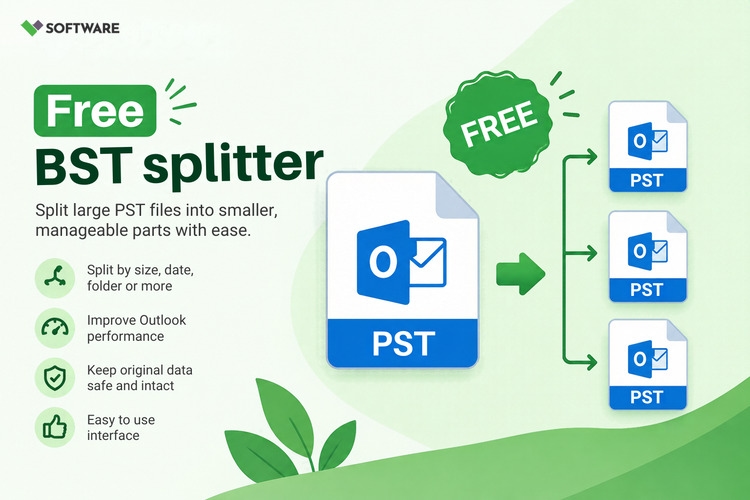
A PST Splitter Tool is designed specifically to divide large Outlook PST files into multiple smaller files according to supported splitting criteria.
Depending on the software, splitting options may include:
Split by size: The original PST is divided according to a selected file-size limit.
Split by year: Mailbox information is separated according to different years.
Split by date: Users can organize PST information according to specified date ranges.
Split by folder: Mailbox folders may be processed separately to create more manageable output files.
Options vary by application, so users should review the software's documentation and supported features before processing important mailbox data.
Important Features to Check in a PST Splitter Tool
Choosing suitable software is important when working with valuable Outlook information. A reliable solution should focus on preserving the integrity and organization of mailbox data.
Before selecting a tool, consider whether it provides:
Support for large PST files
Multiple PST splitting options
Preservation of email properties
Support for email attachments
Folder and subfolder structure retention
Compatibility with required Outlook/PST formats
Simple PST file selection and output management
Preview or verification features, where available
Clear handling of original and output files
Users should also check whether the application modifies the source PST or creates new output files. Keeping the original PST unchanged provides an additional level of protection during processing.
How to Split PST File Without Affecting Email Data
Data integrity should be the primary consideration during PST management. Before beginning the process, create a backup copy of the original PST and store it separately.
Avoid interrupting the splitting operation once processing has started. Users should also ensure that sufficient free disk space is available for the generated PST files.
After splitting, verify the output files carefully. Check important folders, emails, attachments, dates, sender and recipient details, and other relevant mailbox properties.
If you use a PST Splitter Tool, review its supported Outlook versions, PST formats, splitting criteria, and data-preservation capabilities before processing production or business-critical files.
Manual Method vs PST Splitter Tool
The manual Outlook method can be appropriate when only a limited number of emails or folders need to be reorganized. It does not necessarily require additional software, but it involves considerably more manual work.
A dedicated PST splitting application can be more practical when handling large files, numerous folders, or specific splitting requirements. Automated criteria such as file size, date, or year can reduce repetitive work.
The right approach therefore depends on PST size, mailbox complexity, available time, and the required organization method.
Best Practices Before Splitting PST Files
Regardless of the chosen method, users should follow a few precautions.
Always keep an untouched backup of the source PST. Confirm that sufficient disk space is available before creating additional files. Use meaningful names for the resulting PST files so that archived information remains easy to identify.
For important business data, test the process on a copy of the PST first. After completion, open or import the resulting files in a compatible Outlook environment and verify that the required mailbox information is accessible.
Conclusion
Large Outlook PST files can become inconvenient to organize, transfer, archive, and back up. Dividing them into smaller files provides a practical way to create a more manageable mailbox structure.
Users can manually Split PST File data by creating additional Outlook data files and moving selected mailbox information. However, this approach can require considerable time when dealing with a large mailbox.
For more complex requirements, a PST Splitter Tool can automate the process using criteria such as size, year, date, or folder, depending on the application's capabilities. Whichever approach is selected, users should maintain a backup and verify the resulting files carefully.
By following appropriate precautions, users can Split PST File into Smaller Parts while prioritizing the integrity, organization, and accessibility of their Outlook email data.