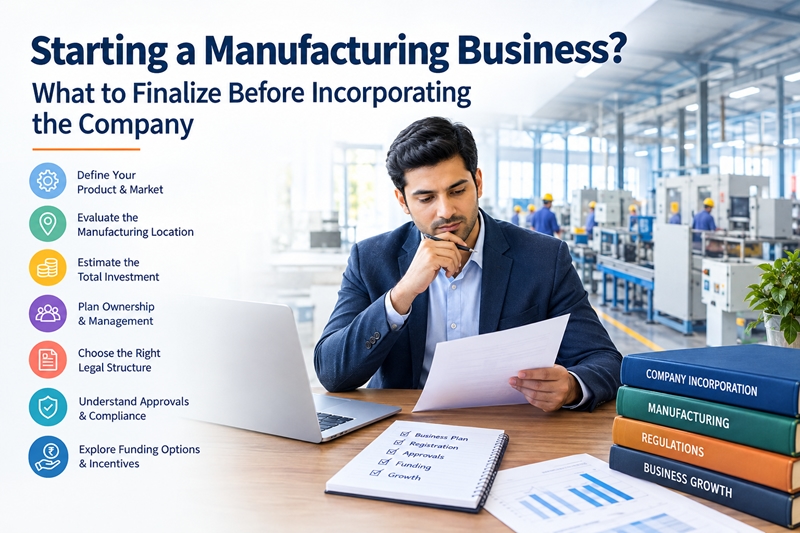
Starting a Manufacturing Business? What to Finalize Before Incorporating the Company
Starting a manufacturing business involves more than selecting a product, arranging investment and registering a company. Before incorporation, entrepreneurs need to understand what they intend to manufacture, where production will take place, how much capital the project requires and which regulatory requirements may affect its establishment.
These decisions are closely connected. For example, selecting a manufacturing location without checking land-use permissions can create difficulties during factory development. Similarly, registering a company without clearly defining its business activities or ownership arrangements can lead to avoidable changes later.
For first-time entrepreneurs, factory promoters and investors, the objective should be to establish a business structure that supports the proposed manufacturing operation. Understanding the requirements of company incorporation for a manufacturing business is an important part of this process, as decisions related to business activities, ownership, investment and regulatory obligations can influence future operations. Finalizing the following aspects before incorporation can help reduce uncertainty, improve investment planning and create a more practical foundation for setting up a manufacturing unit.
Define What You Intend to Manufacture and Who Will Buy It
The first decision should be the manufacturing activity itself. Entrepreneurs sometimes begin with a broad idea, such as manufacturing plastic products, automotive components, industrial chemicals or food products, without identifying the specific products they intend to produce.
This creates uncertainty in subsequent decisions because different products can require different machinery, production processes, raw materials, utilities and regulatory considerations.
Consider an entrepreneur planning to establish a plastic manufacturing unit. Manufacturing packaging containers, automotive plastic components and industrial moulded products may involve different moulding technologies, quality requirements and customer expectations. Treating all three as the same manufacturing opportunity can result in an unsuitable initial project plan.
Before incorporation, establish:
The primary products and any closely related product categories.
The manufacturing process and major raw materials required.
The intended customer segments, such as industrial buyers, distributors or original equipment manufacturers.
The expected production capacity and initial product mix.
Whether the business will also undertake trading, distribution, imports or exports.
Market validation should accompany this exercise. Speak with potential customers, examine competing products and understand the quality specifications and delivery expectations of the intended market.
The objective is not to finalize every production detail before registering the company. It is to define the proposed business clearly enough to make informed decisions about its legal structure, investment and operational requirements.
Evaluate the Industrial Location Before Committing to Land
A suitable manufacturing location should support the production process, infrastructure requirements and applicable land-use conditions. Choosing a site primarily because its purchase price or lease cost appears attractive can create problems later.
For instance, a promoter may identify an affordable plot outside an established industrial area. However, the proposed manufacturing activity may require land-use conversion, additional permissions or infrastructure that is not readily available.
Location assessment should therefore go beyond the availability of land.
Important factors include:
Land use: Confirm whether the proposed industrial activity is permitted at the selected location and whether any conversion or development permissions are required.
Electricity: Assess the connected load, reliability of supply and possibility of future capacity enhancement.
Water availability: Determine whether sufficient water is available for processing, cooling, cleaning and other requirements.
Logistics: Evaluate proximity to suppliers, customers, highways, transport facilities and industrial clusters.
Waste management: Understand the arrangements required for wastewater treatment, emissions and solid or hazardous waste, where applicable.
Expansion potential: Check whether the property can accommodate additional production lines, warehouses or utility infrastructure.
Invest India identifies land allotment, land-use permission, pollution-related approvals, building-plan approval and utility connections among the considerations involved in establishing industrial projects.
Entrepreneurs can also use the National Single Window System (NSWS) to identify relevant central and state-level approvals. However, the applicable authority and final permission depend on the specific project and location.
A site should ideally be shortlisted only after its suitability has been assessed against the proposed manufacturing activity. This reduces the risk of committing substantial capital to land that cannot support the intended operation.
Related Blog: https://www.imarcengineering.com/blog/company-incorporation-for-manufacturing-in-india
Calculate the Complete Project Investment, Not Just Machinery Costs
One of the most common planning gaps in a new manufacturing venture is underestimating the money required to establish and operate the unit.
Promoters may prepare an initial budget covering land, building and production machinery. However, a functioning manufacturing facility also requires utilities, installation, material handling, testing facilities, initial inventory and sufficient working capital.
A more complete investment assessment should consider:
Cost component | What needs to be assessed |
|---|---|
Land and building | Purchase, lease, site development and construction |
Machinery | Equipment, accessories, tooling and installation |
Utilities | Electrical systems, water, compressed air and other services |
Quality infrastructure | Testing instruments and inspection facilities |
Environmental systems | Applicable pollution-control and waste-treatment infrastructure |
Initial inventory | Raw materials, consumables and packaging |
Workforce | Recruitment, training and initial salary requirements |
Working capital | Supplier payments, operating expenses and customer credit periods |
Working capital deserves particular attention. A manufacturing business may complete production and dispatch orders but still face cash shortages if customers pay after extended credit periods while suppliers require earlier payment.
For example, a company manufacturing industrial components may need to purchase raw materials several weeks before receiving payment for finished products. Its financing requirement must cover this operating cycle, not simply the initial machinery purchase.
The Ministry of MSME's PMEGP framework distinguishes capital expenditure from working capital when defining project costs. Its applicability and financial limits are scheme-specific, but the distinction is relevant to broader manufacturing investment planning.
Entrepreneurs should prepare a preliminary project cost estimate and financial projections before deciding how much capital the proposed company needs.
Decide the Ownership Structure and Responsibilities of Each Founder
When multiple individuals establish a manufacturing business, ownership and management arrangements should be discussed before incorporation.
A common situation involves one promoter contributing most of the investment while another contributes technical knowledge, industry relationships or operational expertise. If their respective ownership and responsibilities remain informal, disagreements may arise when the company starts making financial and operational decisions.
Before incorporation, founders should discuss:
The proposed shareholding of each founder.
Initial capital contributions and future funding responsibilities.
Who will become directors and what responsibilities they will undertake.
Who will manage production, finance, procurement and sales.
How important business decisions will be approved.
What arrangements will apply if a founder leaves or transfers shares.
These discussions should be documented through appropriate legal agreements and corporate records.
Shareholding should not automatically be divided equally simply because two or more people are starting the business together. Ownership should reflect the agreed commercial arrangement, investment commitments and long-term intentions of the founders.
This becomes particularly important when a manufacturing company expects to bring in external investors, expand production capacity or introduce additional shareholders later.
Choose a Legal Structure That Supports the Business Plan
The choice between a Private Limited Company, Limited Liability Partnership or another suitable business structure should be based on the proposed ownership model, funding plans and management requirements.
A Private Limited Company may be appropriate for promoters seeking a formal shareholding structure and potential equity investment. An LLP may suit certain businesses that prefer a partnership-based management and ownership arrangement.
However, neither structure is automatically suitable for every manufacturing venture.
Before deciding, evaluate:
Ownership and investment: Consider how promoters will contribute capital and whether external equity investors may be introduced.
Management requirements: Determine how directors, shareholders or partners will participate in business decisions.
Compliance responsibilities: Understand the applicable statutory filings, accounting requirements and governance obligations.
Future growth: Consider whether the business may require additional shareholders, restructuring or changes in ownership as it expands.
Entrepreneurs should also distinguish between authorized share capital, subscribed share capital and the total project investment. These represent different financial concepts. The amount required to establish a manufacturing facility is not the same as the company's share capital.
A company secretary, chartered accountant or other appropriately qualified professional can help assess the legal and financial implications before the structure is finalized.
Prepare the Company's Business Objects and Future Activity Plans
The proposed company's Memorandum of Association (MOA) should accurately describe its intended business activities.
This requires more thought than simply mentioning a broad manufacturing category. The promoters should consider the main products, related activities and realistic business operations that the company intends to undertake.
For example, a company planning to manufacture industrial packaging materials may also expect to undertake related product development, distribution or export activities.
These intentions should be evaluated while preparing the company's objects, rather than relying on vague descriptions that do not adequately represent the proposed business.
The National Company Law and MCA incorporation framework also connects the company's stated objects with the relevant business activity classification and NIC code during incorporation.
Before filing, review:
The principal manufacturing activity.
Related products and ancillary activities.
Proposed import and export operations, if relevant.
Distribution and trading activities, where genuinely intended.
Future expansion into closely related product categories.
Future plans should be realistic. Including unrelated activities simply to make the MOA appear comprehensive does not improve business readiness.
The objective is to create a legal description that reflects the actual business model while allowing for reasonable, planned development.
Identify Applicable Factory and Environmental Approvals
Company incorporation creates a legal entity. It does not automatically authorize that entity to construct a factory or begin manufacturing operations.
This distinction is particularly important for manufacturing entrepreneurs because regulatory requirements depend on the product, production process, location, capacity and applicable laws.
Depending on the project, the promoters may need to assess:
Consent to Establish from the relevant State Pollution Control Board or Pollution Control Committee.
Environmental clearance, where applicable.
Factory building-plan approval and applicable factory registration or licensing.
Fire safety requirements.
Water extraction and wastewater disposal permissions.
Hazardous waste authorization, where relevant.
Sector-specific approvals, such as FSSAI, CDSCO or PESO permissions, depending on the activity.
Two important pollution-control milestones should be understood:
Consent to Establish (CTE): Generally relevant before establishing an industrial unit under applicable pollution-control requirements.
Consent to Operate (CTO): Generally required before operating an industrial unit where the consent regime applies.
The exact applicability, exemptions and procedure must be checked with the relevant authorities.
The National Single Window System can help entrepreneurs identify pre-establishment and pre-operation approvals. It is an information and application facilitation platform; the concerned government department or state authority remains responsible for granting the approval.
A useful approach is to prepare an approval matrix before finalizing the factory layout or purchasing major equipment. This allows the project team to identify permissions that may influence site selection, infrastructure design and commissioning schedules.
Assess Funding Options and Government Incentives
The final pre-incorporation consideration is how the project will be financed.
Manufacturing ventures often require significant initial investment, and the funding arrangement should support both establishment and early operations.
Promoters should evaluate:
Personal or promoter contributions.
Bank term loans for eligible capital expenditure.
Working-capital facilities.
Equipment financing.
External equity investment, where appropriate.
Applicable central and state industrial incentives.
Government incentives should not be treated as guaranteed project income. Eligibility may depend on the industry, location, investment amount, employment generation, production commencement and application deadlines.
For example, a manufacturer establishing a unit in a designated industrial area may need to assess the applicable state industrial policy, while a small enterprise may separately evaluate relevant MSME schemes.
The PMEGP framework provides an example of a scheme that considers project cost, capital expenditure and working capital. However, entrepreneurs should verify its current eligibility conditions rather than assume that every manufacturing company qualifies.
A realistic financial plan should remain viable even if an expected incentive is delayed, reduced or unavailable.
Final Readiness Check Before Incorporation
Before submitting incorporation documents, promoters should be able to answer the following questions:
What exactly will the company manufacture?
Who are its intended customers?
Which industrial location is being considered, and is its land use suitable?
What is the estimated project investment?
How much working capital will be required?
Who will own and manage the company?
Which legal structure supports the business plan?
Do the proposed MOA objects reflect the intended activities?
Which factory, environmental and sector-specific approvals may apply?
What are the funding sources and applicable incentive conditions?
Not every decision must be fully implemented before incorporation. For example, a promoter may register the company before purchasing land or placing machinery orders. However, the important assumptions should be assessed before making commitments that are difficult or expensive to reverse.
How IMARC Engineering Can Help
IMARC Engineering supports entrepreneurs and industrial promoters in evaluating the technical and operational considerations involved in establishing manufacturing businesses. Its engineering and project advisory capabilities can help assess manufacturing requirements, project feasibility, industrial site suitability, preliminary investment needs, plant layout, process planning and applicable regulatory considerations. By connecting early business decisions with practical factory development requirements, IMARC helps promoters approach manufacturing projects with greater clarity. This supports more informed planning before major capital commitments and subsequent project execution.
Connect with an expert: https://www.imarcengineering.com/contact?service=company-incorporation
Conclusion
Incorporating a manufacturing company is an important legal milestone, but it should follow a clear understanding of the business, investment and operational requirements. Defining the product, evaluating the location, estimating project costs, agreeing on ownership and identifying applicable approvals can help entrepreneurs avoid preventable planning gaps. Not every factory decision must be completed before registration, but the assumptions behind those decisions should be examined carefully. A well-prepared promoter can then move from company incorporation towards manufacturing project development with a more realistic plan.
Contact Us:
IMARC Engineering
Phone: +91-120-433-0800
Email: sales@imarcengineering.com
India: C-130, Sector 2, Noida, Uttar Pradesh 201301
LinkedIn: https://www.linkedin.com/showcase/imarc-engineering/