
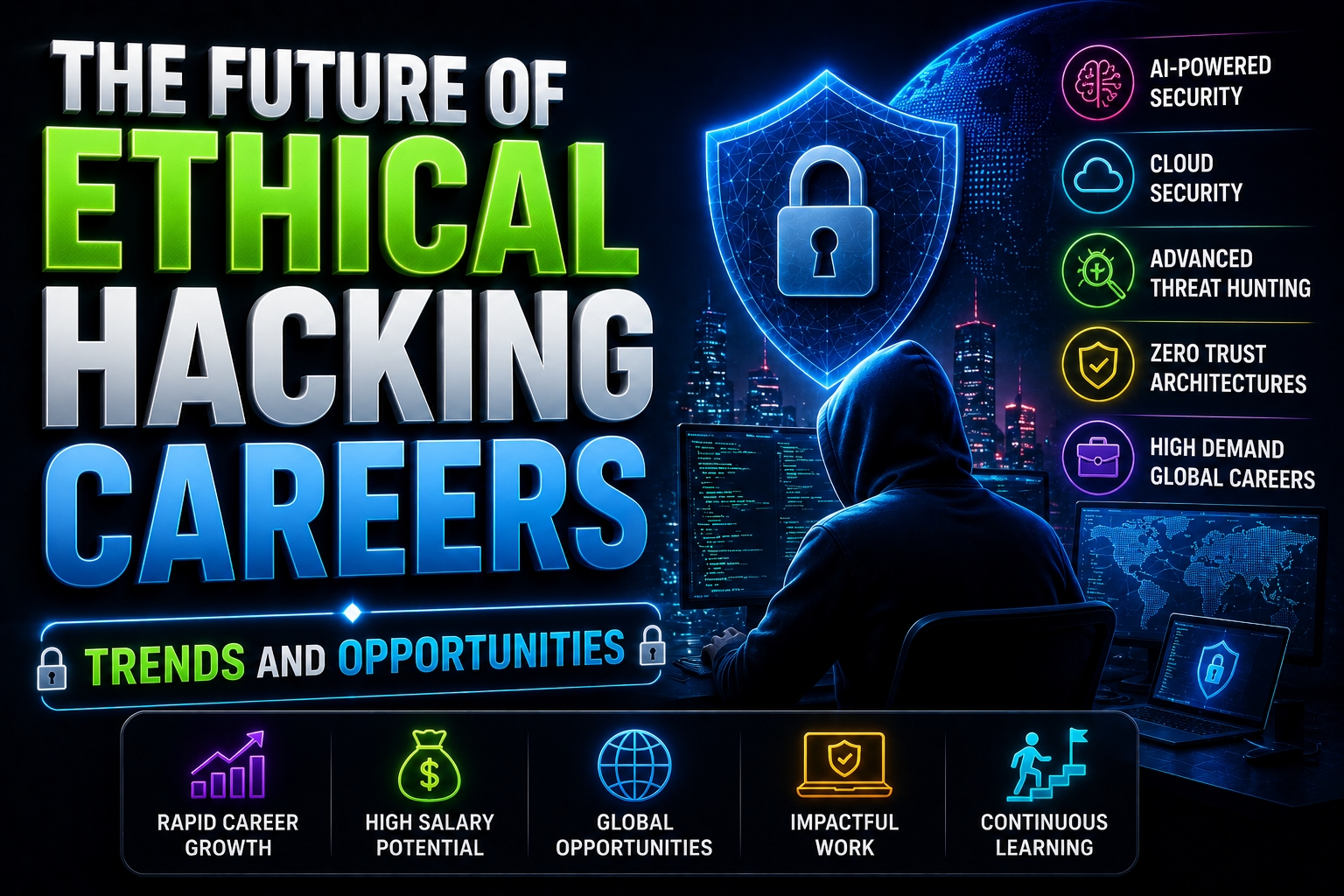
Cybersecurity has become one of the most important priorities for organizations worldwide, and ethical hacking continues to be one of the fastest-growing career paths within the industry. As businesses increasingly rely on cloud computing, artificial intelligence, digital transformation, and connected technologies, protecting systems from cyber threats has become more challenging than ever.
Ethical hackers play a critical role in helping organizations identify vulnerabilities before malicious attackers can exploit them. Their expertise supports stronger security, regulatory compliance, and business continuity across a wide range of industries.
As cybersecurity continues evolving, understanding future trends and career opportunities can help professionals prepare for long-term success. This guide explores how ethical hacking is changing in 2026 and the skills, technologies, and career paths that are shaping its future.
Why Ethical Hacking Continues to Grow
Organizations face increasingly sophisticated cyberattacks that target networks, applications, cloud platforms, and sensitive business data. Cybercriminals continue adopting advanced techniques, including ransomware, phishing campaigns, supply chain attacks, and AI-assisted threats. At the same time, businesses are expanding their digital infrastructure, creating a larger attack surface that requires continuous security testing. Because of these challenges, an ethical hacking career has become increasingly important, as ethical hackers play a critical role as members of modern cybersecurity teams. Their ability to identify weaknesses before attackers do helps organizations reduce security risks and improve resilience.
Artificial Intelligence Is Transforming Ethical Hacking
Artificial intelligence is changing both cyberattacks and cyber defense. Security teams now use AI-powered tools to analyze vulnerabilities, detect threats, automate repetitive tasks, and improve incident response. At the same time, attackers are also leveraging AI to develop more sophisticated attack techniques.
Future ethical hackers will increasingly need to understand:
AI-assisted security testing
Machine learning security concepts
Prompt injection risks
AI model security
Automated vulnerability discovery
Rather than replacing ethical hackers, artificial intelligence is creating opportunities for professionals who understand both cybersecurity and emerging AI technologies.
Cloud Security Will Remain a Major Focus
Organizations continue migrating applications and data to cloud platforms. As AWS, Microsoft Azure, and Google Cloud environments expand, ethical hackers are increasingly expected to understand cloud-native security architectures and cloud-specific attack techniques.
Future penetration testing will involve:
Cloud identity management
Container security
Kubernetes security
Serverless applications
Multi-cloud environments
Cloud configuration reviews
Professionals with cloud security expertise are likely to remain highly valuable.
Growing Importance of Application Security
Modern businesses depend heavily on web applications, APIs, and mobile applications. As software development accelerates, application security has become one of the fastest-growing areas within ethical hacking.
Professionals specializing in application security often focus on:
Area | Why It Matters |
|---|---|
Web Applications | Preventing common vulnerabilities |
APIs | Protecting data exchange |
Mobile Applications | Securing mobile platforms |
Authentication | Preventing unauthorized access |
Authorization | Managing user permissions |
Secure Development | Reducing vulnerabilities early |
Application security expertise is expected to remain one of the strongest career specializations throughout the coming years.
The topic is also discussed thoroughly in an earlier YouTube video from Cert Mage: 🔴
Red Team Operations Continue Expanding
Organizations increasingly conduct advanced security exercises to evaluate their defenses. Red Teams simulate realistic cyberattacks against enterprise environments while Blue Teams defend organizational systems.
Ethical hackers interested in offensive security often pursue careers involving:
Red Team Operations
Adversary Simulation
Threat Emulation
Security Assessments
Penetration Testing
These roles require advanced technical knowledge, creativity, and continuous learning.
Essential Skills for Future Ethical Hackers
The future ethical hacker requires a broad technical foundation.
Key skills include:
Networking
Linux administration
Windows security
Cloud security
Web application testing
API security
Scripting and automation
Vulnerability assessment
Identity and access management
Security reporting
Professionals who combine these technical skills with strong analytical thinking are likely to remain highly competitive.
Certifications That Support Future Growth
Professional certifications continue to support ethical hacking careers.
Popular certifications include:
CompTIA Security+
ISC2 Certified in Cybersecurity (CC)
Certified Ethical Hacker (CEH)
CompTIA PenTest+
Offensive Security Certified Professional (OSCP)
GIAC Penetration Tester (GPEN)
Certified Information Systems Security Professional (CISSP)
Candidates should select certifications that match their experience level and long-term career objectives.
Career Opportunities Beyond Penetration Testing
Ethical hacking skills support a wide variety of cybersecurity careers.
Professionals often transition into roles such as:
Security Consultant
Application Security Engineer
Cloud Security Engineer
Security Architect
Red Team Lead
Incident Response Specialist
Threat Intelligence Analyst
Cybersecurity Manager
This flexibility allows ethical hackers to continue growing throughout their careers.
Industries Hiring Ethical Hackers
Demand for ethical hackers extends well beyond technology companies.
Major hiring sectors include:
Banking
Healthcare
Government
Cloud Computing
Telecommunications
Manufacturing
Retail
Consulting
Energy
Nearly every industry now depends on cybersecurity professionals to protect digital assets and maintain customer trust.
Building a Future-Proof Ethical Hacking Career
Long-term success depends on continuous learning.
Professionals should regularly:
Practice in legal lab environments.
Learn emerging technologies.
Follow cybersecurity research.
Improve cloud security knowledge.
Develop programming skills.
Build practical projects.
Earn relevant certifications.
A commitment to lifelong learning remains one of the most valuable qualities in cybersecurity. Many professionals preparing for ethical hacking certifications use learning resources from Cert Mage to strengthen their understanding of cybersecurity concepts, certification objectives, and penetration testing methodologies.
Future Outlook
The outlook for ethical hacking remains exceptionally positive. Cloud adoption, artificial intelligence, Zero Trust security, digital transformation, and increasingly sophisticated cyber threats continue to expand the need for skilled offensive security professionals.
Organizations are expected to invest further in proactive security testing, creating continued demand for ethical hackers capable of protecting modern digital environments.
Professionals who combine practical experience with expertise in cloud security, AI security, automation, and application security are likely to enjoy excellent long-term career prospects.
Final Evaluation
Ethical hacking is evolving alongside modern technology, creating exciting opportunities for cybersecurity professionals. Artificial intelligence, cloud computing, application security, and advanced threat simulation are reshaping how organizations defend their systems and how ethical hackers perform security assessments.
For individuals interested in cybersecurity, ethical hacking offers strong job demand, diverse specialization options and continuous opportunities for professional growth. By building technical expertise, earning respected certifications, and staying current with emerging technologies, aspiring ethical hackers can develop rewarding careers that remain valuable well beyond 2026.