Most funding advice treats money as one decision: raise or don’t. In practice, raising is a sequence of plays, and each one fits a particular moment in your company’s life. Run the wrong play too early and you give away more than you need to. Run it too late and you lose time.
Here is a simple playbook, organised by what you actually need next.
Play 1: Fund the Proof
When to run it: You have an idea or prototype and need evidence that it works.
Typical sources: Personal savings, friends and family, angel investors, early grants.
At this stage, the goal is not growth. It is learning cheaply. Keep rounds small, spend on validation, and avoid giving up large equity before you know what the business is worth.
Watch out for: Raising more than you can use. Excess capital early on can hide weak signals instead of revealing them.
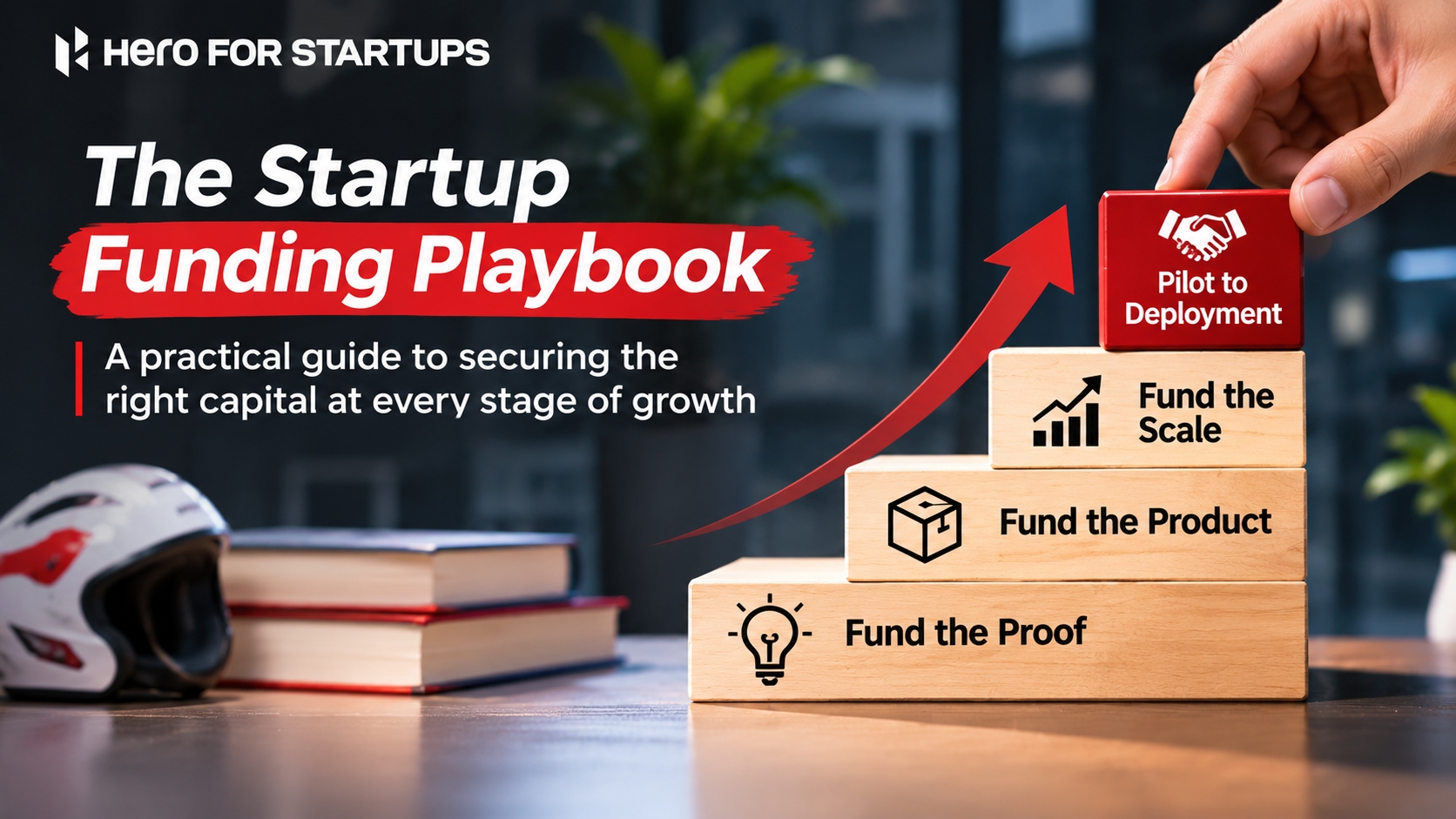
Play 2: Fund the Product
When to run it: The prototype works, and you need to turn it into something customers can buy.
Typical sources: Angels, seed funds, startup programs and incubators.
This is where much of the early capital for startups is raised, and where your story shifts from vision to proof. Early customers, pilots and test results start to matter more than the deck.
Watch out for: Treating the cheque as the finish line. Ask what the investor or program brings besides money.
Play 3: Fund the Scale
When to run it: You have traction, revenue and a repeatable way to win customers.
Typical sources: Venture capital, venture debt, strategic investors.
Here, venture capital funding for startup growth enters the picture. Venture funds look for large markets and fast growth, and they usually take equity and some say in direction. That suits companies that need to move quickly and can credibly show how an investment turns into scale.
Watch out for: Raising venture capital because it is the default. If your business grows steadily on revenue, other options may leave you more ownership.
Play 4: Fund the Gap Between Pilot and Deployment
When to run it: Your product works, but a large buyer has not yet adopted it at scale.
Typical sources: Corporate programs, strategic partners, non-dilutive grants.
This play is often overlooked. Many promising technologies stall between a successful pilot and a signed deployment, and equity rarely solves that problem. A buyer who funds a proof of concept can.
Hero For Startups, Hero MotoCorp’s program for mobility, clean-tech and deep-tech startups, is one example. It offers non-dilutive grants for paid proofs of concept, so startups can build without relinquishing equity. Selected startups also get access to R&D facilities in India and Germany, and successful PoCs are assessed for integration into Hero’s product lines and operations.
Watch out for: Fit. Programs like this are selective. Hero’s is meant for growth-stage startups with existing traction, revenue and product funding, and it is not intended for idea-stage teams.
Running the Plays Well
Match the play to the milestone. Ask what the next 12 months must prove, then choose the money that supports it.
Combine sources. Plenty of companies pair equity with grants or debt. Each source can cover a different need.
Prepare your evidence before your pitch. For any fund raising for a startup effort, a short pack of customers, pilots, revenue and test results does more than a long narrative. Keep it current and easy to share.
Know what you give up. Equity, control, repayment terms and reporting duties differ widely. Read the terms, and ask a lawyer or advisor before you sign anything.
Look past the cheque. Mentorship, infrastructure, customer access and a clear route to deployment can be worth as much as the amount itself.
A Quick Gut Check
Before your next raise, answer four questions:
What must be true in 12 months for us to call this a win?
Which play fits that goal?
What evidence do we already have?
What are we willing to trade for the money?
If you can answer all four, you are already ahead of most founders.
There is no single best way to fund a company. There is a best next play, and it changes as you grow. Start by naming your milestone, then choose the funding that gets you there with the least unnecessary cost.
Curious about non-dilutive funding for growth-stage mobility startups? Visit the Hero For Startups website to explore the program, focus areas and selection process.

