
Big Data Analytics continues to transform how organizations make decisions, solve business challenges, and create new opportunities. From healthcare and finance to retail and cybersecurity, companies rely on analytics to uncover insights hidden within massive datasets.
As a result, employers increasingly seek professionals who can work with data, identify patterns, and deliver actionable recommendations. For students and researchers, selecting the right Big Data Analytics project can help build technical expertise, strengthen a portfolio, and demonstrate real-world problem-solving skills.
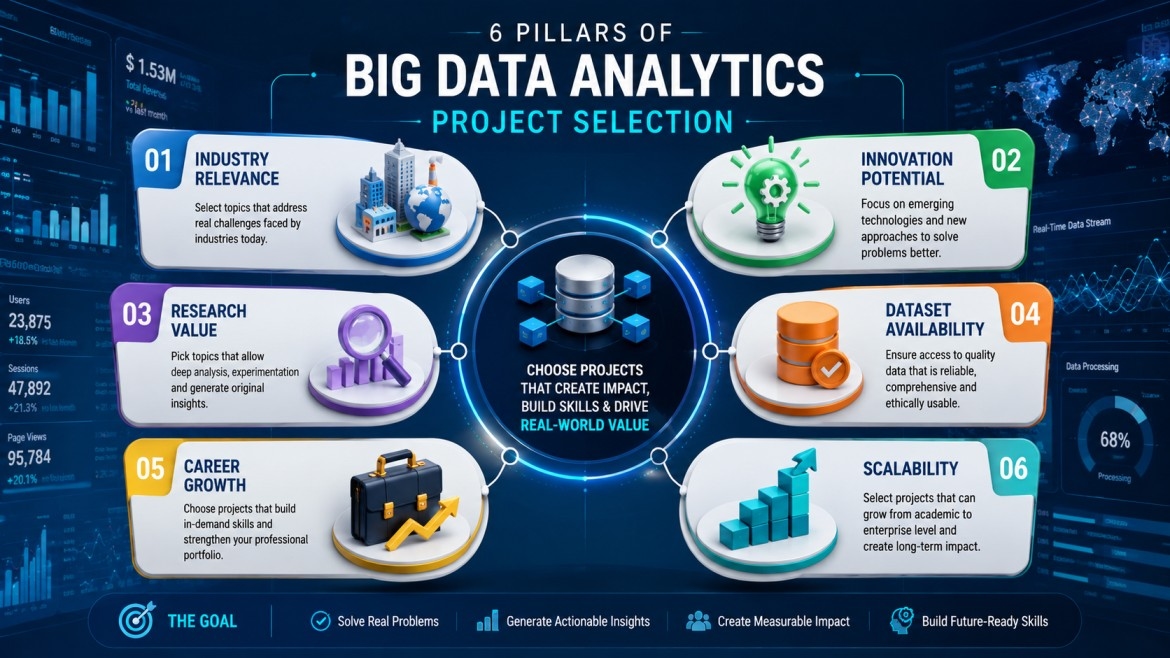
However, not all project topics offer the same value. The best projects combine industry relevance, research potential, innovation, and practical application. In this guide, we explore why Big Data Analytics matters in 2026 and how to identify project topics that align with current industry needs and future career opportunities.

Why Big Data Analytics Matters in 2026:
Organizations are generating more data today than they have at any point, really. Every online transaction, social media interaction, sensor reading, and customer activity adds to a constantly growing stream of information. And still, gathering data by itself doesn't automatically create value. Businesses actually require analytics, or better said, analytical thinking, to change raw information into useful insights.
In 2026, several trends have boosted the importance of Big Data Analytics quite a lot.
What Makes A Strong Big Data Analytics Project?
A lot of students zoom in on technical complexity when they pick a project. But even if your skills are solid, employers and academic reviewers usually look at the actual problem first, not only the fancy models. It can feel a bit annoying, but it is the reality of it.
A really strong project should handle three big questions, kind of like a checklist
1. Does the Project Solve a Real Problem?
If the work tackles a genuine challenge, the results tend to matter more. Like, predicting hospital resource demand creates more real-world value than just building a simple dashboard with no clear objective or context.
2. Does the Project Use Meaningful Data?
Big datasets really do open doors for spotting patterns, shifts, and those quieter insights, too. If the project leans on real-world data, it usually shows more solid analytical ability, compared with projects that rely on made-up samples or overly simplified data.
3. Does the Project Generate Actionable Insights?
Because organizations care about results. A good project should support decision makers, helping them improve performance, lower risk, raise efficiency, or serve customers in a smoother way. And not just "Here are the charts," but something that actually nudges a real next step, you know.
Top 10 Innovative Big Data Analytics Project Topics:
1. AI-Powered Healthcare Predictive Analytics:
Healthcare organizations produce a huge amount of patient data every day. In this project, the goal is to study medical records, patients' past histories, and treatment results to catch diseases early, before they turn into something really serious.
By integrating artificial intelligence, students can develop intelligent models that enhance the accuracy and speed of disease prediction Students will be able to create models that help spot who is at risk for diabetes, heart disease, or even hospital readmission issues. The whole thing is about predictive analytics mixed with machine learning and healthcare data management, while also addressing a practical challenge that has a direct effect on how care is delivered.Skills Demonstrated: Predictive modeling, healthcare analytics, machine learning, data visualization.
2. Real-Time Financial Fraud Detection System:
Financial institutions process millions of transactions every day, so fraud detection is a big challenge, like really. In this project, we use real-time analytics to spot suspicious behavior and quickly flag transactions that look potentially fraudulent.
While looking at transaction patterns, location signals, spending behavior, and account activity, students can create systems that catch anomalies as they happen, not later.
The whole idea has strong industry relevance too, since banks and fintech companies are still putting serious money into fraud prevention technologies. Skills Demonstrated: real-time analytics, anomaly detection, Apache Kafka, Apache Spark.
3. Smart City Traffic Optimization Analytics:
In urban places, more and more they get traffic jammed up and run into all kinds of transportation troubles. This project pulls together information from GPS devices, traffic sensors, public transit systems, and road maps, just to get a clearer picture and improve the flow.
Students could build forecast models for congestion, propose alternative routes, and also help city planners tune the transportation infrastructure so it works a bit smoother, even during peak times.Overall, it brings Big Data Analytics together with smart city development efforts that a lot of governments already support. Skills demonstrated: geospatial analytics, IoT data processing, predictive analytics
4. Customer Sentiment Analytics Across Digital Platforms:
In the middle of all, urban zones are dealing with rising traffic congestion and other transportation frictions. For this project, we pull together data from GPS devices, traffic sensors, public transit systems, and the road topology itself, so the overall traffic flow can actually get better, or at least more predictable.
Students can build predictive models that forecast congestion levels, suggest alternate routes in a smarter way, and assist city planners in optimizing transportation infrastructure in a more informed style.
Basically, the whole effort blends big data analytics with smart city development programs, the kind that many governments already champion right now. Skills Demonstrated: geospatial analytics, IoT data processing, and predictive analytics.
5. Climate Change and Environmental Analytics:
Environmental agencies and researchers rely on data to watch climate patterns and maybe predict future changes. In this project, we look at weather records, pollution levels, satellite imagery, and a bunch of environmental datasets, sort of all together.
Students can spot trends that connect to temperature shifts, carbon emissions, air quality, or even those extreme weather events. Overall, the effort supports sustainability research, and it shows how analytics can, like, add value to global environmental problem-solving. Skills Demonstrated: time-series analysis, environmental analytics, and predictive modeling.
6. Supply Chain Risk Prediction and Optimization:
Global supply chains get hit by all kinds of disruptions, like bad weather moments, political frictions, slower transportation routes, and shifting consumer demand. This project uses analytics in order to forecast where problems might pop up and then suggests preventive steps, instead of waiting too long.
Students can dig through shipping records, inventory signals, supplier performance measures, and demand estimates to make the whole supply chain run more smoothly, and yes, with fewer surprises.
Businesses really like these ideas, since they tend to lower expenses and strengthen operational resilience. Skills Demonstrated: forecasting, supply chain analytics, and risk assessment.
7. Cybersecurity Threat Intelligence Analytics:
Organizations collect massive volumes of network and security data every second, and it piles up faster than anyone expects. In this project, we focus on analyzing logs, user behavior, and network activity to spot cyber threats before they actually manage to cause damage.
Students can build anomaly detection systems that can notice strange or out-of-pattern behavior, then alert the security teams about potential risks. It’s basically about turning noisy data into something usable and not just storing it for later.
Cybersecurity remains one of the fastest-growing technology sectors, so this project feels very helpful for career development in a more direct way.Skills Demonstrated: security analytics, anomaly detection, and machine learning.
8. Smart Retail Recommendation Engine:
Nowadays, a lot of retailers use recommendation systems to make the customer experience feel more personal and also to boost sales, generally. In this project, we look at purchase history, how people browse, what customers seem to like, and also demographic info.
Students can build their own recommendation algorithms that propose products based on a mix of each shopper’s interests and their actual behaviors. For example, even small patterns can turn into helpful suggestions.
It’s also pretty clear that most big e-commerce platforms lean on recommendation engines a good deal, so it becomes a real-world and broadly usable kind of project, not just theory.
Skills demonstrated: recommendation systems, customer analytics, and machine learning.
9. Energy Consumption Forecasting For Smart Grids:
Energy providers need good demand forecasts to handle their resources in a more efficient way. In this project, we look at electricity usage patterns, weather conditions, and also the historical consumption records to help estimate what the future energy demand might look like.
Students can build forecasting models that let utility companies fine-tune how energy is distributed, and it also supports renewable energy integration. Since many countries keep investing in smart grid infrastructure, this theme stays relevant. It’s like always getting more attention each year. Skills Demonstrated: Forecasting, time-series analytics, and sustainability analytics
10. ESG and Sustainability Analytics Platforms:
ESG reporting has become like a huge business priority, more and more. Companies are tracking sustainability metrics so they can satisfy regulatory needs and also what stakeholders expect. In this project, we focus on gathering and looking at ESG-related data, like carbon emissions, energy use, workforce diversity, and some governance indicators.
Students can create dashboards that show sustainability performance, and help point out improvement chances. With all the increasing attention on responsible business behavior , ESG analytics feels like one of the more future-forward Big Data project topics.
Skills Demonstrated: business intelligence, sustainability analytics, dashboard building.
Conclusion
Big Data Analytics remains one of the most valuable and versatile fields in technology. Organizations across industries continue to invest in analytics solutions that improve decision-making, reduce risk, and create competitive advantages.
For students and researchers, the right project can do more than satisfy academic requirements. It can demonstrate technical skills, showcase problem-solving abilities, and open doors to internships, research opportunities, and professional roles.
When selecting a project, focus on solving a real problem, working with meaningful data, and generating insights that create measurable value. Projects that combine technical depth with practical application consistently deliver the strongest outcomes.
As the demand for analytics professionals continues to grow, choosing an innovative and industry-relevant project today can help build a stronger foundation for tomorrow's opportunities.