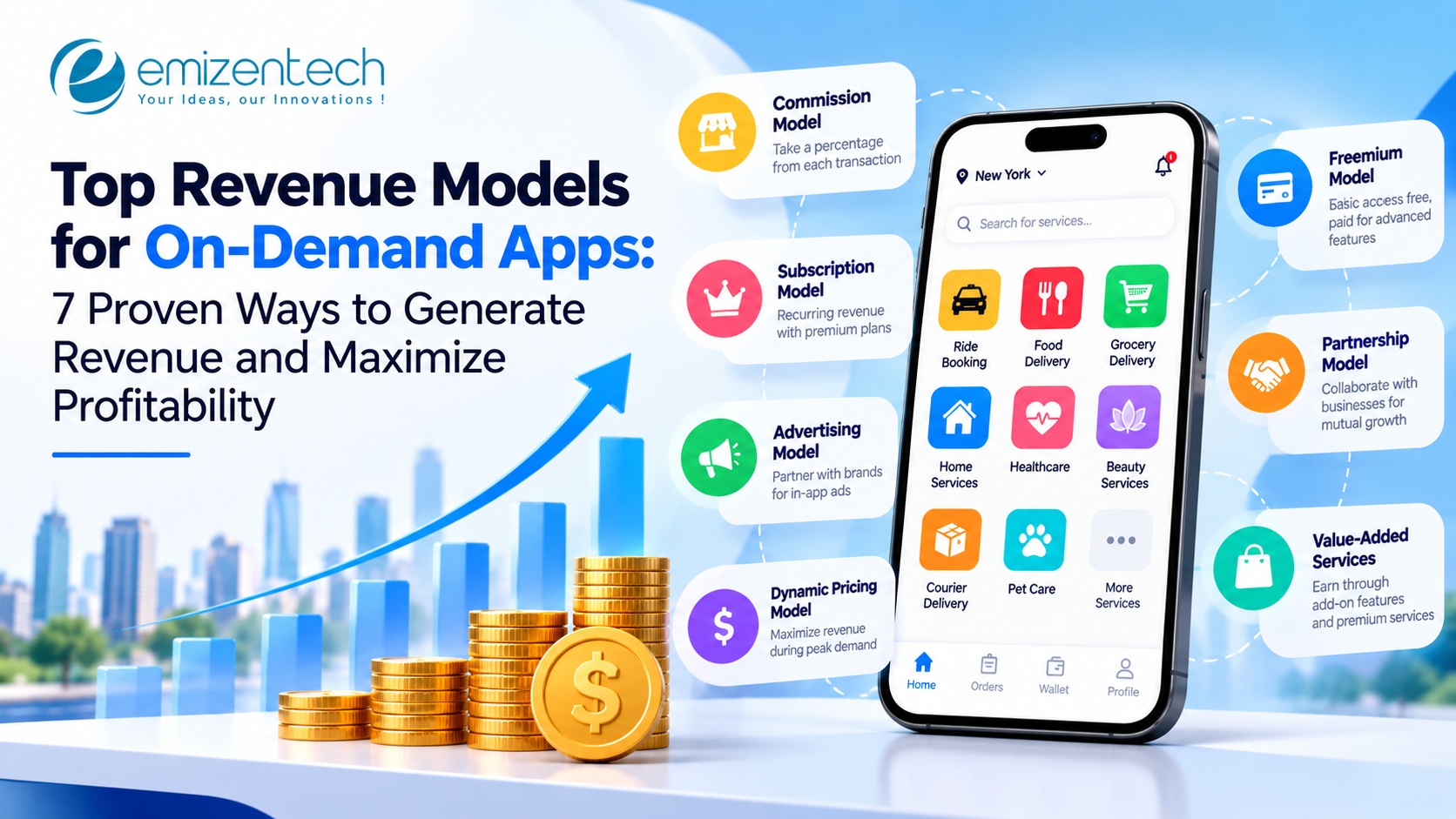
Choosing the right revenue model is essential for building a profitable on-demand business. Whether an application connects customers with delivery partners, drivers, home service professionals, or healthcare providers, its monetization strategy determines how the platform generates income and sustains operations.
A successful on-demand app should create value for customers and service providers while maintaining a revenue structure that supports business growth. Depending on the service category, target audience, and market competition, businesses can combine multiple revenue streams instead of relying on a single source of income.
Here are seven effective revenue models that on-demand businesses can use to generate consistent revenue.
1. Commission-Based Revenue Model
The commission-based model is one of the most widely used monetization strategies for on-demand applications. The platform earns a percentage of every completed transaction between customers and service providers.
For example, when a customer books a home cleaning service worth $100, the platform may charge the service provider a 15% commission. The provider receives $85, while the application generates $15 in revenue.
How businesses can generate revenue through commissions:
Percentage-based commission: Charge a fixed percentage of every completed booking or transaction.
Category-based commission: Apply different commission rates depending on the service category.
Tiered commission: Offer different commission rates based on provider performance or transaction volume.
Order-based commission: Deduct a predetermined amount from every successful order.
This model works particularly well for food delivery, ride-hailing, beauty services, home maintenance, and online service marketplaces.
However, commission rates should be balanced carefully. Excessively high charges can discourage service providers from using the platform, while very low rates may not cover operational expenses.
2. Subscription-Based Revenue Model
A subscription model generates recurring revenue by charging customers, service providers, or both a fixed fee at regular intervals. Instead of earning exclusively from individual transactions, the business receives predictable income through monthly or annual plans.
For example, a grocery delivery application could offer customers a monthly membership that includes free deliveries, exclusive discounts, and priority support.
Businesses can introduce different subscription plans based on user requirements:
Customer subscriptions: Provide benefits such as free delivery, discounted bookings, and priority reservations.
Provider subscriptions: Charge service providers for premium listings, additional visibility, or access to more customer requests.
Business subscriptions: Offer dedicated plans to businesses that require regular services or bulk bookings.
Premium memberships: Include additional benefits such as faster support, exclusive offers, and reduced service fees.
Subscription models are particularly useful for platforms with frequent transactions, such as grocery delivery, transportation, fitness, and home services.
To maintain subscription revenue, businesses must ensure that membership benefits offer enough value to encourage renewals.
3. Surge Pricing and Dynamic Pricing Model
Demand for on-demand services can fluctuate throughout the day, depending on location, availability, weather, and customer activity. Dynamic pricing allows businesses to adjust service charges according to these changing conditions.
For example, a ride-hailing application may increase fares during peak commuting hours when customer demand exceeds driver availability. Similarly, a delivery platform may apply additional charges during periods of unusually high order volume.
Common dynamic pricing approaches include:
Peak-hour pricing: Increase charges during busy periods when demand is high.
Location-based pricing: Adjust prices depending on service availability and demand in specific areas.
Demand-based pricing: Modify rates when customer requests exceed available providers.
Weather-based pricing: Apply pricing adjustments during conditions that make service fulfillment more difficult.
Dynamic pricing can improve revenue opportunities and encourage providers to serve high-demand locations. However, businesses should communicate additional charges clearly before customers confirm their bookings.
4. Featured Listings and Sponsored Placements
On-demand applications with multiple service providers can generate revenue by offering paid promotional placements. Providers pay the platform to improve their visibility and reach more potential customers.
For instance, a home-service marketplace could allow a plumbing business to appear among the top search results for relevant service categories. Similarly, a food delivery application could feature selected restaurants on its homepage.
Businesses can monetize visibility through:
Featured provider profiles: Highlight selected service providers in relevant categories.
Sponsored search results: Display paid listings when users search for specific services.
Homepage promotions: Give businesses premium placement on high-traffic application screens.
Promotional banners: Allow providers to advertise special offers and seasonal discounts.
This revenue model works well for marketplaces where customers compare several providers before making a booking.
However, sponsored listings should remain relevant to user searches. Paid placements must not compromise service quality or make it difficult for customers to identify suitable providers.
Implementing featured listings and sponsored placements requires flexible promotional tools, provider dashboards, and targeted advertising functionality. With professional on demand app development services, businesses can integrate these capabilities to create additional revenue opportunities while improving service visibility on their platforms.
5. Delivery Fees and Convenience Charges
Delivery fees and convenience charges provide another direct revenue stream for applications that facilitate product delivery, transportation, and service bookings.
The platform can charge customers an additional amount for coordinating and fulfilling their requests. These fees may vary according to distance, order value, service type, and operational requirements.
Common fee structures include:
Delivery fees: Charge customers for transporting products or orders.
Convenience fees: Apply a small platform charge for facilitating transactions.
Distance-based fees: Calculate charges according to the distance between the provider and customer.
Small-order fees: Apply additional charges when an order falls below a specified minimum value.
Express service fees: Charge extra for priority delivery or faster fulfillment.
For example, a food delivery application may charge a customer a delivery fee based on distance and a separate convenience fee for using the platform.
Businesses should keep these charges reasonable and display them clearly during checkout. Unexpected fees can increase cart abandonment and negatively affect customer retention.
6. In-App Advertising and Brand Partnerships
Applications with a growing user base can monetize their traffic through advertising and partnerships with relevant brands. Instead of relying only on transaction-based revenue, businesses can earn income by providing advertising opportunities within the platform.
For example, a grocery delivery application could promote packaged food brands, while a fitness service application could display advertisements for sports equipment or nutrition products.
Popular advertising opportunities include:
Banner advertisements: Display promotional banners on selected application screens.
Sponsored recommendations: Promote relevant products or services within search results.
Brand partnerships: Collaborate with businesses to run promotional campaigns.
Push notification promotions: Send sponsored offers to users who have agreed to receive promotional notifications.
Affiliate commissions: Earn a percentage when users purchase products or services through tracked referrals.
Advertising can generate additional income without requiring the platform to increase transaction fees. However, advertisements should be relevant, appropriately placed, and limited in frequency to avoid disrupting the customer experience.
7. Cancellation Fees and Additional Service Charges
On-demand businesses often face operational costs when customers cancel confirmed bookings or request services beyond the original scope. Cancellation fees and additional service charges can help recover some of these expenses.
For example, a customer who cancels a home cleaning appointment shortly before the scheduled time may be charged a cancellation fee to compensate the assigned professional for lost time.
Businesses can introduce charges for:
Late cancellations: Apply fees when customers cancel after the permitted cancellation period.
No-show bookings: Charge customers who fail to attend a confirmed appointment.
Additional services: Collect extra payments for requests beyond the original booking.
Priority fulfillment: Charge for urgent or expedited service requests.
Special handling: Apply additional fees for services requiring extra resources or effort.
These charges should be based on clearly defined policies and communicated before booking confirmation. Fair cancellation and additional service policies help protect provider earnings while maintaining customer trust.
How to Choose the Right Revenue Model for Your On-Demand App?
Not every monetization strategy works for every business. A ride-hailing application may benefit from commissions and dynamic pricing, while a home-service marketplace may generate income through provider subscriptions and featured listings.
Before selecting a revenue model, businesses should evaluate the following factors:
Understand Your Business Model
Identify how the application connects customers with service providers and how transactions are completed. A delivery marketplace, rental platform, and appointment-booking application have different monetization requirements.
Analyze Your Target Audience
Understand what customers are willing to pay for and what service providers can afford. Pricing should reflect the value users receive without creating unnecessary financial barriers.
Evaluate Competitor Pricing
Review how similar applications charge customers and providers. Compare commission rates, subscription plans, delivery charges, and premium features to identify suitable pricing opportunities.
Calculate Operational Costs
Consider development, hosting, payment gateway fees, marketing, customer support, provider onboarding, and maintenance expenses. Your revenue model should generate enough income to cover these costs and support profitability.
Test Multiple Revenue Streams
Businesses do not have to depend on one monetization strategy. Combining commissions with subscriptions, featured listings, or delivery charges can create multiple income sources. However, each revenue stream should add value rather than introduce unnecessary charges.
How Does App Development Influence Revenue Generation?
A revenue model can only work effectively when the application supports the required business operations. Payment processing, commission calculations, subscription management, provider dashboards, promotional placements, and transaction reporting all need to function reliably.
This is why businesses should plan monetization requirements during the product development stage rather than adding them after launch.
A well-planned application should also support changes in pricing structures, promotional campaigns, and payment workflows as business requirements evolve. These capabilities allow businesses to test different monetization strategies without repeatedly rebuilding core application functionality.
Conclusion
Building a profitable on-demand business requires a monetization strategy that balances customer affordability, provider earnings, and platform revenue. Commission-based charges, subscriptions, dynamic pricing, sponsored listings, delivery fees, advertising, and cancellation charges offer different ways to generate income.
Businesses should select revenue models according to their service category, customer behavior, operational expenses, and long-term growth plans. Combining suitable revenue streams can reduce dependence on individual transactions and create more sustainable income opportunities.
With 12+ years of experience in web and mobile app development, EmizenTech helps businesses develop scalable digital platforms with customized features, payment integrations, and monetization capabilities aligned with their business objectives.
FAQs
1. What is the most profitable revenue model for an on-demand app?
Commission-based revenue is a popular choice because the platform earns from completed transactions. However, profitability depends on transaction volume, commission rates, operational costs, and the type of services offered.
2. Can an on-demand app use multiple revenue models?
Yes. An application can combine commissions, subscriptions, delivery fees, featured listings, and advertising. Using multiple revenue streams can create more income opportunities and reduce dependence on a single monetization method.
3. How does surge pricing generate revenue for on-demand apps?
Surge pricing increases service charges when demand exceeds provider availability or during peak periods. It can improve earnings per transaction while encouraging more providers to serve high-demand locations.
4. How do subscriptions help on-demand businesses generate recurring revenue?
Subscriptions provide predictable income through monthly or annual membership fees. Businesses can offer benefits such as free delivery, discounted services, priority bookings, and premium provider visibility.
5. When should a business decide its app monetization strategy?
Businesses should define their monetization strategy during the planning and discovery stage. This allows developers to include the required payment integrations, commission logic, subscription management, and reporting features in the application architecture.