Introduction
Stablecoins are moving beyond simple crypto trading. They are increasingly being considered for cross-border payments, digital settlements, remittances, treasury operations, tokenized assets, and Web3 financial products. This growth has made the choice of development partner just as important as the choice of blockchain network or stablecoin model.
For businesses planning a stablecoin project, UAE and Singapore are two strong locations to consider. Both markets have established digital-asset frameworks, active fintech ecosystems, and growing interest in blockchain-based financial products. However, their regulatory structures, business environments, technical requirements, and market priorities are different.
Dubai's Virtual Assets Regulatory Authority (VARA) regulates virtual-asset activities across Dubai, excluding DIFC, and requires relevant virtual-asset businesses to obtain the required authorization before conducting regulated activities. VARA also has specific rules covering virtual-asset issuance and stable-value assets.
Singapore follows a different model through the Monetary Authority of Singapore (MAS). In September 2026, MAS published proposed legislative amendments to implement its stablecoin regulatory framework, including requirements intended to support value stability and user protection.
So, which market is better for a stablecoin project? The answer depends on the business model, target users, regulatory requirements, blockchain plans, and long-term expansion strategy.
How to Select a Stablecoin Development Company for UAE and Singapore?
The right development partner should be selected based on more than technical skills. A stablecoin project connects blockchain technology with financial operations, asset reserves, security, compliance, and user management.
A suitable partner should be able to explain the complete development process in simple business terms.
Key areas to check include:
Stablecoin architecture and token design
Blockchain network selection
Smart contract development
Reserve and collateral management
Minting and burning mechanisms
Wallet integration
Transaction monitoring
Admin dashboard development
Security testing and audits
API and third-party integrations
Compliance-related technical support
Post-launch maintenance
The company should also understand the target market. A stablecoin intended for payment settlements may require a different structure from one designed for crypto trading, remittance, or tokenized assets.
For UAE projects, the development team should understand the relevant VARA framework and how the proposed activity fits within the applicable regulatory structure. VARA's rules include specific virtual-asset activities such as exchange, custody, transfer and settlement, and issuance.
For Singapore projects, the team should be able to work alongside legal and compliance professionals as the MAS framework develops.
What Should Stablecoin Development Services Include?
Good stablecoin development services should cover the full product lifecycle rather than only creating a token contract.
The first stage is planning. The development team defines the stablecoin type, target currency, reserve model, supported blockchain networks, transaction limits, user roles, and operating requirements.
The second stage is technical development. This can include:
Smart contract creation
Token issuance and redemption
Mint and burn controls
Wallet connectivity
Reserve tracking
Transaction monitoring
Admin controls
API integration
Blockchain explorer integration
Security should be included from the beginning. Smart contracts can control the movement and supply of tokens, so access permissions, transaction controls, emergency functions, and audit procedures need careful planning.
A strong development process also leaves room for future expansion. If the initial stablecoin operates on one network, the architecture should not make future network integration unnecessarily difficult.
UAE vs Singapore: Which Stablecoin Development Solutions Fit Better?
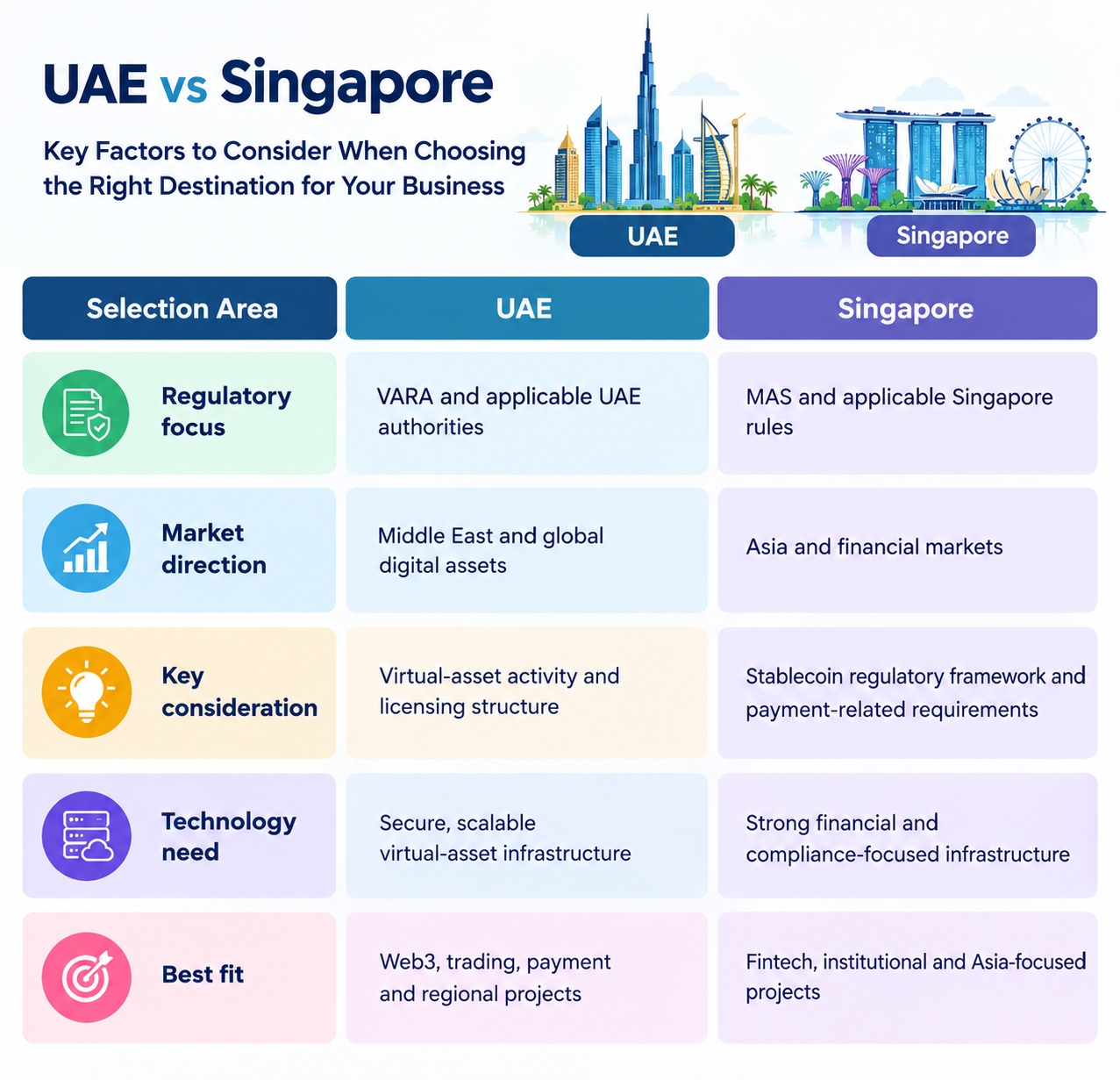
The choice between stablecoin development solutions in the UAE and Singapore should begin with the business objective.
UAE may suit projects focused on:
Dubai-based digital-asset businesses
Middle East and regional markets
Crypto exchanges
Digital-asset payment products
Cross-border settlements
Web3 financial platforms
Tokenization initiatives
Dubai has developed a dedicated virtual-asset regulatory environment through VARA. Its public register also provides information on licensed VASPs and their authorized activities, giving businesses a useful reference when assessing the local market.
Singapore may suit projects focused on:
Asian financial markets
Fintech products
Institutional applications
Payment-related use cases
Regulated digital-asset businesses
Regional blockchain operations
Singapore's regulatory direction places strong attention on reserve assets, value stability, redemption, and user protection. Businesses considering Singapore therefore need a development partner capable of building technical systems that support these requirements.
The best choice is not simply the country with more crypto activity. It is the market that matches the stablecoin's users, currency, business model, and intended financial application.
How Can an Altcoin Development Company Support a Stablecoin Project?
Although stablecoins and altcoins serve different purposes, an altcoin development company can provide useful blockchain development capabilities for a broader digital-asset project.
Stablecoins are generally designed to maintain a stable value against a reference asset, while many altcoins are created with different purposes, such as utility, governance, payments, ecosystem access, or blockchain participation.
A development company working across these areas may support:
Token architecture
Smart contract development
Blockchain integration
Wallet development
Token distribution
Exchange integration
Governance features
Staking mechanisms
Token management dashboards
This can be useful when a business plans to launch a stablecoin alongside another token. For example, a Web3 ecosystem could use a stablecoin for payments while using a separate utility token for platform functions.
However, the technical architecture should keep the roles of different tokens clearly separated. This helps simplify token management, user experience, accounting, and compliance planning.
What Makes a Stablecoin Development Solution Suitable for Both Markets?
A strong stablecoin development solution should be flexible enough to support different operational and regulatory requirements.
For UAE-based projects, the system may need to accommodate requirements related to virtual-asset issuance, reserves, marketing, licensing, and other applicable activities. VARA's rules state that certain stable-value virtual assets and related activities fall under specific regulatory requirements, while AED-referenced fiat virtual assets remain under the UAE Central Bank's regulatory purview.
For Singapore, the product architecture should support requirements associated with the MAS stablecoin framework. MAS's September 2026 consultation proposes legislative amendments under the Payment Services Act to establish how qualifying stablecoin issuers can be regulated and what safeguards they must meet.
From a technical perspective, the platform should therefore support:
Transparent reserve records
Controlled token issuance
Automated redemption
Role-based permissions
Transaction monitoring
Audit logs
Security controls
Compliance reporting
Emergency controls
Scalable blockchain infrastructure
The technology should support the compliance model rather than treating compliance as an additional feature after development.
When Should Businesses Choose a Custom Stablecoin Builder?
A custom stablecoin builder becomes valuable when a business needs control over the stablecoin's design and operating model.
A ready-made platform can be useful for businesses that want to launch with standard functionality. However, businesses with specific reserve structures, payment flows, blockchain requirements, or institutional integrations may require a custom architecture.
Custom development can support features such as:
Currency-specific stablecoins
Multi-chain deployment
Custom reserve management
Permission-based minting
Automated redemption
Institutional wallets
Payment gateway integration
Treasury dashboards
Compliance reporting
Customized transaction limits
For example, a business targeting cross-border settlements may need different transaction workflows from a business creating a stablecoin for a crypto exchange.
Custom development also gives the business greater control over future upgrades. New blockchain networks, additional currencies, institutional integrations, and expanded user roles can be added according to the project's roadmap.
How Can an Altcoin Development Service Add Value?
An altcoin development service can be useful when the stablecoin is part of a larger blockchain ecosystem.
For example, a business could operate a stablecoin for payments while maintaining another token for governance, platform access, rewards, or ecosystem utilities.
A development partner offering both capabilities can help connect the different components without creating unnecessary technical complexity.
Potential supporting features include:
Token creation
Smart contract development
Tokenomics implementation
Wallet integration
Exchange connectivity
Governance modules
Staking functionality
Token management
Blockchain explorer integration
The key is to define a clear purpose for every asset. A stablecoin should not be treated as simply another cryptocurrency. Its value mechanism, reserve structure, redemption process, and operational controls require separate planning.
This approach can make the overall ecosystem easier to manage while giving the business room to introduce additional blockchain products later.
What Should Custom Stablecoin Development Services Cover?
Custom stablecoin development services should cover both the technical product and the operational foundation required to run it.
A practical development process can follow these stages:
1. Business and Market Analysis
The project begins by defining the target market, stablecoin purpose, reference currency, user groups, transaction model, and expected usage.
2. Regulatory Planning
The applicable rules should be identified before technical architecture is finalized. UAE and Singapore should not be treated as having identical requirements.
3. Stablecoin Architecture
The development team defines the token model, reserve structure, minting process, burning mechanism, redemption process, and access controls.
4. Blockchain Selection
The network should be selected according to transaction speed, fees, ecosystem support, security, liquidity, and integration requirements.
5. Smart Contract Development
The token contract and supporting contracts are developed with controlled permissions and clearly defined functions.
6. Platform Development
Wallets, admin panels, APIs, dashboards, transaction monitoring, and other required components are connected to the stablecoin infrastructure.
7. Security Testing
The complete system should undergo smart contract testing, vulnerability checks, access-control testing, and independent security review where appropriate.
8. Deployment and Maintenance
After deployment, the platform requires monitoring, upgrades, issue resolution, blockchain updates, and ongoing technical support.
This step-by-step approach reduces the risk of building a technically strong product that does not match the intended business or regulatory environment.
How to Compare Stablecoin Development Service Providers in UAE vs Singapore?
When comparing a stablecoin development service provider, businesses should evaluate the company using practical questions rather than relying only on marketing claims.
The development partner should also be evaluated on:
Blockchain capabilities
Smart contract security
Stablecoin architecture
Compliance awareness
API development
Wallet integration
Scalability
Testing practices
Post-launch support
Ability to customize the platform
A company that only provides a token contract may not be enough for a complete stablecoin project. A full development partner should be capable of connecting the token with the surrounding business infrastructure.
How to Choose the Right Stablecoin Development Company for Long-Term Growth?
Choosing a stablecoin development company should come down to long-term product requirements rather than location alone.
For a UAE-focused project, the development partner should understand the Dubai virtual-asset environment and know when activities may require VARA licensing or other regulatory consideration. VARA states that firms conducting regulated virtual-asset activities in or from Dubai, excluding DIFC, have legal licensing obligations before beginning those activities.
For a Singapore-focused project, the partner should understand the MAS regulatory direction and build systems that can support reserve management, redemption, user protection, monitoring, and reporting requirements as applicable.
The final selection can be based on five practical questions:
Can the company build the required stablecoin model?
Can the platform support the target blockchain networks?
Can the architecture accommodate regulatory and compliance requirements?
Can the system scale as transaction volume and users increase?
Can the development team provide support after launch?
Final Takeaway
UAE and Singapore both offer strong opportunities for stablecoin businesses, but the right choice depends on the project's target market, business model, regulatory pathway, and technology requirements. Dubai can be attractive for businesses targeting the Middle East and the wider virtual-asset market, while Singapore can be suitable for fintech and Asia-focused projects operating within a structured financial environment. The strongest development partner should combine blockchain engineering, stablecoin architecture, security, integrations, scalability, and regulatory awareness. For businesses planning a stablecoin launch, selecting the right technology partner at the beginning can make the difference between a basic token project and a complete, scalable financial platform.
Check : https://www.malgotechnologies.com/stablecoin-development
Call/WhatsApp: +918778074071
Email: info@malgotechnologies.com