Armenia is small, but its history runs deep. Tucked into the South Caucasus, it has some of the oldest Christian monuments in the world, along with dramatic mountain scenery and stone monasteries that seem to grow out of the hillsides.
Armenia has three UNESCO World Heritage Sites, and all of them are religious monuments. They're spread across different parts of the country, which makes them a good backbone for a cultural trip. If you'd like the logistics handled, Armenia tour packages from Dubai can combine these sites with guided sightseeing, local food and time in the countryside.
Visiting them isn't just about old buildings. Together they tell the story of how faith, architecture, education and art developed in Armenia over more than a thousand years.
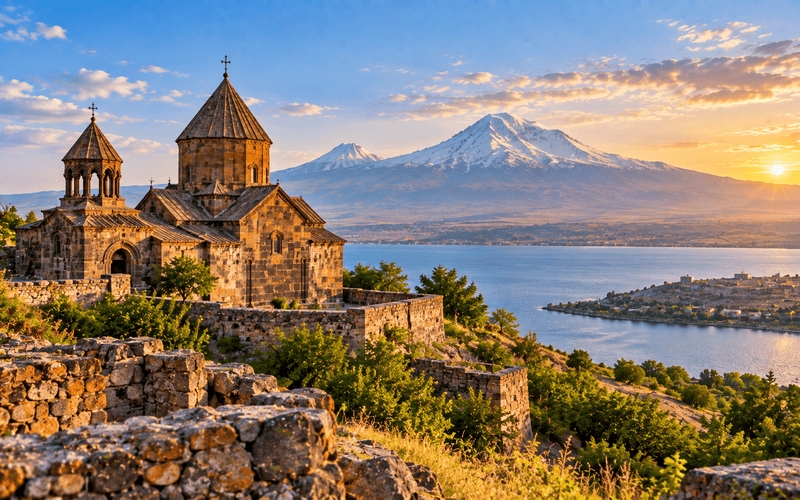
The Monasteries of Haghpat and Sanahin
These two medieval monasteries stand in the northern Lori region, amid green hills and valleys. Sanahin was founded in the mid-10th century, and Haghpat followed in the 10th century too, with building continuing into the 13th. Both were major centers of learning as well as worship, known for theology and manuscript work.
Haghpat has churches, chapels, a bell tower and a library, and it shows medieval Armenian architecture at its finest. Sanahin is just as impressive, with its own religious monuments and a strong scholarly tradition. Visitors can admire detailed stonework, traditional forms and a peaceful setting.
The Cathedral and Churches of Echmiadzin and the Archaeological Site of Zvartnots
Echmiadzin is the spiritual heart of the Armenian Apostolic Church and is home to the Catholicos of All Armenians. It sits a short drive from Yerevan. The cathedral was founded in 303 AD, and it's a key site in the story of Armenia as one of the earliest Christian nations.
The UNESCO listing also covers the churches of St. Hripsime, St. Gayane and St. Shoghakat. Their design influenced church architecture across Armenia for centuries.
Nearby are the ruins of Zvartnots. This 7th century cathedral was originally a circular structure of impressive scale. It was destroyed long ago, possibly by an earthquake, but the surviving columns and foundations still give a sense of how grand it once was.
The Monastery of Geghard and the Upper Azat Valley
Geghard is one of the most striking sights in Armenia. It sits in the Azat Valley, surrounded by steep cliffs, and the setting is as impressive as the buildings.
Many of its churches and chambers are partly carved into the rock. The monastery's name refers to the spear said to have wounded Christ, which was once kept here. Its origins go back to early Christian times, but most of the buildings you see today are medieval. Explore the stone churches, the rock-cut spaces, the detailed carvings and the quiet courtyards. If you're interested in medieval architecture, this one is a must.
What Connects the Three Sites
Armenian religious architecture has a distinct look. Builders used local volcanic stone, especially tuff and basalt, which gives churches and monasteries their warm colors and textures. Common features include domes, conical roofs and elaborate stone carving.
Seeing all three sites shows how that style developed over time, from early Christian buildings to the medieval monasteries that doubled as schools and libraries. They're monuments of faith, but they're also a record of Armenia's cultural history.
Khachkars: Armenia's Carved Cross-Stones
You'll see khachkars at almost every monastery. These carved stone crosses are decorated with geometric and floral patterns, and you'll find them around churches, cemeteries and old settlements. No two are quite alike, and the best ones show extraordinary skill.
The World Heritage List doesn't include khachkars, but UNESCO recognizes the craft separately as intangible cultural heritage. Looking at their designs is one of the easiest ways to learn about Armenian art as you travel.
Beyond the UNESCO List
Armenia's heritage goes well beyond these three sites. Several other places are on UNESCO's Tentative List, meaning the country plans to nominate them in the future. They include Noravank, Tatev Monastery and the Garni archaeological complex. Garni, a short drive from Geghard, is a good add-on if you have time.
These sites show that Armenia's history stretches from prehistoric settlements and ancient kingdoms to the medieval monasteries.
Why These Sites Are Worth Visiting
The three sites are important for their history and architecture, but also for how they feel. Many are away from the big cities, so getting there takes you through Armenian countryside and traditional villages. Armenia is one of the oldest Christian nations in the world, and these monuments show why.
Best Time to Visit
Spring, summer and autumn are all good, depending on what you want.
Spring brings pleasant weather and colorful scenery, which suits monasteries set among nature.
Summer has long days, so it's easy to combine sightseeing with outdoor activities.
Autumn is often the prettiest season, with mild weather and fall colors.
Winter can be beautiful, especially with snow on the monasteries, but check road and weather conditions if you're heading to remote areas.
Planning Your Trip
Yerevan is the natural base. Echmiadzin, Zvartnots and Geghard are all easy day trips from the capital, and you can combine them with other nearby sights.
Haghpat and Sanahin are farther north in Lori. The drive from Yerevan takes a few hours, so it's worth allowing extra time, or even an overnight stay. You can pair them with village visits, traditional restaurants and scenic stops. Since many sites are in rural areas, arranging transport ahead makes the trip smoother.
Conclusion
Armenia's three UNESCO sites give you a compact, rewarding introduction to the country's history. Haghpat and Sanahin show its medieval scholarly tradition, Echmiadzin marks its spiritual center, and Geghard combines rock-cut architecture with a dramatic landscape.
They suit travelers who want something different from a typical holiday, with architecture, faith, history and scenery all in one trip. Whether you have a few days or a few weeks, they're a great way to get to know Armenia and the warmth of its people.