
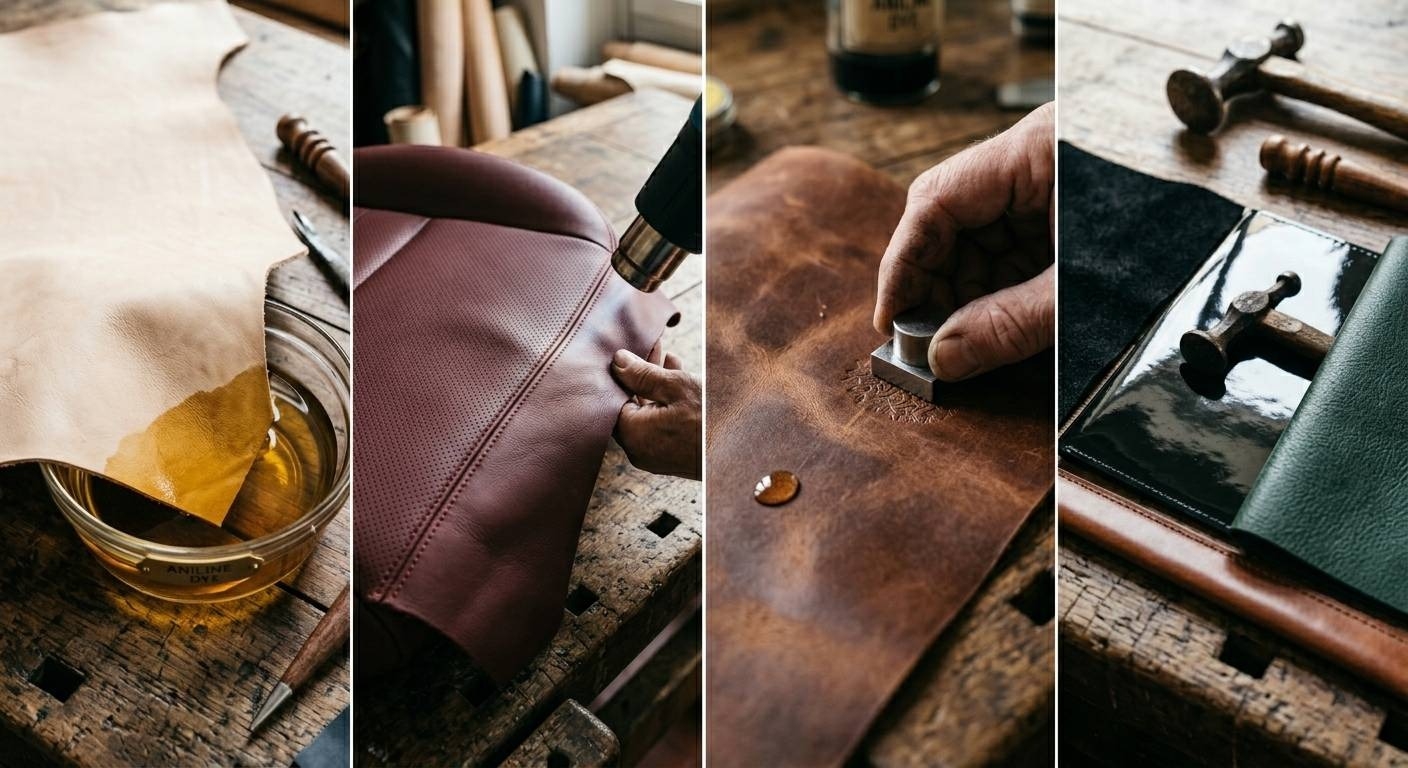
Leather has been among the longest-standing materials used by man for millennia. From ancient sandals to contemporary designer handbags, while the difference between sub-standard leather products and excellent leather items has always lain not only on quality leather but also in the process of leather finishing performed during the final stages of manufacture.
The following guide is designed for all those interested in purchasing the finest leather products, be it professionals, connoisseurs or ordinary people. This article will provide you with insight into all leather surface finishes used widely in the industry and will allow you to get acquainted with each type of leather finish and the purpose it serves.
Why Leather Finishing Is Important Beyond Your Imagination
Leather making entails the transformation of raw hides into finished leather, but the finishing process is what gives the product its character. Industry research indicates that the value of the worldwide leather chemicals market, which encompasses finishing chemicals, stood at more than USD 8.5 billion as of 2022 and will continue growing until 2030. The growth signifies the significance of the leather processing stage towards producing high-quality and durable leather goods.
Finishing dictates:
The leather's appearance (matte, shiny, distressed, natural)
Its texture (soft, hard, velvety, smooth)
Durability (scratch-resistance, water resistance, etc.)
Aging process (patination or color preservation)
Maintenance capabilities
Global Leather Industry: Key Finishing Statistics
Metric | Data | Source / Year |
Global leather chemicals market value | USD 8.5 Billion | Grand View Research, 2022 |
Projected CAGR for leather chemicals | 4.8% through 2030 | Industry Reports |
Share of pigmented leather in furniture market | Over 65% | Leather Working Group |
Aniline leather premium price vs pigmented | 30 to 50% higher | Trade Estimates |
Suede and nubuck global market share | Approx. 12% | Statista, 2023 |
The Various Methods of Finishing Leather
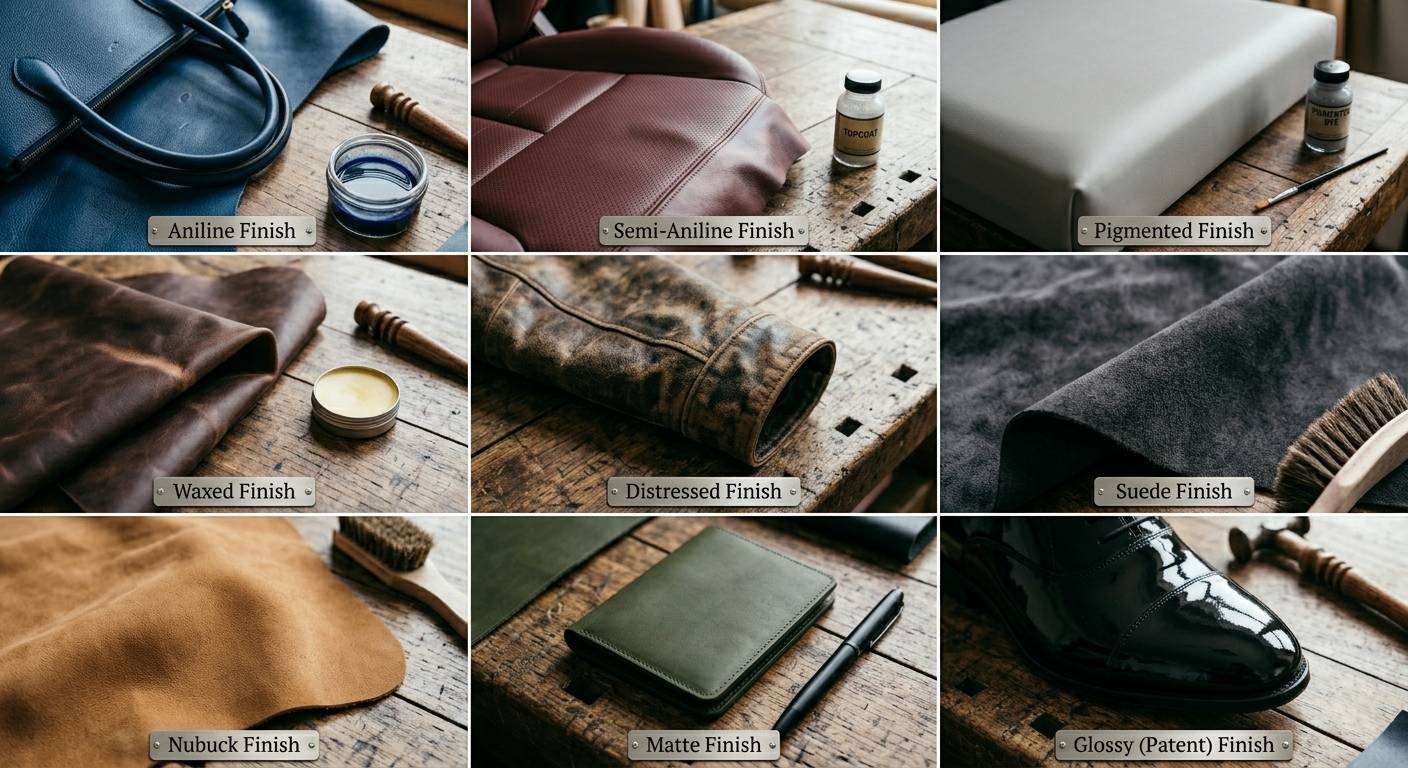
In today’s world, there are many ways to finish leather products. Each method is unique in its application and design. The following are the various leather finishing techniques utilized in manufacturing.
1. Aniline Leather Finish
Aniline leather finish is regarded as the most natural leather finish technique. In this process, leather is dyed with water-soluble dyes and does not contain any pigment layer on top. As such, the leather will have a natural appearance where every pore and scar will be visible.
Appearance: Natural-looking and transparent
Feel: Warm and very soft
Durability: Poor
Uses: Luxury furniture, expensive handbags, expensive shoes
Maintenance: Requires frequent conditioning
2. Semi-Aniline Leather Finish
Semi-aniline leather finish is a combination of both the aniline leather and pigmented leather finishes. This process involves dyeing the leather before adding a protective layer on top. The resulting leather looks very close to aniline leather but is more practical to use.
Appearance: Has a natural look with some consistency in color
Feel: Very soft
Durability: Good
Uses: Furniture, car seats, high-end bags
3. Pigmented Finish
A pigmented finish is the most common type of leather finish used during leather quality finishing in commercial settings. It consists of an opaque pigment bonded with polymers that gives the surface a standardized look, creating a protective yet tough leather surface.
Appearance: Uniform, hides any flaws and creates an even surface color
Feel: Plastic, but only on inferior materials
Durability: Extremely high. Resistant to water, abrasions, and fading
Suitable for: Furniture upholstery, car seats, budget handbags, and leather belts
Leather Maintenance: Easy to clean and practically maintenance-free
4. Waxed Finish
A waxed leather finish is achieved through impregnation or coating with wax. The process is particularly popular when creating leather clothing, footwear, and accessories that should be weather-resistant and tough in design.
Appearance: Matte to somewhat glossy, creates a unique pull-up effect
Feel: Stiff at first, becomes more supple after prolonged wear and heating
Durability: Very high. Creates a leather that perfectly resists weathering
Suitable for: Motorcycle leathers, outdoor shoes and gear, gloves, bags
Maintenance: Requires periodic reapplication of the protective layer
5. Distressed Finish
The distressed leather finish is deliberately aged and weathered to give it an old-fashioned look and feel. The manufacturer uses methods like tumbling, rubbing by hand, sanding, and chemical processing to age leather as if it has been subjected to natural wear and tear for decades within hours.
Appearance: Vintage, rugged, and worn look with natural inconsistencies
Touch: Uneven, usually soft
Toughness: Moderately tough to highly tough based on leather used
Suitable for: Black Leather Jackets, vintage bags, and casual shoes
Maintenance: Regular conditioning to avoid leather drying
6. Suede Finish
Suede leather finishing is created by buffing the inner split side of the hide to raise fine fibers, creating a velvety, plush texture. Unlike nubuck which uses the outer grain, suede comes from the inner layer, making it softer but less durable
Appearance: Soft velvet-like matte texture
Feel: Extremely soft, luxuriously plush
Durability: Low. Very sensitive to water, stains, and abrasion
Best for: Fashion shoes, luxury jackets, accessories, upholstery accents
Care: Requires suede brush and water-repellent spray
7. Nubuck Finish
Nubuck leather finishing is achieved by sanding or buffing the grain side (outer surface) of full-grain leather to create a slight nap. Often confused with suede, nubuck is more durable because it uses the stronger outer layer of the hide.
Appearance: Fine velvety texture, slightly more refined than suede
Feel: Soft yet firmer than suede
Durability: Moderate. More durable than suede but still needs care
Best for: Premium shoes, outdoor boots, quality bags, belts
Care: Nubuck brush required; avoid moisture exposure
8. Matte Finish
Matte leather finish refers to any finishing method that produces a non-reflective, flat surface appearance. This is often achieved through special topcoats or by controlling the pigment and lacquer application. Matte finishes have surged in popularity due to modern minimalist aesthetics.
Appearance: Flat, understated, sophisticated
Feel: Smooth or slightly textured
Durability: Good when properly sealed
Best for: Contemporary fashion bags, wallets, minimalist footwear
9. Glossy or Patent Finish
A glossy leather finish produces a highly reflective, mirror-like appearance through multiple coatings of lacquer or polyurethane. Patent leather is the most intense form of this type of leather finish and is often used in formal footwear and fashion accessories.
Appearance: Highly reflective, mirror-like finish
Touch: Stiff feel compared to natural finishes
Durability: Resistant to damage but may become brittle over time
Ideal use: Formal footwear and fashion accessories
Techniques for Surface Detailing in Leather Products: Texture and Patterns
In addition to color and coating applications, surface detailing in leather products also includes various techniques used to change the physical properties of the leather’s surface such as textures and patterns. Such surface detailing techniques are of utmost importance in developing unique and branded leather products.
One of the most critical things when learning about surface detailing in leather products is differentiating between patterns raised and sunk into leather surfaces. If you want to know more about these two techniques and their comparison in terms of how they work, appearance, strength, and where each one of them is used, then we highly advise you to check out this comprehensive guide called what is embossing.
Leather Finish Comparison: At a Glance
Use this quick reference table to compare all major leather finishing types across key decision factors.
Finish Type | Natural Look | Durability | Maintenance | Best Use Case |
Aniline | Highest | Low | High | Luxury sofas, premium bags |
Semi-Aniline | High | Moderate | Moderate | Furniture, car interiors |
Pigmented | Low | High | Low | Automotive, office furniture |
Waxed | Moderate | High | Low to Moderate | Outerwear, boots |
Distressed | High (vintage) | Moderate | Moderate | Fashion jackets, casual bags |
Suede | Unique texture | Low | High | Fashion shoes, luxury jackets |
Nubuck | Unique texture | Moderate | Moderate | Premium shoes, quality bags |
Matte | Moderate | Good | Low | Contemporary fashion items |
Glossy/Patent | Low (artificial) | Good | Low | Formal shoes, statement pieces |
Leather Edge Finishing Methods
The edge finishing of leather products is sometimes ignored by consumers but it is actually an important factor in determining the level of quality work done. The method used to finish off raw edges gives an idea about the care taken in the preparation of the leather product.
The various leather edge finishing methods are as follows:
Burnishing: The edge is polished using a wooden or metal polish tool which presses the leather fibers and gives a natural finish. Popular for traditional leather products.
Edge Painting: This is when colored paint is applied in layers onto the leather edge, which is then left to dry. Very popular in bags and footwear production.
Folding/ Turned Edge: This entails folding the leather edge inside and applying glue on it. Popular among high-end leather products.
Wax Finishing: This is when natural waxes such as beeswax or carnauba wax are applied to the edge of the leather.
Beveling: In this technique the leather edge corners are beveled using a specific tool before polishing or painting the edge.
Trends in Modern Leather Finishing Processes
The trend in modern leather finishing processes is moving forward fast, spurred by environmental concerns, consumer demand, and advancements in material sciences. These are some of the major trends influencing the current state of the leather finishing process:
Water-Based Finishes: The shift from conventional solvent-based finishes to water-based finishes results in fewer volatile organic compounds (VOC) emissions.
Bio-Based Finishing Agents: In the leather texture finishing process, plant-based oils, tannins, and waxes are replacing petroleum-based agents due to environmental concerns.
Laser Etching: Using high-powered lasers enables etching of intricate designs, textures, and logos on leather surfaces without applying any physical force or chemicals.
Nanocoating Technology: The application of ultra-thin nanocoatings on leather provides invisible water repellent and stain resistance without affecting the leather’s appearance.
Vegetable-Tanned Leather: Consumer interest in environmentally-friendly materials has created more demand for vegetable-tanned leather, characterized by natural patinas.
Frequently Asked Questions (FAQs)
What are the ways of finishing leather products?
Leather products are finished using a wide range of methods including aniline dyeing, pigment coating, wax impregnation, suede buffing, nubuck sanding, distressing, embossing, lacquering, and edge painting. Each method serves a specific functional or aesthetic purpose in the overall leather manufacturing process.
What are the different types of leather finishes?
The main types of leather finishes are aniline, semi-aniline, pigmented, waxed, distressed, suede, nubuck, matte, and glossy (patent). Each type delivers a different combination of appearance, durability, and maintenance requirements.
What are the techniques for finishing leather edges?
Leather edge finishing techniques include burnishing, edge painting, wax sealing, folding/turned edges, and beveling. Premium leather goods use a combination of beveling and burnishing to create clean, rounded, and durable edges
Concluding Remarks
Leather finish techniques are important not only for leather craftsmen and producers. They represent useful information for buyers and leather owners, who have to make the proper decision regarding the purchase or maintenance of certain types of leather products.
Whether it comes to the transparency and softness of aniline leathers or the durability of waxed and pigmented finishing techniques, it all depends on the purpose of the product and its quality. In case you need to purchase a leather item, you will be able to know exactly what it is and how it is manufactured.
Leather craftsmanship methods are quite sophisticated and complex in terms of technology. Therefore, they can help you make the proper decision concerning any kind of leather products.