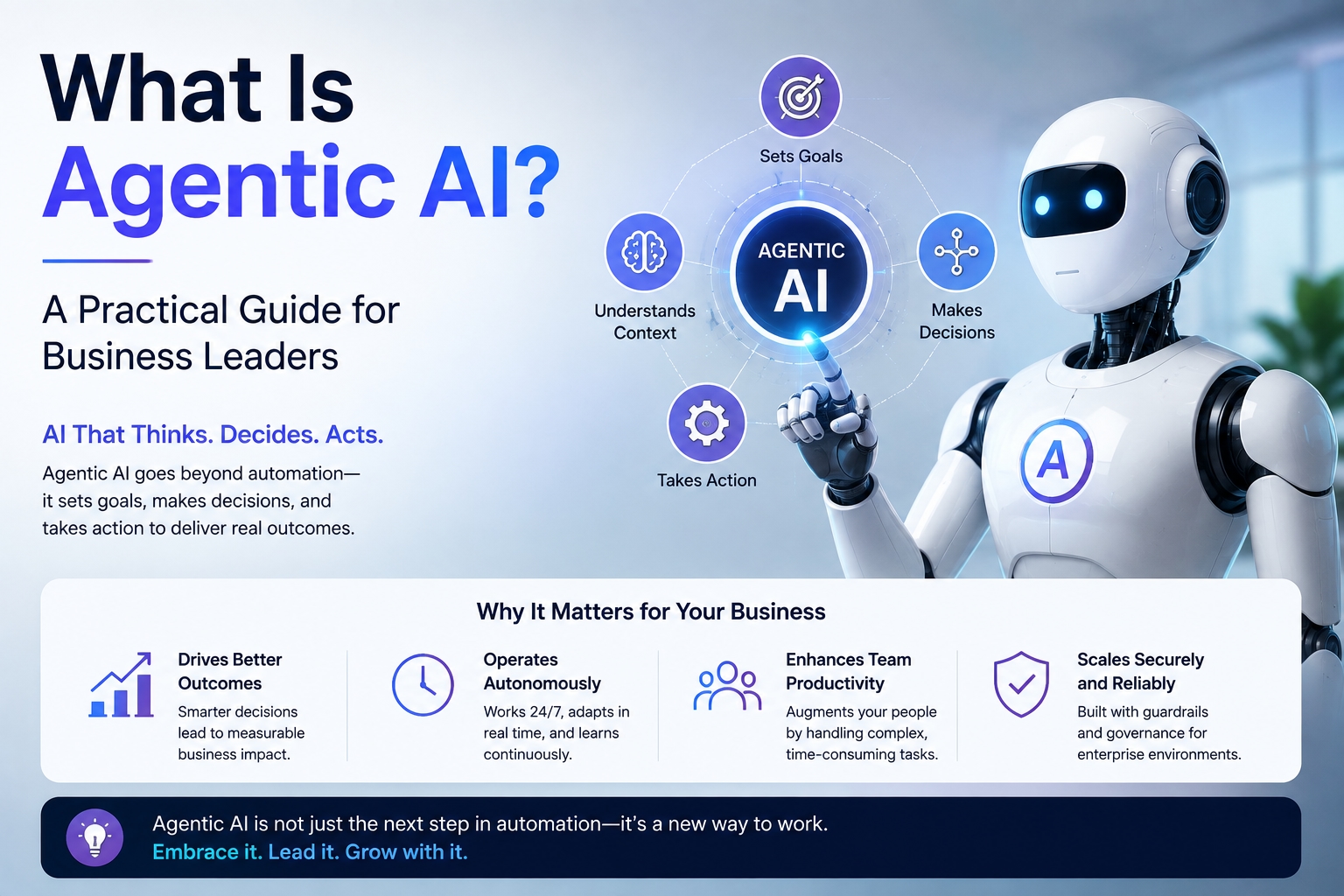
Agentic AI is the term getting attached to nearly every AI product announcement this year, which has made the phrase almost meaningless in casual use. Ask a vendor what makes their product "agentic," and you'll often get a marketing answer rather than a technical one. That's unfortunate, because the underlying concept is genuinely useful, and understanding it clearly makes the difference between deploying AI that actually reduces operational work and deploying a chatbot with a new label.
At its core, agentic AI refers to AI systems that can pursue a goal across multiple steps, using tools, making decisions, and adjusting course, with defined boundaries on what they're allowed to do without human approval. That last part, the boundaries, is what separates a genuinely useful agentic system from something that sounds impressive in a demo and creates chaos in production.
Agentic AI vs. a Chatbot: What Actually Changes
A standard chatbot answers a question and stops. You ask, it responds, the interaction ends. It has no persistent goal beyond generating a good answer to whatever you just typed.
An agentic AI system works differently. Give it a goal, say, "process this insurance claim," and it can:
Pull the relevant documents from a claims system
Cross-reference policy details and prior claim history
Flag inconsistencies or missing information
Apply business rules to determine next steps
Either complete the routine parts of the process automatically or escalate the ambiguous ones to a human
The chatbot answers one question. The agentic system executes a workflow. That distinction matters enormously for what kind of business value each one produces.
Agentic AI vs. Traditional Automation: The Other Common Confusion
The second point of confusion is between agentic AI and traditional workflow automation, robotic process automation (RPA), scripted integrations, and rules engines that have existed for years.
Traditional automation follows fixed, predefined rules. If a specific field is empty, do X. If a value exceeds a threshold, route to Y. It's reliable and fast, but it breaks the moment a situation falls outside the rules it was programmed to handle.
Agentic AI, built on large language models with reasoning capability, can handle situations that weren't explicitly anticipated. It can read an unstructured document, understand the relevant context, and decide on an appropriate next step rather than failing because the input didn't match an expected format. This is the practical reason agentic systems are replacing brittle RPA scripts in workflows involving unstructured data: contracts, claims correspondence, customer emails, and clinical notes.
The Architecture Behind a Working Agentic System
A production-grade agentic AI system generally has a few consistent components, regardless of the specific use case:
Defined decision boundaries. What the agent is allowed to decide autonomously, and what it must escalate to a human. This is the single most important design decision in any agentic system.
Tool access. The agent needs scoped, permissioned access to the systems it interacts with, CRMs, databases, internal APIs, rather than broad, unrestricted access.
Memory and state management. For multi-step tasks, the system needs to track what it has already done and what remains, particularly in multi-agent setups where several agents coordinate on parts of a larger workflow.
Escalation logic. Clear rules for when the agent hands off to a human, whether that's low confidence, a policy exception, or a threshold being crossed.
Audit trails. A record of what the agent decided, what tools it used, and why, which matters both for debugging and for regulatory review in industries where that's required.
Organizations that skip the decision-boundary and escalation-logic work tend to end up with agentic systems that either do too little to be useful or, worse, take actions nobody explicitly authorized. This is the practical reason experienced Agentic AI development services spend as much time on governance design as on the underlying model architecture.
Where Agentic AI Delivers Real Business Value
Not every workflow benefits from an agentic approach. It tends to deliver the clearest ROI in processes that are:
Multi-step and currently handled by a person manually moving work between disconnected systems
High-volume enough that even modest per-case time savings add up
Governed by consistent business rules, even if those rules have many exceptions
Costly to get wrong, which is exactly why human escalation paths matter
Common high-value applications include KYC and compliance workflow automation in financial services, insurance claims triage, research and grant coordination workflows, customer support that requires pulling data from multiple systems, and regulatory document processing.
A real-world agentic AI security deployment illustrates this well: rather than a passive filter flagging a single risk signal, an agentic system can reason about intent across multiple data points and independently decide whether to escalate, quarantine, or request additional verification- the kind of layered decision-making a static rules engine simply can't replicate.
Where It's Still Risky
It's worth being direct about the limitations. Agentic AI in high-stakes decisions, credit approvals, medical diagnoses, or anything with significant financial or legal consequence, generally still needs a human in the loop for final approval, not because the technology can't technically make the decision, but because accountability and regulatory expectations require it. Organizations in regulated industries, working with a knowledgeable AI development partner in Toronto or elsewhere, tend to build agentic systems that handle the routine 80 percent of cases autonomously while explicitly routing the remaining ambiguous or high-stakes cases to human judgment.
Getting Started With Agentic AI
Organizations exploring agentic AI for the first time generally do best starting narrow: pick one well-understood, multi-step process with clear success metrics, define exactly what the agent can and can't decide on its own, and expand scope only after the initial deployment proves reliable under real operating conditions. Mobcoder AI helps businesses approach agentic AI development with this practical, workflow-first mindset, focusing on clearly defined use cases, scoped autonomy, system integrations, and human oversight before expanding to more complex processes. Trying to deploy a broad, general-purpose agent across an entire department on day one is the most common way these projects stall.
Frequently Asked Questions
Is agentic AI the same thing as AGI or general artificial intelligence?
No. Agentic AI refers to goal-directed systems operating within defined tools and boundaries for specific tasks. It has nothing to do with general intelligence matching or exceeding human cognitive ability across all domains.
Can agentic AI replace an entire team's workflow?
Rarely, and that's usually not the right goal. The more reliable pattern is agentic AI handling the routine, well-defined portion of a workflow while humans manage exceptions, oversight, and anything requiring judgment.
What's the biggest risk in deploying agentic AI?
Poorly defined decision boundaries. An agent given too much autonomy without clear escalation logic can take actions that create real operational or compliance problems, which is why governance design matters as much as the technical build.
Do I need a multi-agent system, or is a single agent enough?
Most organizations should start with a single, well-scoped agent handling one process. Multi-agent orchestration, where several agents coordinate, adds real value for complex workflows but also adds coordination complexity that isn't worth it for simpler use cases.
How long does it typically take to deploy a working agentic AI system?
It varies significantly by workflow and integration complexity, but single-agent automation for a well-defined process is generally faster to deploy than multi-agent orchestration involving several connected systems.
Conclusion
Agentic AI is a genuinely useful category, not just a rebrand of existing chatbot or automation technology, but only when it's built with real decision boundaries, scoped tool access, and clear escalation logic. The organizations getting real value from it aren't the ones chasing the most autonomous possible system. They're the ones being precise about what the agent should decide alone and what should still go to a person.